smzh blue logo
Insurance

Health Insurance for Your Baby: Mind the Registration Deadline

Artikel
3 Mär 2026
smzh-image

The key points at a glance

  • Under Article 5 of the Federal Health Insurance Act, the registration deadline is three months from birth.
  • Basic insurance carries a duty to accept. There is no health check and no reservation.
  • A baby does not have to be with the same insurer as the parents. Each person is insured individually.
  • For children, the ordinary deductible is CHF 0, the excess is capped at CHF 350 per year, and no hospital contribution applies.
  • Supplementary insurance follows different rules and is best examined before birth.

Registering your baby: how it works

Four steps, and the first is the only one with a deadline.

  1. 1. Compare children's premiums. The catalogue of benefits is by law identical at every insurer, the premium is not. Compare using the federal government's official premium calculator, setting the same deductible and the same model everywhere.
  2. 2. Register the child in writing. The insurer needs the child's name, date of birth, sex, address and OASI number (AHV number). You receive the OASI number with the birth registration from your municipality of residence. If it is not yet available, register the child anyway and submit the number later.
  3. 3. Check the policy. Verify the entry date. It must show the date of birth and not the date of your letter. If the date is incorrect, contact your health insurer.
  4. 4. Sort out supplementary insurance separately. Neither the three-month deadline nor the duty to accept applies to it. It follows its own rules, more on which below.

The three-month registration deadline is generously measured, but it should be kept in mind. Ideally, compare the available offers in the final weeks before the birth and complete the registration in the days afterwards.

What happens if you miss the deadline?

Because the insurance obligation exists, joining is possible even after a missed deadline. But, as a rule, cover then begins only upon joining and not retroactively. Any cost that arises in between birth and joining, you bear yourself. In addition, a premium surcharge for late joining may apply.

With a healthy child this hardly matters, because little arises in the first weeks. With a premature birth, a complication or a congenital condition, on the other hand, it quickly comes to substantial amounts. Therefore, the deadline should be taken seriously, even though in the vast majority of cases it passes without consequence.

Important: The duty to accept itself does not hinge on the deadline. An insurer may not reject your child even with a late registration and may not ask health questions.

Does the baby have to be with the same insurer as the parents?

No. In Switzerland there is no family insurance. Each person is insured individually, and that applies to a newborn too. You are therefore free to choose the health insurer for the baby, regardless of where the father and mother are insured.

Whether it is worth it is a matter of arithmetic. In our analysis of the FOPH 2026 premium dataset for the Canton of Zurich, premium region 1, the cheapest children's premium is CHF 58.70 per month and the most expensive CHF 161.30. The median is CHF 117.00. Between the cheapest and the most expensive insurer there is thus CHF 1,231 per year and child, and that with a legally identical catalogue of benefits.

In percentage terms, the spread is greater for children than for adults: the most expensive insurer charges 2.75 times the cheapest.

There is one caveat, however. The family ceiling, under which no further children's premium is owed from the third child onwards, applies only with the same insurer. Anyone with three or more children therefore calculates differently than a family with one child.

What level of deductible for the baby?

For children up to age 18, the ordinary deductible is CHF 0. Voluntarily, you can choose CHF 100, 200, 300, 400, 500 or 600. The excess is 10 percent as for adults, but for children is capped at CHF 350 per year. Children pay no hospital contribution.

For a baby, the calculation almost always comes out against the optional deductible, and for two reasons. First, the children's premium is low, so a percentage discount amounts to little in francs. Second, doctor's visits in the first year of life are frequent and hard to plan.

Cost-sharingChild up to 18Adults from 19
Ordinary deductibleCHF 0CHF 300
Optional deductibleCHF 100 to 600 in six levelsCHF 500 to 2,500
Excess10 percent, at most CHF 350 per year10 percent, at most CHF 700 per year
Hospital contributionnoneCHF 15 per day

From the 2026 premium dataset of the Federal Office of Public Health, for the Canton of Zurich, premium region 1, family-doctor model and with accident cover, we analyzed all 23 tariffs that offer all seven deductible levels.

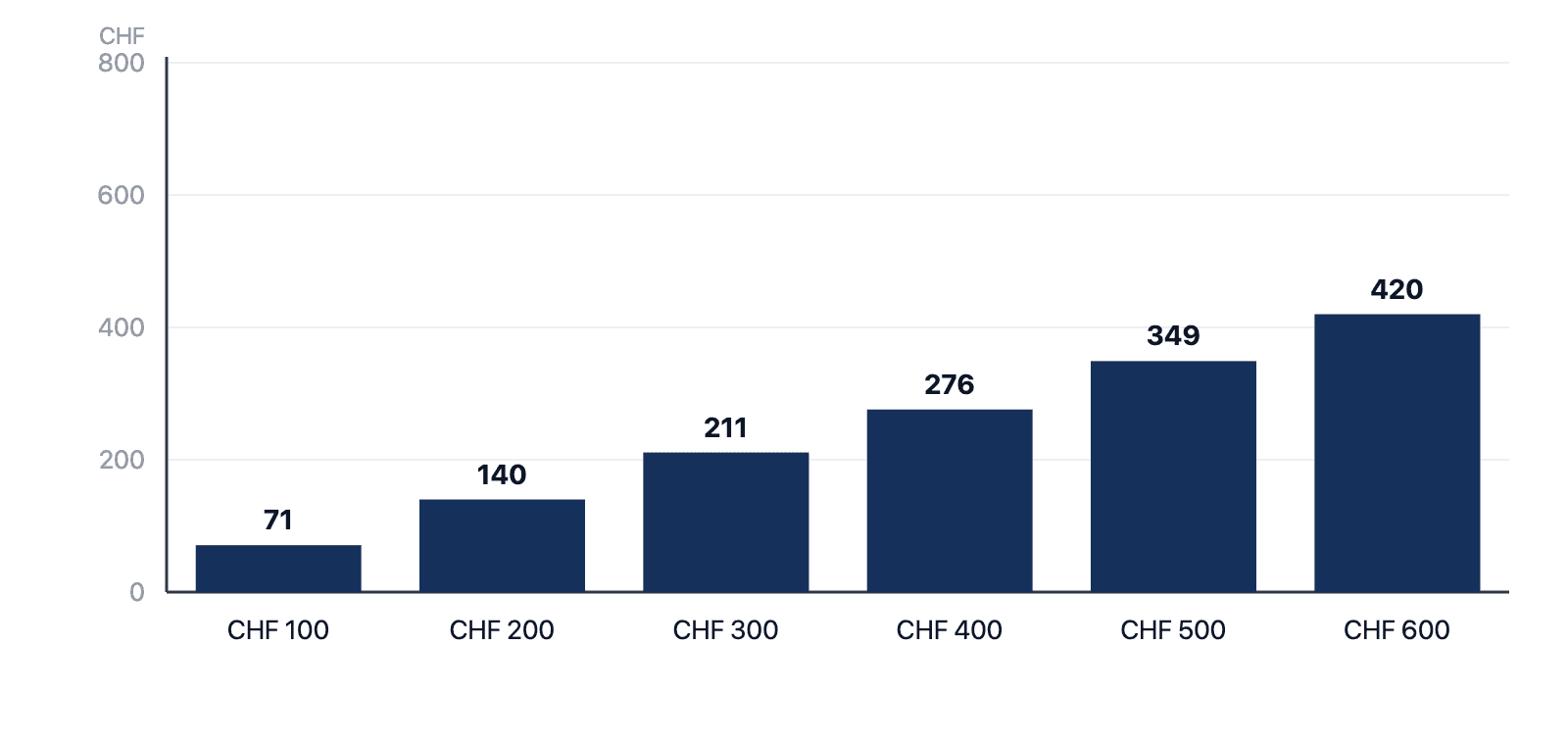
Bar chart of the break-even points by children's deductible: CHF 71.00 at the CHF 100 level up to CHF 420.00 at the CHF 600 level. Above that, the ordinary CHF 0 deductible is cheaper.
The annual costs up to which a children's deductible pays off at all

The median premium falls from CHF 117.70 with the ordinary deductible to CHF 86.20 at CHF 600. That is a CHF 378 discount per year for CHF 600 of additionally borne risk. The break-even point is therefore at CHF 420 of annual costs: below it, the optional deductible is cheaper; above it, the ordinary deductible of CHF 0.

CHF 420 a year is quickly reached with an infant. Check-ups, vaccinations and two or three infections are enough. And in the worst case, when the deductible is exhausted, with the highest children's deductible you pay CHF 222 more than with CHF 0.

The finding holds across all levels: at no single level does the discount cover the additionally borne risk. At a CHF 100 deductible, the discount is CHF 64, at CHF 300 it is CHF 190, at CHF 600 it is CHF 378. This is due to the low starting premium, since a percentage discount on CHF 117.70 amounts to little in francs.

The ordinary deductible of CHF 0 is therefore almost always the best choice for a baby. An optional deductible only becomes interesting for an older, healthy child who over the years hardly ever needs medical treatment.

Accident cover must stay in for the baby

Children have no cover under the Federal Accident Insurance Act. Accident cover therefore belongs in basic insurance and must not be suspended.

Compare children's premiums in your region

For children, premiums differ by insurer and by region – put the offers side by side before you register your baby.

Compare health insurers now

Accident cover must stay in for the baby

Under the Federal Accident Insurance Act, cover against accidents hinges on employment of at least 8 hours per week for the same employer. For a baby, therefore, no compulsory cover applies.

For children, therefore, accident cover belongs in basic insurance and may not be suspended. Anyone who excludes it for a child is not covered for accidents.

The question only becomes relevant when your child begins an apprenticeship or a side job of at least 8 hours per week. Then cover arises through the employer, and suspension becomes possible.

Pregnancy and health insurance: what to clarify before the birth

In basic insurance you have three months to register and a guarantee of acceptance. With supplementary insurance, neither applies. It is governed by the Insurance Contract Act, and there the company assesses the risk. It may attach a reservation or reject the application.

That is why the right time to examine supplementary cover is before the birth and not after. If an irregularity shows up after the birth, it is known for a later application and can lead to a reservation. Some companies therefore offer to register the unborn child already during the pregnancy.

Special cases around the newborn

Congenital defects. Up to the completed 20th year of age, Disability Insurance bears the costs of recognized congenital defects, thereafter basic insurance. The child must nonetheless be registered with a health insurer, because the insurance obligation exists independently of this.

Costs of the birth itself. These run through the mother's health insurer, not the child's. Check-ups, birth and breastfeeding advice are exempt from the deductible and excess with no time limit. From the 13th week of pregnancy until eight weeks after the birth, the exemption also applies to general illness benefits.

Birth abroad. What is decisive for the insurance obligation is the place of residence. A child resident in Switzerland must be insured here even if it was born abroad. The three-month deadline applies in the same way.

Moving to Switzerland with a small child. Here too a three-month deadline applies, but then from taking up residence rather than from birth. If observed, cover applies retroactively from the move.

Premium reduction. For families with lower and middle incomes, the cantons must reduce children's premiums by at least 80 percent. Which families fall under this is determined by each canton itself. Check this in the year of birth, because income can change through maternity leave.

What gets confused about health insurance for babies

The registration deadline is not the start of cover. With timely registration, protection applies from the date of birth, not from the day of your letter. Conversely, premiums are also owed from the date of birth, and the first bill is correspondingly higher.

The duty to accept applies only to basic insurance. With supplementary insurance, the company assesses the risk.

A family discount is not the family ceiling. Discounts for families are contractual and differ from insurer to insurer. The family ceiling is in the law and applies at every insurer, but only if all children are with the same insurer.

Our assessment: The real decision with a newborn is not the deductible and not the insurer, but the timing. A health insurance comparison must therefore be made before registration.

FAQ on health insurance for the baby

By when must I register my baby with a health insurer?

Within three months of birth. Register the child within this deadline and cover applies retroactively from the date of birth, and premiums are owed from that day. With a late registration, cover as a rule begins only upon joining, and a premium surcharge may apply. The duty to accept itself remains in place.

From when is the baby insured?

From the date of birth, provided you keep to the three-month deadline. The insurer then sets the entry date retroactively to the date of birth, and premiums are likewise owed from that day. Check this on the policy, because an incorrectly set entry date otherwise only comes to light when the first larger bill arrives, and the correction is then more laborious.

Does the baby have to be with the same insurer as the parents?

No. In Switzerland each person is insured individually; there is no family policy. You can register your child with any authorized insurer, regardless of where the parents are insured. Note, however, that the statutory family ceiling from the third child onwards applies only with the same insurer.

What excess does a baby have?

By law CHF 0. Voluntarily, deductible levels of CHF 100 to CHF 600 are possible. For an infant, however, this is rarely worthwhile, because the children's premium is low and the discount is correspondingly small, while doctor's visits in the first year of life are relatively frequent.

Does my baby need accident cover in basic insurance?

Yes. Children have no cover under the Federal Accident Insurance Act. Accident cover must therefore be included in basic insurance and may not be suspended. Anyone who excludes it for a child has no protection for accidents. Only with an apprenticeship or a side job does this change.

Can I register my child before birth?

In basic insurance this is not necessary, because the duty to accept applies and the three-month deadline only runs from the date of birth. With supplementary insurance, however, it makes sense, because a risk assessment takes place there and an irregularity identified after birth can lead to a reservation. Some companies therefore accept registrations already during the pregnancy.


Sources

  • Federal Health Insurance Act (KVG), SR 832.10, Articles 3, 5, 8, 27, 61 and 64: fedlex.admin.ch
  • Ordinance on Health Insurance (KVV), SR 832.102, Articles 93 and 103
  • Federal Disability Insurance Act (IVG), SR 831.20, Article 13
  • Federal Accident Insurance Act (UVG), SR 832.20, Articles 1a and 3
  • Own analysis of the FOPH dataset “Health insurance premiums 2026”: opendata.swiss

Reviewed as of: 31 August 2026. Legal bases and amounts are reviewed at least annually.

This content is provided for general information only and does not constitute individual insurance, investment or legal advice.

Author:
smzh-image

Burak Er

Head Research & Advisory Solutions
Share on: