smzh blue logo
Insurance

Health Insurance Deductible 2027: Which Level Works for You?

Artikel
23 Mär 2026
smzh-image

The key points at a glance

  • Adults choose between a deductible of CHF 300, 500, 1,000, 1,500, 2,000 and CHF 2,500.
  • The premium discount for a higher deductible is capped at 70 percent of the additional risk borne. At CHF 2,500 that is at most CHF 1,540 per year.
  • 30 of 34 insurers use this maximum discount in full. That is why the break-even point is almost everywhere the same, namely between CHF 1,725 and CHF 2,012.
  • What matters is not the monthly premium but the annual costs made up of premium, deductible and retention fee, and whether you can bear CHF 3,200 in a year with high medical costs.
  • The deductible for 2027 can only be changed with effect from 1 January 2027.

How high is the deductible?

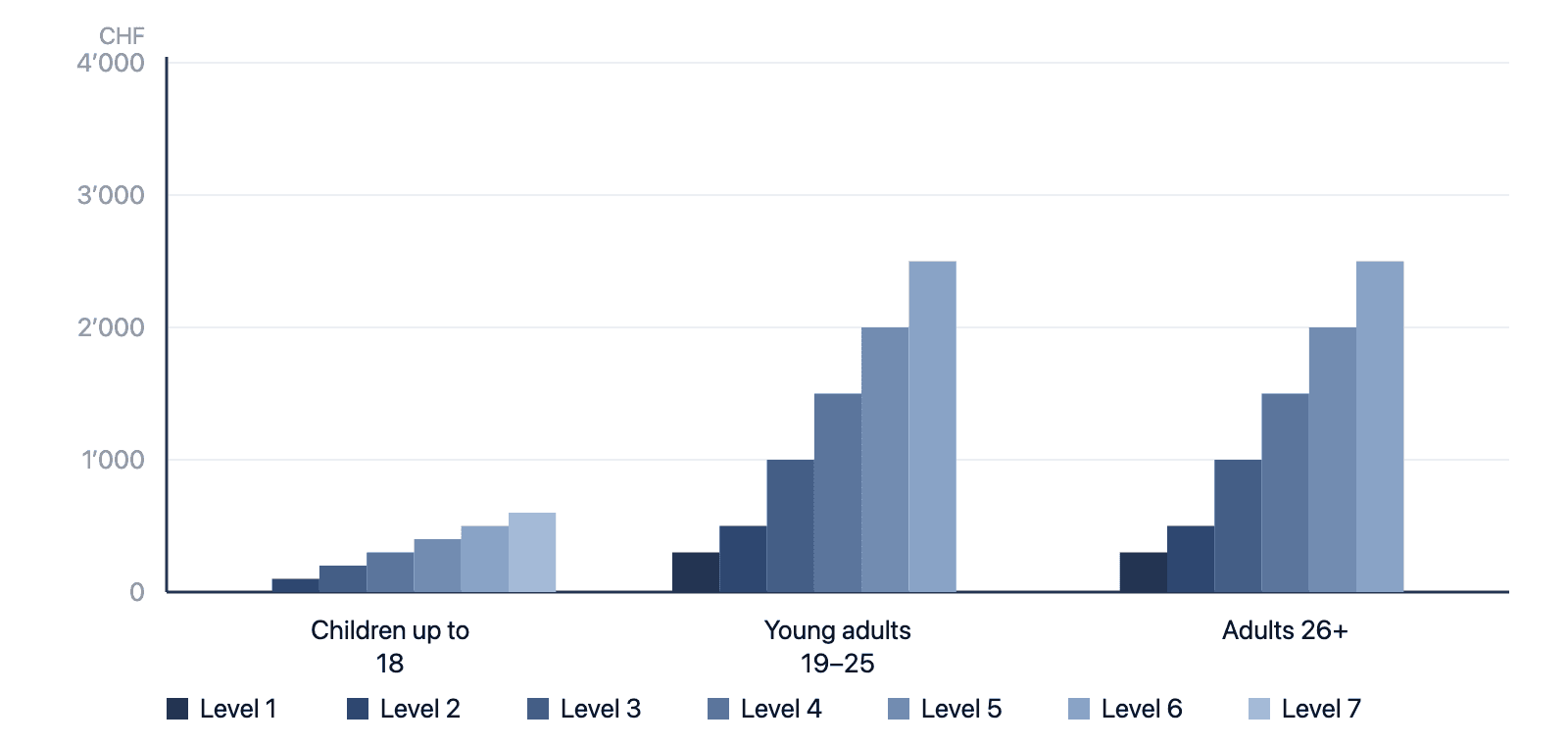
The deductible is the amount you bear yourself each calendar year before basic insurance contributes to the costs. For adults the ordinary deductible is CHF 300, for children CHF 0. Adults and young adults can choose a deductible of CHF 500, 1,000, 1,500, 2,000 or CHF 2,500. For children there are six fixed levels of CHF 100, 200, 300, 400, 500 or 600.

Above the deductible you also bear a retention fee of 10 percent, capped at CHF 700 per year, and at CHF 350 for children. One exception concerns medicines: anyone who obtains an originator drug even though an equivalent generic would be available at a significantly lower price bears a retention fee of 40 instead of 10 percent on it. If there are medical reasons for the originator drug and the doctor records this on the prescription, it remains at 10 percent. If an inpatient hospital stay is added, a further CHF 15 per day applies. Children and young adults in education up to age 25 are exempt from this contribution.

For cost-sharing only two age groups apply: children up to 18 and adults from 19. Young adults from 19 to 25 do have their own, lower premium age class, but bear the full adult deductible and the full retention fee.

Available annual deductibles and corresponding break-even points, in CHF

Bar chart of the available annual deductibles: children up to 18 from CHF 0 to CHF 600, adults and young adults from CHF 300 to CHF 2'500.
Available annual deductibles of compulsory basic insurance

The first bar in each group is the ordinary deductible: CHF 0 for children, CHF 300 for adults and young adults. For cost-sharing the law recognises only two groups, children up to 18 and adults from 19.

Source: Art. 103 para. 1 and Art. 93 para. 1 KVV (SR 832.102), as of 2026.

Why the break-even point is almost always around CHF 2,000

Under Article 95 of the Ordinance on Health Insurance, the premium discount for an optional deductible is capped at 70 percent of the additional risk assumed. Anyone who chooses the CHF 2,500 deductible instead of CHF 300 bears CHF 2,200 more risk. The discount may therefore be at most CHF 1,540 per year. Insurers may grant less, but not more.

Our own analysis of the FOPH 2026 premium dataset shows how far insurers actually use the permitted discount: 30 of 34 insurers pass on the full statutory discount, that is 88.2 percent. None stays below 90 percent. Between the most generous and the most restrained insurer there is CHF 150 per year, as the lowest grants CHF 1,390 instead of CHF 1,540.

From this follows the break-even point. With an annual discount of CHF 1,540, the calculation tips at around CHF 2,011 in treatment costs. Across 1,023 combinations of canton, premium region and insurer it lies between CHF 1,725 and CHF 2,012, and the median is CHF 2,011 in all 26 cantons. The choice of insurer therefore decides the level of your premium, but hardly which deductible is worthwhile for you.

A worked example from Zurich

The break-even point of a region is a median. A concrete case shows this: Canton of Zurich, premium region 1, adults from 26, with accident cover, family-doctor model. Of 46 insurer-tariff pairs, the median case is CHF 566.40 monthly premium with the 300 deductible and CHF 463.10 with the 2,500 deductible. That gives an annual discount of CHF 1,239.60.

Anyone in this case who uses no benefits at all pays CHF 5,557 a year with the high deductible and CHF 6,797 with the low one. At CHF 2,000 in treatment costs the ratio flips: CHF 7,557 versus CHF 7,267. The reason lies in the cap. Anyone who chooses the low deductible bears at most CHF 1,000 in cost-sharing. With the high deductible, by contrast, the bill rises up to CHF 2,500.

In this case the break-even point is CHF 1,677, and thus below the Switzerland-wide median. The reason is the discount: at CHF 1,239.60 it is below the statutory maximum. Calculate with your own premiums, therefore, rather than working with a rule of thumb. You will find the federal government's official calculator on Priminfo.

From what health costs is the CHF 300 deductible worthwhile?

From around CHF 2,000 in costs charged to basic insurance.

The low deductible is the more predictable choice if you regularly obtain medicines, are in ongoing treatment, have an operation ahead of you or expect higher costs for other reasons. It limits your cost-sharing to CHF 1,000 per year, made up of the CHF 300 deductible and at most CHF 700 retention fee, excluding the hospital contribution.

A pregnancy, by contrast, is not a reason for a lower deductible. The special maternity benefits are exempt from the deductible and retention fee with no time limit, and general illness benefits additionally from the 13th week of pregnancy until eight weeks after the birth. Since 1 January 2026, vaccinations under Article 12a of the Health Care Benefits Ordinance have also been exempt from the deductible. The 10 percent retention fee remains, however.

When is the CHF 2,500 deductible worthwhile?

It is worthwhile if you stay below the break-even point and can pay your deductible and the retention fee in the event of unexpectedly high costs.

With the highest deductible, your maximum cost-sharing is CHF 3,200 per year, that is CHF 2,500 deductible and CHF 700 retention fee. This amount can arise within a few weeks, for example after an accident or an unexpected diagnosis. The CHF 2,500 deductible is therefore the right choice only if you can raise this amount from your own means at short notice.

Which deductible suits me?

Two figures are enough for the decision: your expected treatment costs for 2027, in so far as they are charged to basic insurance, and your reserve for the worst case of CHF 3,200. The following overview brings the two together.

Your situationSuitable deductibleWhy
You use hardly any benefits and can bear CHF 3,200 at short noticeCHF 2,500Below the break-even point, the premium discount saves more than the higher cost-sharing costs
You use hardly any benefits, but could not bear CHF 3,200 at short noticeCHF 1,000 to 1,500The calculation favours the high deductible, your reserve does not. A middle level limits both
You expect more than around CHF 2,000 in treatment costsCHF 300Above the break-even point the low deductible wins, and your cost-sharing is capped at CHF 1,000
You are in ongoing treatment or chronically illCHF 300Cheaper and predictable: you know your ceiling for the whole year
An operation is planned for 2027CHF 300The costs are highly likely to arise, the discount is not worthwhile
You are pregnantsame as without pregnancyMaternity benefits are exempt from the deductible and retention fee, but pregnancy does not shift the break-even point

If none of these examples applies to you, your expectation is close to the break-even point. Then it is not the calculation that decides but your reserve: anyone who can bear the worst case without difficulty takes the high deductible. Anyone who cannot stays with the low one.

A comparison from smzh is free and without obligation and shows you the figures for your own profile.

Which costs count towards the deductible?

Only benefits charged to basic insurance.

Bills from supplementary insurance do not count, nor do benefits outside the statutory catalogue. What is decisive for charging the deductible and retention fee, under Article 103 of the Ordinance on Health Insurance, is the date of treatment, not the date of the bill. When obtaining more expensive medicines, an increased retention fee may apply under Article 38a of the Health Care Benefits Ordinance.

Over the year, the deductible is used up first. Only on the amount above it does the 10 percent retention fee apply, until the maximum is reached. After that, basic insurance covers the further insured costs, apart from the hospital contribution and the special retention-fee rules.

Work out deductible and premium together

A deductible level only works together with your insurer's premium – compare both figures for 2027 in one step.

Compare health insurers now

By when must the deductible for 2027 be adjusted?

The deductible always takes effect only on 1 January. A change during the year is not possible, not even with a change in your life situation.

If you change the deductible with your current insurer, notify them in good time before the turn of the year, because the deadlines of individual insurers differ. If you also change insurer, the cancellation must have reached the current insurer by 30 November 2026 at the latest. The postmark is not sufficient. With the new insurer you choose the deductible and model freely from its offering.

With the ordinary deductible and the standard model, there is additionally the option to switch with effect from 30 June, with cancellation by 31 March. Outstanding, reminded premiums or cost-sharing can block a switch until they are paid in full.

Will the minimum deductible rise to CHF 400 in 2027?

On 13 March 2026 the Federal Council sent an amendment to the Health Insurance Act out for consultation that would, as a first step, raise the minimum deductible from CHF 300 to CHF 400. Children would remain exempt from the deductible. An adjustment mechanism is additionally envisaged, intended to take effect if insured persons' cost-sharing falls below 13.5 percent of gross benefits.

Until a definitive decision, the minimum deductible of CHF 300 applies. Our assessment: for the choice of deductible for 2027 the proposal changes nothing, because any increase would only take effect after the legislative process is complete. Anyone deciding today calculates with the levels in force.

Reviewing your deductible for 2027 together

The break-even point answers the arithmetic question. Whether the level suits your situation additionally depends on your expected treatments, your liquidity and your existing supplementary insurance.

Special cases around the deductible

Four situations deviate from the annual logic.

Changing insurer mid-year. You keep the chosen deductible, provided the new insurer offers it. The deductible already charged and the retention fee already paid are credited by the new insurer. So you do not pay twice.

Change of age group. The adult deductible applies from 1 January of the year in which a person turns 19, not from the birthday. For the year concerned, the deductible is therefore that of adults from the outset.

Bonus insurance instead of an optional deductible. Alongside the optional deductible there is bonus insurance, where the discount rises with each claim-free year and falls again when benefits are used. It cannot be combined with an optional deductible.

Lower limit of the reduced premium. The discount is not only capped at the top. The reduced premium must be at least 50 percent of the ordinary premium with accident cover for the same premium region and age group. This lower limit is rarely reached in practice, but it limits how far discounts may go at all.

What is often confused about the deductible

The deductible is not the retention fee. You bear the deductible in full, the retention fee only at 10 percent of the amount above it. Together they make up the cost-sharing.

Cost-sharing is not the premium. You pay the premium every month, regardless of whether you use benefits. Cost-sharing arises only when you use them. The deductible decides both at once, and that is why it can only be judged by the annual costs, never by the monthly premium alone.

A discount is not a saving. The discount is certain, and so is the additional risk borne. Whether a saving results on balance is decided only by how high the treatment costs actually are in the year concerned.

Compare your existing health insurance solution today! The comparison takes around two minutes, is free and commits you to nothing.

The deadlines at a glance

Dates for the 2027 insurance year

DeadlineWhat to do
End of September 2026The federal government publishes the approved 2027 premiums.
31 October 2026Your insurer must have notified you of your personal 2027 premium. Only then do you know your own starting position.
30 November 2026The cancellation must have reached your current insurer. What counts is receipt, not the postmark.
1 January 2027The new basic insurance begins. From this day the chosen deductible and the chosen model apply.
31 March 2027Second cancellation date, effective 30 June 2027, open only with the ordinary deductible and the standard model.

A supplementary insurance under the VVG follows its own deadlines from the contract. Cancel it only once the new cover has been confirmed in writing.

Outstanding premiums or cost-sharing that have been formally reminded can block the switch until they are paid.

FAQ on the health insurance deductible 2027

Can I change the deductible every year?

Yes. But the change always takes effect only on 1 January. An adjustment during the year is not provided for. Notify your wish in good time before the turn of the year, because the specific deadlines differ from insurer to insurer. If you change insurer at the same time, 30 November applies for the cancellation.

What does a CHF 2,500 deductible mean?

You bear the first CHF 2,500 in treatment costs per year in full before basic insurance pays. Above that comes the 10 percent retention fee up to a maximum of CHF 700. In the worst year this means cost-sharing of CHF 3,200. In return, the premium falls. The discount is capped at 70 percent of the additional risk borne, that is 70 percent of CHF 2,200, which gives CHF 1,540 per year. Calculated that way, by no means all insurers grant it in full.

Do all health expenses count towards the deductible?

No. Only benefits charged to compulsory basic insurance. Bills from supplementary insurance and benefits outside the statutory catalogue do not count. What is decisive is the calendar year of treatment, not the date on the bill. Anyone treated in December who receives the bill in January thereby charges the deductible of the year of treatment.

Is the CHF 300 deductible always better with a chronic illness?

Usually, but not necessarily. What is decisive is the expected costs in relation to the break-even point. Anyone regularly using more than around CHF 2,000 in benefits is better off with the low deductible and limits cost-sharing to CHF 1,000 per year. With fluctuating needs, it is worth comparing both levels with your own premiums.

Is a middle deductible worthwhile as a compromise?

Rarely for the calculation alone. Because the premium discount is capped by law and rises linearly with the risk assumed, middle levels usually only shift the calculation. They make sense above all if you expect hardly any benefits but could not bear CHF 3,200 yourself.

Which deductible applies to children?

For children the ordinary deductible is CHF 0. Six levels from CHF 100 to CHF 600 can be chosen. The retention fee is capped at CHF 350 per year; the hospital contribution of CHF 15 per day does not apply to children. For several children of the same family with the same insurer, additional ceilings apply.

Do I have to choose the deductible again when changing insurer?

When switching with effect from 1 January, you choose the deductible and model freely from the new insurer's offering. If, by contrast, you switch during the year, for example after moving, you keep the deductible chosen so far, provided the new insurer offers it. The new insurer credits the deductible and retention fee already charged in the current year.

How do I compare deductibles fairly across several insurers?

Always compare the same configuration: same deductible, same model, same accident cover. Otherwise you are comparing two different products. An insurer's deductible offering applies to the whole canton.


Sources

  • Federal Health Insurance Act (KVG), SR 832.10, in particular Articles 62 and 64: fedlex.admin.ch
  • Ordinance on Health Insurance (KVV), SR 832.102, Articles 93 to 95 and 103 to 105
  • Health Care Benefits Ordinance (KLV), SR 832.112.31, Articles 12a and 38a
  • Federal Office of Public Health, deductible calculator and approved premiums: priminfo.admin.ch
  • Federal Council, press release of 13 March 2026 on the consultation on the minimum deductible: admin.ch
  • Health insurance premiums 2026 dataset of the Federal Office of Public Health: opendata.swiss

Status of review: 31.08.2026. Legal bases and amounts are reviewed at least annually and whenever there is a specific reason to do so.

This content is provided for general information only and does not constitute individual insurance, investment or legal advice.

Author:
smzh-image

Burak Er

Head Research & Advisory Solutions
Share on: