smzh blue logo
Insurance

Health Insurance for the Family: What Applies to Children and Parents

Artikel
26 Feb 2026
smzh-image

The key points at a glance

  • For children, the ordinary deductible is CHF 0. Optional deductibles are possible in six fixed levels from CHF 100 to CHF 600.
  • The retention fee is generally 10 percent, but at most CHF 350 per year and child.
  • For several children of the same family with the same insurer, a ceiling applies.
  • In our analysis of 25 insurers, the most expensive children's premium costs around 2.75 times the cheapest.
  • From 1 January of the year in which the child turns 19, the adult deductible and the full retention fee apply, even during education.

What children pay in basic insurance

Children pay less than adults, and clear rules apply. No ordinary deductible is charged for children. Cost-sharing begins with the retention fee of generally 10 percent, and this is capped at CHF 350 per year. For adults the maximum is CHF 700. One exception concerns medicines: if an originator drug is obtained even though an equivalent generic is available at a significantly lower price, the retention fee on it is 40 instead of 10 percent. The cost-sharing actually paid can thereby exceed CHF 350.

Parents can voluntarily choose a deductible for their child. There are six fixed levels: CHF 100, 200, 300, 400, 500 and 600. In return, the premium falls. But because children's premiums are low anyway, the discount in francs is small, while the risk borne falls on the family.

The contribution of CHF 15 per day towards an inpatient hospital stay does not affect children: they are exempt, as are young adults in education. In addition, vaccinations under the Health Care Benefits Ordinance are exempt from the deductible. The retention fee, however, remains.

How much do children's premiums differ?

The approved 2027 premiums have not yet been published. All amounts in this article therefore come from the official 2026 premium dataset of the Federal Office of Public Health and indicate an order of magnitude for 2027.

Overall, it can be seen that children's premiums differ far more than the small amounts suggest. We analysed the 2026 premium dataset of the Federal Office of Public Health and, across all insurers, compared a like-for-like configuration: Canton of Zurich, premium region 1, children's age class, family-doctor model, deductible CHF 0, with accident cover. The statutory scope of benefits is identical. The family-doctor models themselves do, however, differ in terms of doctor list, first point of contact, exceptions and sanctions.

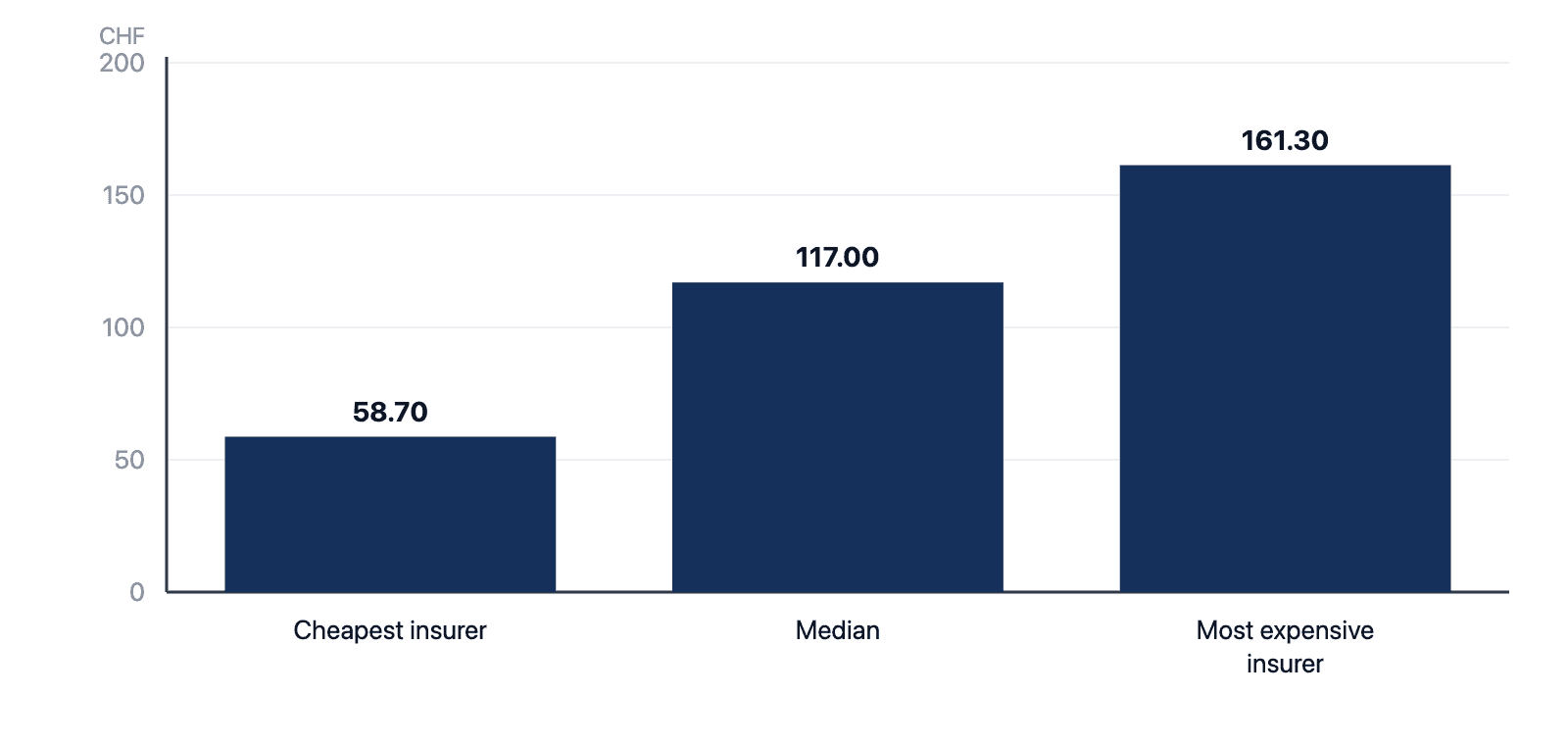
Bar chart of children's premiums at 25 insurers: cheapest CHF 58.70, median CHF 117.00, most expensive CHF 161.30 per month, with an identical benefits catalogue.
CHF 1'231.00 a year separates the cheapest and the most expensive children's premium

The cheapest of the 25 insurers analysed charges CHF 58.70 per month, the most expensive CHF 161.30. That is around 2.75 times as much and equals CHF 1,231 per year and child.

So if, for example, two children of a family are insured with the most expensive rather than the cheapest insurer, the household pays CHF 1,231 per child, that is around CHF 2,462 more per year. This is calculated for the same configuration and with no difference in benefit entitlement.

These figures show why a comparison is worthwhile precisely for children. The gap between the cheapest and the most expensive insurer is proportionally much larger for children's premiums: 2.75 times versus 1.22 times for adults, the latter calculated with a deductible of CHF 300. Because several children count multiple times, the difference weighs even more heavily in the household budget than a single adult premium.

If you would like to lay your family's premiums side by side: the smzh comparison is free and without obligation.

Why children's premiums vary so widely

The 2.75-fold gap between the cheapest and the most expensive children's premium calls for explanation, because the benefit entitlement is the same everywhere. Three reasons work together.

The amount is small, so the spread is proportionally large. A few francs' difference in the calculation weigh more heavily on a children's premium than on an adult's.

Children's premiums are a steering instrument for the insurers. Each insurer sets its premiums itself, and the children's age class is one of the three by which it may grade them. An insurer that wants to win families can start here.

The differences accumulate across the family. What is a manageable amount for one person becomes, with two or three children, an item that runs for years.

It follows that comparing insurers pays off more for children than for adults, while the optional deductible brings less there. Both have the same reason, namely the low starting premium.

What applies at which age?

For children, premium and cost-sharing follow different age limits: for the premium there are three age classes, for cost-sharing two.

Children 0–18Young adults 19–25Adults from 26
Premium age classown, lowest classown, reduced classfull premium
Ordinary deductibleCHF 0CHF 300CHF 300
Optional deductiblesCHF 100 to 600 in six levelsCHF 500 to 2,500CHF 500 to 2,500
Retention fee maximumCHF 350 per yearCHF 700 per yearCHF 700 per year
Hospital contribution CHF 15 per dayexemptexempt, if in educationowed

Two rules soften the transition for young adults in education. They remain exempt from the hospital contribution of CHF 15 per day until 25. And for lower and middle incomes, the federal government prescribes a minimum reduction of 50 percent of the premium. Both apply regardless of the fact that cost-sharing is already at adult level. Anyone expecting a markedly higher bill in the year of the 19th birthday should therefore first check entitlement to a premium reduction in their canton of residence and then the deductible.

What is decisive here is not the birthday but the turn of the year. Cost-sharing jumps fully to adult level on 1 January of the year in which the child turns 19, regardless of whether it is still at school, studying or doing an apprenticeship. It remains in the reduced premium class of young adults until the end of the year in which it turns 25.

The ceiling for several children

If several children of a family are insured with the same insurer, their combined cost-sharing is capped. With the ordinary deductible, together they bear at most as much as applies to one adult. With an optional deductible, at most twice the maximum amount per child applies.

What this means in practice only becomes clear from a calculation. Take three children with the ordinary deductible who each incur CHF 4,000 in treatment costs in the same year. Without a ceiling, each child would pay a 10 percent retention fee up to its maximum of CHF 350, that is CHF 1,050 together. Thanks to the ceiling, the three together bear at most as much as the maximum deductible and retention fee for one adult. The relief thus grows with each additional child.

Two conditions are decisive here. The children must belong to the same family and be insured with the same insurer. Anyone who splits the children across two insurers to use the cheapest offer at each loses this ceiling. The premium advantage may outweigh it, but a careful calculation is essential to find the most advantageous solution.

A second point belongs in the same calculation. For children from lower and middle incomes, the federal government prescribes a minimum reduction of 80 percent of the premium, and for young adults in education 50 percent. Whether your income falls under this is determined by your canton of residence. A check is therefore worthwhile before you save on the deductible: a reduction acts directly on the premium and costs you no additional risk.

Family premiums in a single comparison

Children, young adults and parents can be worked through together – so you can see which insurer suits the whole household.

Compare health insurers now

Does my child need accident cover?

Yes, because a child does not yet work. Accident cover hinges on employment of at least eight hours per week for the same employer.

It follows that for children, accident cover belongs in basic insurance. Anyone who excludes it has no protection at all for accidents. The same applies to students without employment and to young adults who do not yet work eight hours per week.

If your child begins an apprenticeship or a side job of at least eight hours, cover under the Accident Insurance Act (UVG) arises, and suspension becomes possible. If the employment ends again, accident cover in basic insurance must, by law, be reactivated.

Which insurance model suits a child?

The models are open to children just as to adults, and the benefit entitlement is identical in every model. The usual discount is between 8 and 20 percent.

But the calculation comes out differently for children than for adults. Because the children's premium is low, a discount of 15 percent amounts to little in francs. At the same time you commit to a designated first medical point of contact, and for a child doctor's visits are more frequent and less predictable than for a healthy adult.

What is decisive, therefore, is less the discount than the question of whether the designated first point of contact fits everyday life. If the paediatrician is the first port of call anyway, the family-doctor model costs nothing in convenience. If not, you buy a small discount with a restriction that gets in the way when illness strikes.

Special cases for children and families

Five situations occur frequently and appear in no premium table.

Registration after the birth and guaranteed cover. You have three months, and acceptance is guaranteed: in basic insurance there is a duty to accept with no health check and no reservation. It is different with supplementary insurance. Because the company there assesses the risk, taking it out should be examined early, for a child ideally before the birth. Anyone who waits risks a reservation for something that only shows up later.

The deadline in detail. You have three months. Keep to the deadline and cover applies retroactively from the date of birth, and premiums are owed from that day. With later registration, insurance as a rule begins only upon joining.

Congenital defects. Up to the completed 20th year of age, Disability Insurance bears the costs of recognised congenital defects, thereafter basic insurance. In those years, treatment therefore does not run through your child's health insurer.

The hospital contribution. The contribution of CHF 15 per day for an inpatient stay does not apply to children. Young adults in education are also exempt until 25.

Maternity. Check-ups, birth and breastfeeding advice are exempt from the deductible and retention fee with no time limit. For general illness benefits, the exemption applies from the 13th week of pregnancy until eight weeks after the birth.

Vaccinations. Vaccinations under the Health Care Benefits Ordinance and vaccination advice are exempt from the deductible. The 10 percent retention fee remains. For children with the ordinary deductible of CHF 0, this exemption changes nothing, because no deductible applies there anyway. With a chosen children's deductible, however, it does.

What is regularly confused with children

Three age classes for the premium, two for cost-sharing. The premium recognises children, young adults and adults. Cost-sharing recognises only children up to 18 and adults from 19. That is why a 20-year-old pays a reduced premium but the full deductible.

A family discount is not the family ceiling. Some insurers advertise discounts for families. Such discounts are contractual and not regulated by law, they differ from insurer to insurer and can be withdrawn. The family ceiling, by contrast, is in the law and applies at every insurer.

The family ceiling applies only with the same insurer. If the children are spread across several insurers, it lapses. Anyone who splits the children to use the cheapest offer at each insurer should calculate both variants.

Children's deductibles are their own levels. The ordinary deductible for children is CHF 0. Anyone who does want to choose a deductible has six levels to choose from, between CHF 100 and CHF 600. Anyone who transfers the adult logic and looks for a high deductible for a child will not find it, because the law does not provide it for children.

Our assessment: for children the optional deductible rarely pays off, whereas comparing insurers almost always does. The reason is always the same: the premium is low, so the discount in francs is small, while the price difference between insurers remains proportionally large.

The deadlines at a glance

Dates for the 2027 insurance year

DeadlineWhat to do
End of September 2026The federal government publishes the approved 2027 premiums.
31 October 2026Your insurer must have notified you of your personal 2027 premium. Only then do you know your own starting position.
30 November 2026The cancellation must have reached your current insurer. What counts is receipt, not the postmark.
1 January 2027The new basic insurance begins. From this day the chosen deductible and the chosen model apply.
31 March 2027Second cancellation date, effective 30 June 2027, open only with the ordinary deductible and the standard model.

A supplementary insurance under the VVG follows its own deadlines from the contract. Cancel it only once the new cover has been confirmed in writing.

Outstanding premiums or cost-sharing that have been formally reminded can block the switch until they are paid.

FAQ on health insurance for children and families

From when must I insure my child?

Within three months of birth. Register the child within this deadline and cover applies retroactively from the date of birth, and premiums are owed from that day. If you register it later, insurance as a rule begins only at the time of joining. In the case of inexcusable delay, a premium surcharge is added.

Do children pay a deductible?

Not necessarily: for children the ordinary deductible is CHF 0. Voluntarily, six optional deductibles from CHF 100 to CHF 600 are possible. The retention fee is generally 10 percent and is capped at CHF 350 per year and child. For maternity benefits it does not apply; for certain medicines it rises to 40 percent.

Is there a ceiling for several children?

Yes. If several children of the same family are insured with the same insurer, their combined cost-sharing is capped: with the ordinary deductible at the maximum for one adult, with an optional deductible at twice the maximum amount per child.

What changes at age 19?

Cost-sharing switches fully to adult level: ordinary deductible CHF 300 instead of CHF 0, and retention fee up to CHF 700 instead of CHF 350. What is decisive is 1 January of the year in which the child turns 19, not the birthday. Education makes no difference. The child remains in the reduced premium class of young adults until the end of the year in which it turns 25.

Is an optional deductible worthwhile for children?

Rarely. Because the children's premium is low, the discount in francs is small, while the family bears the full additional risk. Comparing insurers generally brings more for children: in our analysis, CHF 1,231 per year and child separates the cheapest from the most expensive insurer.

Is the birth exempt from cost-sharing?

The special maternity benefits, yes: check-ups, birth and breastfeeding advice are exempt from the deductible and retention fee with no time limit. For general illness benefits, the exemption applies from the 13th week of pregnancy until eight weeks after the birth. Outside this window, the deductible and retention fee apply as usual.

Sources

  • Federal Health Insurance Act (KVG), SR 832.10, Articles 3, 61, 64 and 65: fedlex.admin.ch
  • Ordinance on Health Insurance (KVV), SR 832.102, Articles 93, 103 and 104
  • Health Care Benefits Ordinance (KLV), SR 832.112.31, Article 12a
  • Federal Office of Public Health, 2026 premiums, press release of 23 September 2025: bag.admin.ch
  • Own analysis of the FOPH dataset “Health insurance premiums 2026”: opendata.swiss

Status of review: 31.08.2026. Legal bases and amounts are reviewed at least annually and whenever there is a specific reason to do so.

This content is provided for general information only and does not constitute individual insurance, investment or legal advice.

Author:
smzh-image

Burak Er

Head Research & Advisory Solutions
Share on: