smzh blue logo
Insurance

Accident Cover in Your Health Insurance: Suspend It or Keep It?

Artikel
12 Feb 2026
smzh-image

You can suspend the accident cover in your health insurance if you work at least 8 hours a week for the same employer. You are then insured through that employer against non-occupational accidents as well, and the cover in your basic insurance becomes duplicate. In our analysis that lowers the premium by a median of CHF 472.00 a year, with no change to your protection.

The key points at a glance

  • From a weekly working time of 8 hours with the same employer, full cover under the Federal Accident Insurance Act applies.
  • Only then may the accident cover in basic insurance be suspended.
  • In our analysis of 46 tariff pairs, suspending it saves a median of CHF 39.30 a month, that is CHF 472.00 a year.
  • Suspension is not automatic. You have to notify your insurer.
  • If the UVG cover falls away, the accident cover in basic insurance revives by operation of law.
  • Anyone receiving unemployment benefit remains insured against accidents through Suva.

When do you need the accident cover in your health insurance?

Whenever you are not insured against accidents elsewhere. Basic insurance contains accident cover by operation of law, so that nobody is left without protection. For people in employment, the Federal Accident Insurance Act applies alongside it.

What is decisive is a working time of at least eight hours a week with the same employer. Anyone who reaches that threshold is insured through their employer not only against occupational accidents but also against non-occupational accidents, that is accidents in their free time. Anyone below it is covered exclusively against occupational accidents. The journey to work then also counts as an occupational accident. Everything that happens in your free time remains a matter for basic insurance in that case, and the cover there is indispensable.

The threshold relates to each individual employment relationship. Anyone with two jobs of five hours each does not reach the eight hours with either employer and is therefore not insured against non-occupational accidents, even though the total comes to ten hours.

Occupational accident, non-occupational accident, occupational illness

The Federal Accident Insurance Act recognises three grounds of cover, and the difference between them decides not the benefit but the precondition, and who pays.

The catalogue of benefits for occupational and non-occupational accidents is identical in law. What differs is the precondition for cover, the premium burden and possible reductions in benefits. The premiums for occupational accident insurance are borne by the employer. Those for non-occupational accident insurance are in principle borne by employees through a salary deduction.

People who reach the eight-hour threshold therefore see the deduction for non-occupational accident insurance on their salary statement and at the same time pay for the accident cover in their basic insurance, as long as they have not suspended it. So they are paying for the same protection twice.

Occupational illnesses are also covered by the compulsory scheme. They do not arise suddenly but through work over a longer period, and therefore do not fall under the definition of an accident but under a category of their own.

What is decisive is whether full cover under the Federal Accident Insurance Act exists, that is occupational and non-occupational accidents together. Anyone insured only against occupational accidents does not have full cover in that sense and still needs the accident cover in their basic insurance.

How much does suspending it save?

We calculated the answer from the Federal Office of Public Health's 2026 premium dataset. For each insurer we compared the two tariffs for the same configuration, once with and once without accident cover: Canton of Zurich, premium region 1, adults from 26, family doctor model, CHF 300.00 deductible.

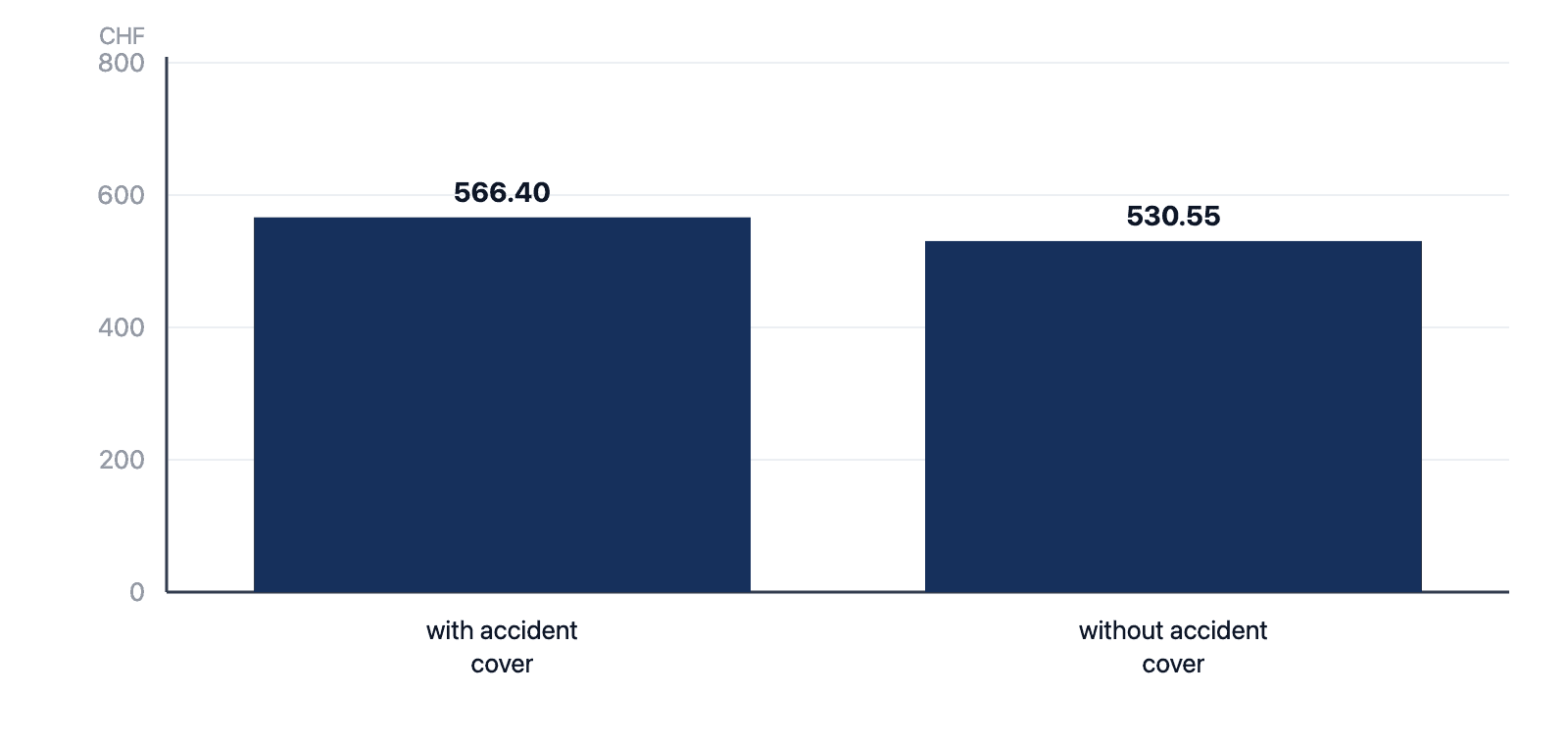
Bar chart of the median premium per month: CHF 566.40 with accident cover, CHF 530.55 without accident cover.
Own analysis of the FOPH 2026 premium dataset: Canton of Zurich, premium region 1, adults from 26, family doctor model, CHF 300.00 deductible, 46 tariff pairs. The difference of CHF 39.30 a month corresponds to CHF 472.00 a year.

The range runs from CHF 3.80 to CHF 45.70 a month.

Source: own analysis of the FOPH dataset «Krankenversicherungsprämien 2026» (opendata.swiss), as of 26.08.2026.

Across 46 tariff pairs the median premium with accident cover is CHF 566.40 a month, without it CHF 530.55. That is CHF 39.30 a month, or CHF 472.00 a year. The range, however, is considerable: depending on the insurer the saving lies between CHF 3.80 and CHF 45.70 a month. It is therefore worth looking at your own tariff specifically rather than working with an average.

What is remarkable is less the median than the spread. Between CHF 3.80 and CHF 45.70 a month lies a factor of twelve, and that for identical statutory cover. The reason lies in the pricing: every insurer sets its own premiums, and how heavily it weights the accident component is its own decision. The Federal Office of Public Health approves the premiums but does not prescribe a split.

The question «is suspending it worth it» therefore has no general answer. At an insurer with a low accident component it achieves almost nothing, at another almost CHF 550.00 a year. The only reliable route is to look at the two tariffs of your own insurer, and to do so before you take on the effort of notifying them.

The notification itself is simple. The insurer applies the suspension on proof of full UVG cover. As a rule a confirmation from the employer or the salary statement showing the deduction for non-occupational accident insurance is enough.

Who may suspend it and who may not?

The allocation is clearly regulated, but it changes with every change in your employment situation. The following overview sorts the most common cases.

Your situationCover under the UVGAccident cover in basic insurance
Employment of 8 hours a week or more with the same employerOccupational and non-occupational accidentsmay be suspended
Employment of under 8 hours a weekoccupational accidents only, journey to work includedis needed
Several small part-time jobs, each under 8 hoursoccupational accidents onlyis needed
Self-employed without voluntary UVG insurancenoneis needed
Unemployed with entitlement to unemployment benefitinsured through Suvamay remain suspended
Not in employment, children, students without a jobnoneis needed
Retirednoneis needed

Even where suspension is permitted, however, it is only worth it if your insurer shows a meaningful difference between the two tariffs. Both need checking.

Two points should be borne in mind here. First, suspension is not automatic: you have to notify your health insurer, otherwise you keep paying. Second, the reverse route applies by operation of law: if full UVG cover falls away, the accident cover in basic insurance revives, so that no gap arises. You should still report the change, so that your policy reflects the actual circumstances.

Check accident cover in the comparison too

Whether you suspend accident cover changes the premium at every insurer – check both in the same comparison.

Compare health insurers now

What happens when you change jobs

After a resignation, cover against non-occupational accidents continues for a further 31 days, counted from the end of your entitlement to at least half your wages. Within that deadline the cover can be extended by an agreement with the accident insurer, known as insurance by agreement.

Insurance by agreement deserves a remark of its own here, because it is tight on time. It must be agreed within the 31 days. Anyone who misses that deadline can no longer take out the insurance. It extends cover against non-occupational accidents beyond the employer and is therefore the alternative to re-including the accident cover in your basic insurance. Which route is cheaper depends on the length of the gap.

After that, UVG protection ends and the accident cover in basic insurance is needed again. The same applies to a reduction in hours below eight, to a longer unpaid break and to retirement.

One important exception concerns unemployment. Anyone entitled to unemployment benefit is automatically insured against accidents with Suva, without a separate registration. That protection also applies during waiting periods and labour-market measures. During that time the accident cover in basic insurance can remain suspended. Anyone whose benefits are exhausted, or who has no entitlement to unemployment benefit, needs it again. Anyone who does not think about the suspension in such situations has no gap in the legal sense, because the cover revives by operation of law. But anyone planning a break between two jobs without insurance by agreement should not forget to notify their health insurer.

When an event counts as an accident

In practice this question decides who pays. An accident is a sudden, unintended harmful effect of an unusual external factor on the human body. All four characteristics have to come together.

In the case of an illness it is not accident insurance that is responsible but basic insurance, and that means the deductible and the retention fee apply. This distinction makes the boundary financially relevant.

What accident insurance does differently from health insurance

Two differences are big enough to change the bill.

No cost-sharing. Medical treatment under the Federal Accident Insurance Act involves neither a deductible nor a retention fee. Anyone fully covered through their employer therefore pays nothing out of their own pocket in the event of an accident, whereas the same treatment through basic insurance would trigger cost-sharing.

Free choice of doctor and hospital within the compulsory scheme. Medical treatment under the UVG covers the general ward of the hospital, and free choice of doctor and hospital is guaranteed within the compulsory scheme itself. In basic insurance, by contrast, you choose among the listed hospitals, and for elective treatment outside your canton the tariff of your canton of residence is reimbursed.

What is confused about accident cover

Suspending is not cancelling. The accident cover is dormant, not deleted. If the UVG cover falls away, it revives by operation of law. So you do not have to reapply for anything or observe any waiting period. You should still report the change, so that the premium is right.

A non-occupational accident is not the same as free time. Anyone working under eight hours a week is insured only against occupational accidents. The journey to work expressly counts among those, everything else does not.

Accident cover is not accident insurance. The accident cover in basic insurance is an extension of your health insurer's catalogue of benefits. Accident insurance under the UVG is a social insurance of its own with its own benefits, including a daily allowance and pensions, which health insurance does not have. Anyone who suspends is giving up the extension, not the accident insurance.

The self-employed are not automatically insured. They are not subject to the compulsory UVG scheme and can insure themselves voluntarily. Without that voluntary insurance they need the accident cover in their basic insurance.

Our assessment: accident cover is the point in basic insurance where too much is paid for the longest. Check it whenever your working hours or your employment status change.

FAQ on accident cover in health insurance

From when am I insured through my employer against accidents in my free time?

From at least 8 hours a week with the same employer. Cover against non-occupational accidents then exists alongside cover against occupational accidents. Anyone below that is insured only against occupational accidents. The journey to work also counts as an occupational accident in that case. Everything that happens in your free time then remains a matter for basic insurance.

How much does suspending accident cover save?

In our analysis of 46 tariff pairs in the Canton of Zurich it is a median of CHF 39.30 a month, or CHF 472.00 a year. The range, however, runs from CHF 3.80 to CHF 45.70 a month. What is decisive is the difference between the two tariffs of your own insurer.

Do two part-time jobs count together?

No. The 8-hour threshold applies per employment relationship. Anyone with two jobs of five hours each does not reach it with either employer and is therefore not insured against non-occupational accidents.

How long am I still insured against accidents after resigning?

Cover against non-occupational accidents continues for a further 31 days, counted from the end of your entitlement to at least half your wages. Within that deadline you can extend it through insurance by agreement. If you are entitled to unemployment benefit, you are insured against accidents through Suva after that. Without that entitlement, the accident cover in basic insurance is needed again and revives by operation of law.

Do I have to report the suspension?

Yes. The suspension does not take effect automatically but only on your notification to your health insurer. Conversely, if the UVG insurance falls away the cover revives by operation of law. Report the change anyway, so that your policy reflects the actual circumstances and the premium is right.

Does my deductible apply in the event of an accident?

Not if the case runs through accident insurance under the UVG: medical treatment is covered there with no deductible and no retention fee, and free choice of doctor and hospital exists within the compulsory scheme itself. If the case runs through basic insurance, the deductible and the retention fee apply as they do for illness.

Sources

Federal Accident Insurance Act (UVG), SR 832.20, Articles 1a, 3, 4, 5 and 10: fedlex.admin.ch

Ordinance on Accident Insurance (UVV), SR 832.202, Articles 8 and 13

Federal Health Insurance Act (KVG), SR 832.10, Articles 8, 9 and 10

Federal Act on the General Part of Social Insurance Law (ATSG), SR 830.1, Article 4

Own analysis of the FOPH dataset «Krankenversicherungsprämien 2026»: opendata.swiss

Author:
smzh-image

Burak Er

Head Research & Advisory Solutions
Share on: