smzh blue logo
Insurance

Basic Insurance in 2027: What It Covers and What It Doesn't

Artikel
30 Mär 2026
smzh-image

The benefits of basic insurance are legally identical at every health insurer. Coverage includes examination, treatment, and care for illness, both outpatient and inpatient, provided they're effective, appropriate, and cost-efficient. The only thing that differs is the price you pay for it: the premium, the cost-sharing, and the rules of the model you choose.

Key Takeaways

  • The benefits catalog is identical for every insurer.
  • Only care provided by licensed providers is reimbursed.
  • Dental treatment is covered only in narrow exceptional cases.
  • Abroad, basic insurance pays out only in limited cases.

What Does Basic Insurance Cover?

Mandatory health insurance covers the cost of examination, treatment, and care for illness, both outpatient and inpatient. It also covers maternity benefits and, if no accident insurance applies, benefits for accidents. This is the same at every health insurer in Switzerland.

What matters is the standard against which every individual benefit is measured. It must be effective, appropriate, and cost-efficient. These three criteria are why certain treatments aren't reimbursed.

The three terms mean different things, and any one of them on its own can keep a benefit out of the catalog. Effective means the benefit has been proven by scientific methods. A treatment that helps patients but whose effect can't be documented doesn't meet this criterion. Appropriate means the treatment is suitable and proportionate to the treatment goal. An effective treatment can still be inappropriate in a specific case. Cost-efficient means that, given equal benefit, the less costly option is chosen.

Whether a benefit is added to the catalog is decided by the Federal Department of Home Affairs, on application and after consulting the relevant commissions — not by any individual insurer. That's why an insurer can't cover a benefit as a goodwill gesture, and why these decisions don't change if you switch insurers. It also explains why the catalog keeps changing: it's updated on an ongoing basis, usually effective 1 January and 1 July.

A second filter matters just as much: only care provided by licensed providers is reimbursed. If you receive treatment from someone who isn't licensed, you have no entitlement to reimbursement even if the treatment itself would otherwise be in the catalog.

What's Covered, and What Isn't?

The dividing line isn't drawn between important and unimportant — it's between mandatory and non-mandatory benefits.

AreaUnder Basic Insurance
Medical examination and treatmentCovered, outpatient and inpatient
Hospital stayCovered in the general ward of a listed hospital
MedicationCovered if on the Specialties List; case-by-case reimbursement only under narrow conditions
MaternityCovered; specific maternity services even without cost-sharing
Dental treatmentOnly in exceptional cases
Treatment abroadOnly in limited cases, chiefly emergencies
Hospital comfort amenities, free choice of hospital physicianNot covered — that's a matter for supplementary insurance

Two points are regularly confused. First, some freedom to choose your hospital is already included in basic insurance, but it's limited: you choose among listed hospitals, and treatment outside your home canton is reimbursed at your home canton's rate. Second, licensed providers are bound by tariff protection: for mandatory benefits, they may not bill you anything beyond the official tariff.

Dentist, Glasses, Psychotherapy, Acupuncture: What's Covered

The overview above sorts benefits into categories. But the real questions are about specific services, and there the answers get more nuanced.

Does Basic Insurance Cover the Dentist?

Generally, no. Cavities, dental hygiene, and braces aren't mandatory benefits. Dental treatment is covered only for a severe, unavoidable disorder of the chewing apparatus, for a severe systemic illness whose treatment requires it, or, as a fallback, for an accident with no other coverage.

Articles 17 through 19 of the Health Care Benefits Ordinance list exhaustively which conditions qualify. Anything not listed there, you pay for yourself, even if the treatment makes medical sense.

Does Basic Insurance Cover Glasses?

For children, yes; for adults, almost never. Up to age 18, there's a contribution of CHF 180 a year toward eyeglass lenses and contact lenses, on an ophthalmologist's prescription. Adults don't receive this annual contribution.

Higher contributions are possible regardless of age, but only for specific eye conditions, such as after surgery or an illness-related change in refractive power. You always pay for the frames yourself, even for a child.

Does Basic Insurance Cover Psychotherapy?

Yes, provided a qualified physician orders it. Since 1 July 2022, the referral model has applied: licensed psychotherapists bill basic insurance directly for their own services. Without that referral, the treatment remains a private matter, and you bear the full cost yourself.

Does Basic Insurance Cover Acupuncture?

Yes, if a licensed physician performs it. What matters isn't the method, but who provides it: only a physician with a specialist qualification and complementary-medicine training may bill for complementary-medicine services.

Treatment from a therapist without this qualification isn't a mandatory benefit — it's a matter for supplementary insurance.


Basic Insurance Abroad: The European Health Insurance Card and Its Limits

Outside the EU and EFTA, basic insurance pays at most double what the same treatment would have cost in Switzerland — and only in an emergency, at that. In countries with a high cost of care, that's the number that actually matters.

Behind this is the territoriality principle: what's reimbursed is care provided in Switzerland. Everything else is the exception.

In the EU, EFTA, and the United Kingdom, the European Health Insurance Card applies. It's printed on the back of your insurance card and doesn't need to be ordered separately. It entitles you to the medical care that's necessary given the type of treatment and your expected length of stay. You're treated under the host country's own terms.

Outside this region, the remainder is yours to cover. Where treatment costs several times the Swiss rate, double the Swiss reimbursement covers only a fraction of it, and for a hospital stay that quickly runs into five-figure amounts.

For trip planning, that means: within Europe, your insurance card is enough. Outside it, travel coverage isn't a convenience — it's your actual protection, and it should include medical repatriation, which basic insurance doesn't cover at all.

What You Pay Yourself

Covered doesn't mean free. For every reimbursed benefit, you first pay the deductible, then a 10 percent coinsurance up to the annual maximum, and, for a hospital stay, the daily hospital charge on top of that. Since 1 January 2024, an exception applies to medication: for a brand-name drug when a significantly cheaper generic with the same active ingredient is available, coinsurance is 40 percent instead of 10 percent. If medical reasons justify the brand-name drug, it stays at 10 percent.

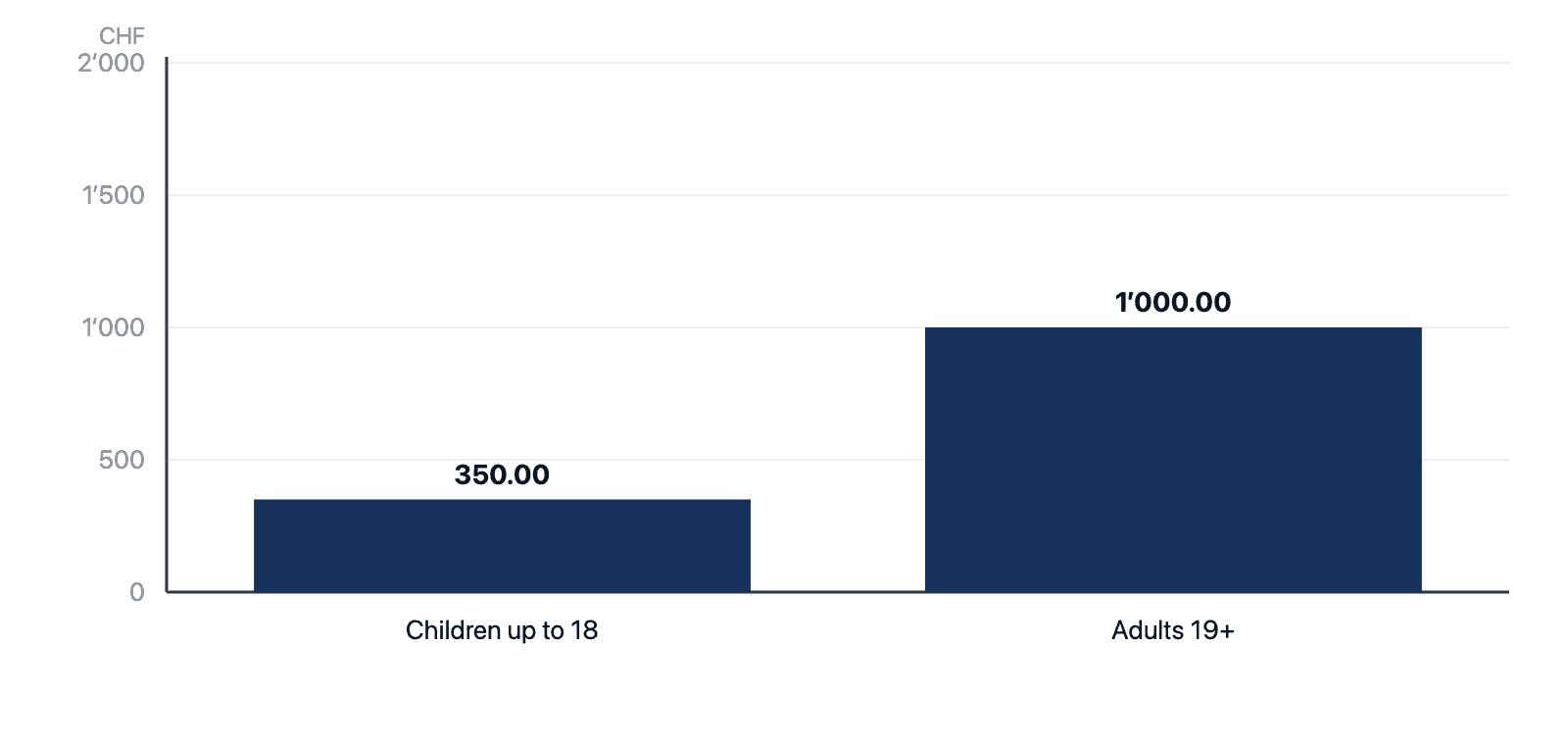
Bar chart of the maximum cost-sharing amount per calendar year with the ordinary deductible: children up to 18 CHF 350.00, adults from 19 CHF 1'000.00.

For adults, this figure combines the CHF 300 ordinary deductible and the CHF 700 maximum coinsurance. Children aren't charged an ordinary deductible, and their coinsurance is capped at CHF 350. The CHF 15-a-day hospital charge isn't included; children and young adults still in education are exempt from it. Choosing a higher optional deductible shifts the annual maximum up accordingly.

Sources: Art. 64 KVG (SR 832.10) and Art. 103 et seq. KVV (SR 832.102), as of 27 August 2026.

Cost-sharing is capped. With the ordinary deductible, adults pay at most CHF 1'000 a year — CHF 300 in deductible and CHF 700 in coinsurance. For children, it's at most CHF 350, since no ordinary deductible is charged for them. The hospital charge doesn't count toward this cap.

A worked example makes this concrete. Say you have the ordinary CHF 300 deductible, and over the course of the year you incur CHF 1'000 in outpatient treatment costs. You pay the first CHF 300 of that in full, plus 10 percent of the remaining CHF 700, which is CHF 70. Your total cost-sharing comes to CHF 370, and your insurer covers CHF 630. Worked through like this, it's clear that "covered" and "free" are two different things.

The Hospital Charge and Licensed Providers

During a hospital stay, the daily hospital charge is added on top. It's CHF 15 a day, but it isn't charged for the discharge day or for days of leave. Children, young adults in education, and women exempt under maternity provisions don't pay it. Unlike the deductible and coinsurance, the hospital charge has no annual cap, since it's based on the length of your stay.

Reimbursement, moreover, is limited to care provided by licensed providers. Licensing means the person or institution meets the statutory requirements and is authorized to bill basic insurance. If you receive treatment from someone who isn't licensed, you bear the cost yourself — and that doesn't change even if the treatment itself would otherwise be in the catalog.

What determines which calendar year a cost is assigned to is the treatment date, not the invoice date. So a treatment in December counts toward the old year, even if the bill doesn't arrive until February. Anyone changing their deductible or switching insurers should keep this in mind, since it determines that assignment.

Because the catalog is identical everywhere, the premium remains the one factor that genuinely distinguishes one insurer from another.

Same benefits, different premiums

The benefits catalogue is the same for everyone by law, the premium is not – so compare the premiums for identical cover.

Compare health insurers now

Why the Catalog Is the Same for Everyone

The fact that the benefits catalog is identical everywhere is no accident — mandatory health insurance is designed as social insurance. Because everyone resident in Switzerland must be insured, and every insurer must accept everyone, competition can't run on the scope of benefits. It runs on premium, service, and the rules of the model you choose instead.

This also explains tariff protection. Licensed providers may not bill anything beyond the official rate for mandatory benefits. The bill that reaches you is therefore capped from above, regardless of which insurer you're with or which physician you choose.

This doesn't apply to services outside the catalog. There, freedom of contract prevails, and the price is negotiable. Anyone wanting treatment that isn't part of the catalog should therefore clarify the cost in writing before the treatment takes place.

Why a Cheaper Insurer Doesn't Mean Less Coverage

The worry that a cheaper insurer provides fewer benefits is the most common reason people put off switching. It's unfounded, though. The benefits catalog is set by law and is identical for every insurer. No insurer can decide not to reimburse a mandatory benefit, and none can offer an extra mandatory benefit to stand out from the competition, either.

How far prices can diverge for an identical entitlement is shown by our analysis of the FOPH's 2026 premium dataset. For an identical configuration in the canton of Zurich — premium region 1, adults age 26 and older, family doctor model, and a CHF 300 deductible — the cheapest of the 25 insurers analyzed charges CHF 522.80 a month, the most expensive CHF 639.30. That's a difference of CHF 1'398 a year for a legally identical benefits catalog.

What actually distinguishes insurers comes down to three other things: the premium, which reflects each insurer's pricing and pool of policyholders; the service, meaning accessibility and how quickly claims are processed; and the rules of the insurance model you choose, such as the physician list under a family doctor model. Your entitlement to medically necessary treatment isn't one of them.

When comparing, then, don't analyze benefits — analyze configurations: same deductible, same model, same accident coverage. Only then does the real price difference between insurers become clear.

Special Cases Where the Catalog Applies Differently

Six situations depart from the standard case.

Treatment abroad. Basic insurance applies only in limited cases, chiefly emergencies and specific situations. How much it covers depends on the applicable agreement with the country in question. For vacations outside Europe and for longer stays, it's worth arranging separate coverage, for example through travel insurance or supplementary insurance with international coverage.

Elective treatment outside your home canton. You choose among listed hospitals. For elective treatment outside your home canton, reimbursement follows your home canton's rate, and you cover any difference yourself.

Dental treatment. It's covered only in narrow exceptional cases, exhaustively defined in the Health Care Benefits Ordinance. Routine checkups and treatment aren't among them. "Exhaustive" here means the list is complete. For everyday dental care, then, you need either supplementary insurance or a willingness to pay the cost yourself.

Medication outside the Specialties List. Only medications on the Specialties List are reimbursed. Case-by-case reimbursement is possible, but only under narrow conditions. That's the route by which an unlisted medication can exceptionally still be covered — for example, if no listed alternative exists and a significant therapeutic benefit is expected. The decision rests with the insurer, in consultation with its medical advisor, not with your treating physician, and it applies only to that individual case. A favorable decision for someone else, therefore, establishes no entitlement of your own.

Congenital conditions. Up to age 20, disability insurance covers the cost of recognized congenital conditions; after that, basic insurance takes over.

Maternity. Specific maternity services are reimbursed and exempt from cost-sharing. For general illness-related benefits, that exemption applies from the 13th week of pregnancy through eight weeks after birth.

Common Misconceptions About the Benefits Catalog

Covered isn't the same as free. The catalog states what gets reimbursed. What you pay out of that yourself is decided by the deductible, coinsurance, and hospital charge.

Choice among listed hospitals isn't unrestricted choice of hospital. Basic insurance covers the general ward of a listed hospital. Private clinics, semi-private or private wards, and extended choice of hospital physician are all matters for supplementary insurance.

Tariff protection doesn't mean everything is included. For mandatory benefits, licensed providers may not bill anything beyond the official tariff. That protection doesn't extend to services outside the catalog, and those need to be agreed on in advance.

Our take: benefits and premium shouldn't be confused when it comes to basic insurance. Anyone who believes a more expensive insurer means better care is paying for something they already have either way. Anyone who wants hospital comfort amenities and free choice of hospital physician needs supplementary insurance for that — not a more expensive basic policy.

FAQ: Basic Insurance Benefits

Are Benefits the Same at Every Health Insurer?

Yes. The benefits catalog for mandatory health insurance is set by law and identical for every insurer. No insurer can drop a mandatory benefit or offer an extra one. What differs is the premium, the service, and the rules of the insurance model you choose.

What Do the EAC Criteria Mean?

Effective, appropriate, and cost-efficient (the Swiss "WZW" test). Every benefit under basic insurance must satisfy all three conditions, and effectiveness must be proven by scientific methods. That's why not every treatment on offer is reimbursed, even one that seems medically sensible. Whether a benefit is added to the catalog is decided by the Federal Department of Home Affairs, after consulting the relevant commissions.

Dentist and Health Insurance: What's Covered?

Only in narrow exceptional cases, exhaustively defined in the Health Care Benefits Ordinance. Routine dental treatment and checkups aren't among them. Anyone wanting coverage for those needs supplementary insurance — and being accepted for it requires a health screening and can come with an exclusion.

Health Insurance Abroad: What Applies?

Basic insurance applies abroad only to a limited extent, chiefly in emergencies and specific situations. How much it covers depends on the applicable agreement with that country. For longer stays and travel outside Europe, it's worth arranging separate coverage, for example through travel insurance or supplementary insurance with international coverage.

Can I Freely Choose My Hospital?

Within the hospital list, yes. You choose among listed hospitals. For a hospital outside your home canton, reimbursement follows your home canton's rate, and you cover any difference yourself. This limit doesn't apply when the treatment is medically necessary elsewhere. Free choice of hospital physician and comfort amenities, on the other hand, are matters for supplementary insurance.

Can My Physician Bill Me More Than the Official Rate?

Not for mandatory benefits. Licensed providers are bound by tariff protection and may not bill anything beyond the official rate for basic-insurance benefits. That protection doesn't extend to services outside the catalog, since those need to be agreed on in advance. So get any such items confirmed in writing before treatment.

Sources

Federal Act on Health Insurance (KVG), SR 832.10, Articles 25, 25a, 27, 29, 31, 32, 33, 34, 41, 44, and 52: fedlex.admin.ch

Health Insurance Ordinance (KVV), SR 832.102, Articles 36, 71a–71d, 103, and 104

Health Care Benefits Ordinance (KLV), SR 832.112.31, Articles 17–19a

Federal Act on Disability Insurance (IVG), SR 831.20, Article 13

Health Care Benefits Ordinance (KLV), SR 832.112.31, Articles 4b and 11b, and Annex 2 (List of Aids and Devices, item 25, vision aids)

Regulation (EC) 883/2004 on the coordination of social security systems, applicable via the Agreement on the Free Movement of Persons

Federal Office of Public Health, "Benefits Abroad," "New Rules for Psychological Psychotherapy from 1 July 2022," and "Physician-Provided Complementary Medicine," accessed 31 August 2026: bag.admin.ch

Author:
smzh-image

Burak Er

Head Research & Advisory Solutions
Share on: