smzh blue logo
Insurance

HMO, Family Doctor, or Telemedicine Model in 2027: What Actually Pays Off?

Artikel
5 Feb 2026
smzh-image

Key Takeaways

  • The statutory benefits catalog is identical across every model. You give up nothing that is medically necessary.
  • What differs is the designated first point of contact, the physician lists, the exceptions, and how strictly the rules are enforced.
  • Measured in the canton of Zurich, the family doctor model is 11.5 percent cheaper, HMO 11.9 percent, and telemedicine and pharmacy models 10.1 percent each.
  • The cheapest model is only a good deal if you actually follow its rules day to day.
  • Since 2025, you can switch to a cost-saving model with your current insurer at any time during the year, not just at year-end.

What health insurance models are available?

Besides the standard model with free choice of physician, Swiss law recognizes insurance forms with restricted choice. These require you to contact a designated point of first contact when you fall ill, in exchange for a premium discount. The legal basis is Article 62 of the Health Insurance Act (KVG) and Articles 99 through 101 of its implementing ordinance (KVV).

ModelDesignated First ContactBest Suited ForWhat to Watch For
StandardAny licensed provider of your choicePeople who want maximum flexibilityUsually the highest premium
Family DoctorYour designated family doctor's practicePeople with a trusted, long-standing physicianThe practice must appear on the insurer's list
HMOA specific group-practice centerPeople with good care available nearbyWhether the center stays reachable, including after a move
Telemedicine and PharmacyA telephone hotline or the pharmacyPeople who prefer to check first rather than go straight to a doctorThe consultation is binding, not just a suggestion

Each insurer sets the specific terms of these models on its own. Two family doctor models from different insurers can differ significantly in their physician lists, exceptions, and penalties. Read the terms of the specific offer, not just the model description.

How Much Do You Actually Save With a Cost-Saving Model?

A discount of 8 to 20 percent is commonly cited. That's a range spanning every insurer and region, and it's too wide to serve as a basis for a decision. We therefore ran the numbers ourselves using the Federal Office of Public Health's 2026 premium dataset.

We analyzed the canton of Zurich, premium region 1, adults age 26 and older, a CHF 300 deductible, with accident coverage included — a configuration held identical across all models.

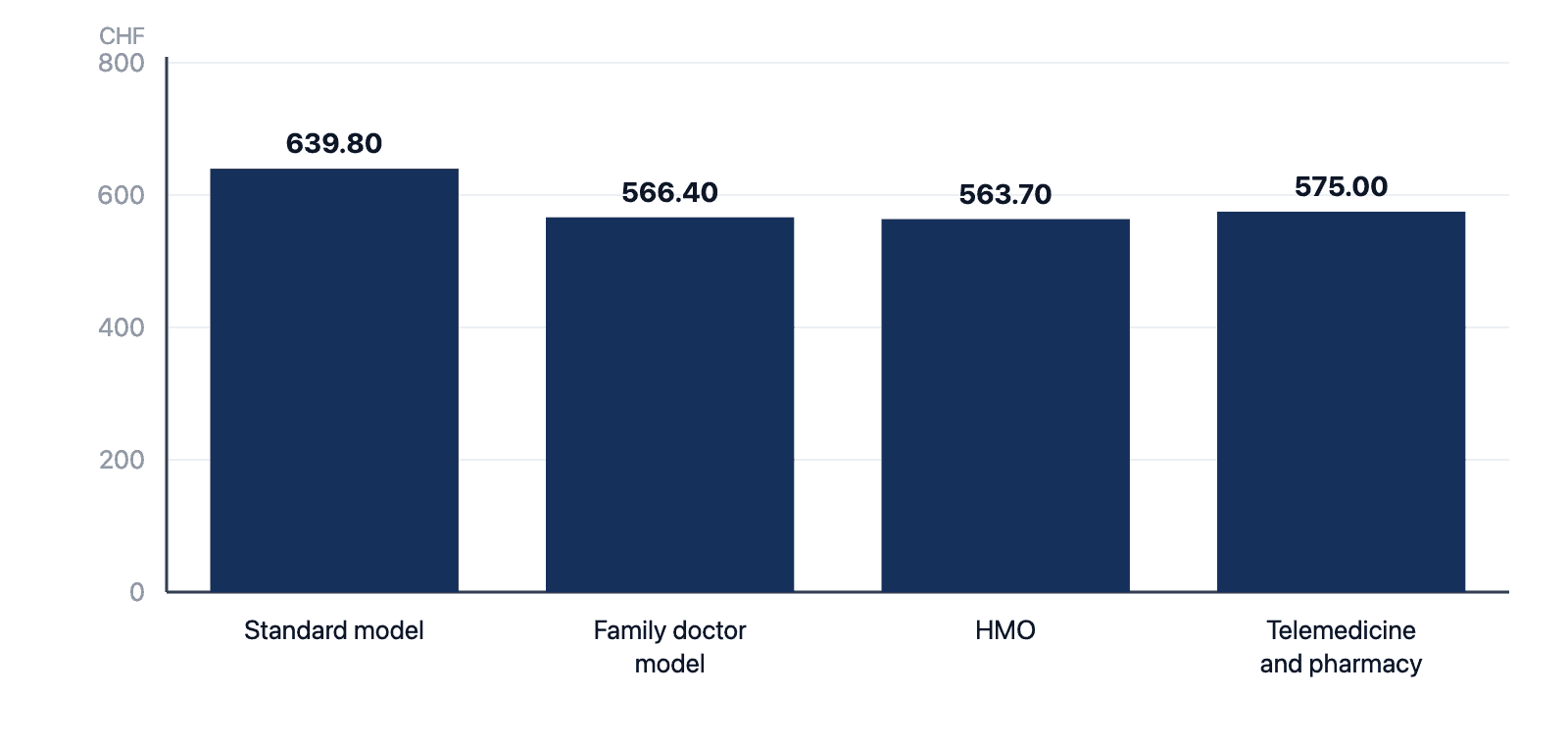
Bar chart: median premium by insurance model – standard model CHF 639.80, family doctor model CHF 566.40, HMO CHF 563.70, Telmed and pharmacy CHF 575.00.
Median premium by insurance model, in Swiss francs per month

Canton of Zurich, premium region 1, adults age 26 and older, CHF 300 deductible, with accident coverage. 128 rate plans from 25 insurers were analyzed. The statutory benefits catalog is identical across every model.

Source: smzh analysis of the FOPH 2026 premium dataset (opendata.swiss).

The median cost of the standard model is CHF 639.80 a month. The family doctor model comes in at CHF 566.40, the HMO model at CHF 563.70, and the telemedicine and pharmacy models at CHF 575.00. Annualized, that's a savings of CHF 881 for the family doctor model, CHF 913 for HMO, and CHF 778 for telemedicine. The actual discounts therefore fall in the lower third of the commonly cited range.

The difference among the three cost-saving models is small: about CHF 135 a year separates the cheapest from the most expensive, and only about CHF 32 separates HMO from the family doctor model. You shouldn't base your choice among family doctor, HMO, and telemedicine on price alone, but on which first point of contact suits you. This ranking holds for the configuration we analyzed in the canton of Zurich. In a different premium region or with a different insurer, the order between HMO and the family doctor model can flip, because each insurer calculates its own discounts.

Moving from the standard model to any cost-saving model captures almost the entire effect. The fine-tuning below that affects only a few francs a month, but involves very different day-to-day rules. Anyone who picks a model whose rules they can't actually follow ends up losing more than the discount is worth.

How Common Are These Models?

The statistics answer clearly whether a cost-saving model is the exception. Well over seven in ten adults have restricted choice of physician. Among adults, 42.1 percent are on the family doctor model, 28.7 percent on the standard model, 18.9 percent on telemedicine, and 10.3 percent on HMO. The share with “restricted choice” comes from official statistics; the breakdown among individual models comes from a market survey.

Why Models With the Same Name Can Differ

The law permits insurance forms with restricted choice and ties the premium discount to them. The specifics — what the first point of contact looks like, which exceptions apply, and what happens if you don't comply — are left to each insurer to decide.

That leads to the point most often overlooked when comparing plans: Two offers that are both called a “family doctor model” can work very differently. They can maintain different physician lists, enforce the first-contact rule with different strictness, allow different exceptions, and respond differently to a violation.

So a price comparison across models is informative, but comparing the actual terms is essential. First, clarify who counts as the first point of contact and whether your own doctor is on the list. Second, which exceptions apply without prior consultation. And third, what happens if you violate the model's rule.

When Does the Family Doctor Model Make Sense?

The family doctor model makes sense if you already have a regular practice you trust. You contact that practice first for any new complaint, and it refers you onward if needed. For people with chronic conditions or regular treatment needs, this model amounts to no real restriction at all.

Before signing up, check two things: whether your practice is on your prospective insurer's list, and what happens if the practice closes or you move. If your practice isn't on the list, you would need to switch practices to keep the discount — the most common reason a family doctor model stops working out after the fact. You should also clarify how the insurer handles referrals: some models require prior authorization for every specialist visit, while others leave certain specialties open without one. These rules are set out in the terms of the specific offer.

HMO Model: When It Pays Off

An HMO model makes sense if a center is within reasonable reach and you don't have, or need, a long-standing relationship with one physician. In an HMO, several specialists work under one roof, which keeps the distance between disciplines short.

The trade-off is being tied to one location. A move within the same canton can be enough to make the model impractical. So check not only whether a center is reachable today, but also how stable your living situation is. For families, everyone insured under the same model must also use the same center.

Compare model and insurer together

The same model discount comes out differently at each insurer – compare family doctor, HMO and Telmed directly across the providers.

Compare health insurers now

What to Check Before Signing Up for an HMO Model

Whether an HMO model works well in daily life comes down to three factors.

Reachability. The center is your first stop for any new health issue. If it's thirty minutes away, that distance could become a problem when you're sick. Check the travel time and opening hours before you sign up.

The range of specialties on-site. Group practices vary in how much they cover in-house. The more specialties available on-site, the less often you'll need a referral. If a specialty you regularly need is not available, the short distance probably won't help you much.

The rules for when you're away. If you travel frequently for work or have a second residence, read what applies when the center isn't reachable. These provisions vary considerably from product to product.

The real difference from the family doctor model lies less in price than in the type of commitment. With a family doctor model, you commit to a person; with an HMO model, you commit to an organization. If your family doctor is unavailable, you need a stand-in. If someone at the center is unavailable, a colleague steps in. On the other hand, your family doctor gets to know you over years, while at a center you won't necessarily see the same specialist every time.

When Does Telemedicine Make Sense?

If you're comfortable calling first whenever a new health issue comes up. The telephone consultation service is available around the clock and decides whether — and where — you should go next.

What's often underestimated is how binding this is. The call isn't a suggestion — it's the contractually agreed first step. So clarify in advance which exceptions apply, for example for emergencies, eye exams, or gynecological care.

What Are the Drawbacks of the HMO and Family Doctor Models?

The drawback of the HMO model is being tied to one location. A move within the same canton can already be enough to make the center no longer workable, leaving you to switch models at the next available date.

You don't choose who treats you. In a group practice, whoever is on duty handles your case. For many people that doesn't matter; for others it does.

The referral requirement also remains a bottleneck. Even if you're certain you need a specialist, you still have to go through the center first — costing you an appointment that the standard model wouldn't require.

The drawback of the family doctor model, by contrast, is being tied to one person. Vacations, illness, or a practice closing are foreseeable events, and you should know beforehand how each is handled.

The practice must be on the list for that specific model. Two insurers with the same model name maintain different lists, and a practice can disappear from a list without you noticing.

Not every practice accepts new patients, either. The discount is worthless if the only suitable practice on the list has stopped taking new patients.

What Applies to Both Models

The discount ranges from 8 to 20 percent. If you don't follow the rules, you can end up losing more than the discount is worth: depending on the terms, you may face a warning, a forced switch to another model, or denial of coverage for avoidable extra costs.

What Stays the Same Across Every Model

The statutory benefits catalog, however, is identical across all models. Every insurer must cover the same mandatory benefits. Also unchanged are the deductible and coinsurance amount, which you choose independently of the model, as well as the guaranteed enrollment requirement in basic insurance. In an emergency, you may go directly to the nearest available help under every model. Which deductible suits you is a separate decision you make independently of the model.

What Happens If You Break the Rule Just Once

The consequences of a violation are set out in the contract and therefore vary by insurer. Possible outcomes include a reduced reimbursement, being moved back to the standard model at the next year-end, or simply a warning. Your entitlement to medically necessary treatment remains intact in every case.

Emergencies are exempt from the first-contact requirement. What else is possible without prior consultation — such as an annual gynecological checkup or an eye exam — is set out in the terms and should be read before you sign up.

How Do You Switch Models?

You switch models effective 1 January, either by changing insurers or directly with your current one. Since 1 January 2025, switching to a model with restricted choice has also been possible at any time during the year with your current insurer. Switching back to the standard model, however, still follows the ordinary deadlines.

Special Cases in Choosing a Model

Four points regularly get overlooked in the model decision.

Mid-year switch into a cost-saving model. Since 1 January 2025, you can switch to a model with restricted choice with your current insurer at any point in the year. You don't have to wait for year-end.

The way back takes longer. Returning to the standard model is subject to the ordinary deadlines, so you have to wait until year-end.

Bonus insurance as a third option. Alongside the deductible and the model, there's also bonus insurance, where the discount grows with every claim-free year and drops again once you file a claim. It cannot be combined with an optional higher deductible.

How steep the discount is allowed to be. The reduced premium must be at least 50 percent of the standard premium with accident coverage for the same premium region and age group. That caps how far model discounts can go in the first place.

Common Misconceptions About These Models

The model changes the path, not the entitlement. The mandatory statutory benefits are identical under every model. What's restricted is whom you contact first.

A cost-saving model isn't the same as saving money automatically. The discount applies only as long as you follow the model's rules. If you can't follow them in practice, you pay a lower premium but risk a reduced payout when you actually need care.

The commonly cited range isn't your discount. The commonly cited 8 to 20 percent is a range spanning all insurers and regions. Your actual discount comes from the specific offer from your insurer in your premium region.

Restricted choice of physician doesn't mean no choice at all. You still choose — you just commit to one point of first contact. Referrals to specialists remain possible.

Choosing a model isn't the same as choosing an insurer. Both lower your premium, but independently of each other. If you only switch models without also reviewing your insurer, you leave the bigger lever untouched.

If you'd like to review both together: smzh's comparison is free and non-binding, and it runs the numbers on model, deductible, and accident coverage for your specific profile.

Deadlines at a Glance

Key Dates for the 2027 Insurance Year

DateWhat to Do
End of September 2026The federal government publishes the approved 2027 premiums.
31 October 2026Your insurer must have notified you of your personal 2027 premium. Only then do you know your own starting point.
30 November 2026Your notice of cancellation must have arrived at your current insurer. What counts is the date received, not the postmark.
1 January 2027Your new basic insurance takes effect. From this date, your chosen deductible and model apply.
31 March 2027Second cancellation deadline, effective 30 June 2027, available only with the ordinary deductible and standard model.

Supplementary insurance under the Insurance Contract Act (VVG) follows its own contractual deadlines. Don't cancel it until your new coverage has been confirmed in writing.

Outstanding premiums or cost-sharing amounts that are in reminder status can block a switch until they're paid.

FAQ: Health Insurance Models

Do I Give Up Any Benefits With a Cost-Saving Model?

No. The statutory benefits catalog is identical under every model and covers the same mandatory benefits. What's restricted isn't your entitlement, but the path to it: you contact the agreed point of first contact for a new complaint instead of going directly to a specialist of your choice. Emergencies are exempt, as is, typically, the annual gynecological checkup and the eye doctor.

What Happens If I Don't Follow the Model's Rules?

The consequences of a violation depend on your insurer's terms. Possible outcomes include a reduced reimbursement or removal from the model effective the start of the next year.

Does the Restriction Apply in an Emergency?

No. In an emergency, you may go directly to the nearest available help under every model. What counts as an emergency and what other exceptions exist — for example, for eye exams or gynecological checkups — is set out in each insurer's terms and varies from insurer to insurer.

Can I Switch Models Mid-Year?

Into a model with restricted choice, yes — since 1 January 2025, even with your current insurer. Switching back to the standard model, or switching insurers, still follows the ordinary deadlines, meaning it typically takes effect at year-end with notice given by 30 November.

Is HMO Always Cheaper Than the Family Doctor Model?

In our analysis, only barely: 11.9 percent versus 11.5 percent in discount, or about CHF 32 a year. This order can flip depending on the insurer and region. So decide based on which first point of contact suits you — an HMO center within easy reach is probably worth more than half a percentage point of discount.

Does My Family Doctor's Practice Need to Be on a List?

Yes. Each insurer maintains its own list of approved practices for its family doctor model. If your practice isn't on it, you can't use that model with that practice. Check this before signing up — it's the most common reason a family doctor model turns out not to work after the fact.

Sources

Federal Act on Health Insurance (KVG), SR 832.10, Article 62: fedlex.admin.ch

Health Insurance Ordinance (KVV), SR 832.102, Articles 99 through 101, and Article 100 paragraph 2 on mid-year switching

Federal Office of Public Health, Health Insurance Premiums Dataset 2026: opendata.swiss

Federal Office of Public Health, Premium Calculator: priminfo.admin.ch

Author:
smzh-image

Burak Er

Head Research & Advisory Solutions
Share on: