
smzh blue logo
Finance
Investments

Why the SNB Can Still Wait After the ECB and the Fed

Artikel
17 Sep 2026
smzh-image

After both the ECB and the US Fed raised their key interest rates by 0.25% as expected, attention now turns to the Swiss National Bank, which decides on its monetary policy on 24 September.

Will the SNB follow the international tightening course? After it kept rates at zero in June, the current data still offers little support for a rate hike in September. The more interesting question is whether the more robust economy and higher inflation are already laying the groundwork for a first rate increase in 2027.

2027 moves into focus

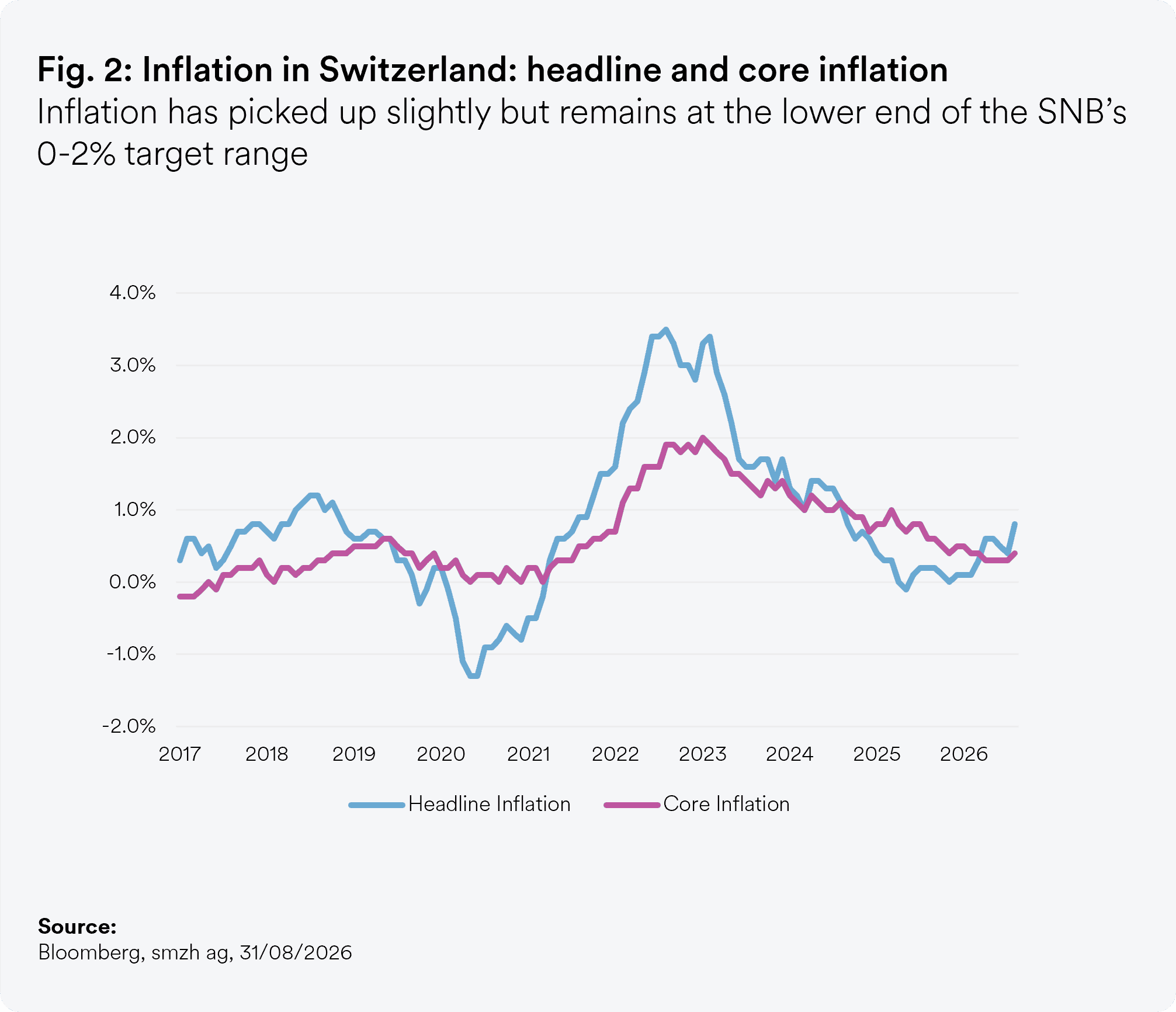
The SNB occupies a special position in monetary policy terms. Swiss consumer prices rose by 0.8% year on year in August. The economic data also paints a more constructive picture. Adjusted for sporting events, GDP grew by 1.5% in the second quarter compared with the previous quarter, after 0.5% in the first quarter. The industrial sector developed particularly dynamically, with value added up by 3.9%. The purchasing managers' index for manufacturing rose in August from 53.2 to 57.1 points, signalling a markedly stronger expansion in industry. The KOF Economic Barometer also improved to 106.7 points and is thus above its long-term average. Consumer sentiment has likewise improved year on year but, at −33 points, remains subdued. Overall, this points to a Swiss economy that is recovering but not yet overheating.
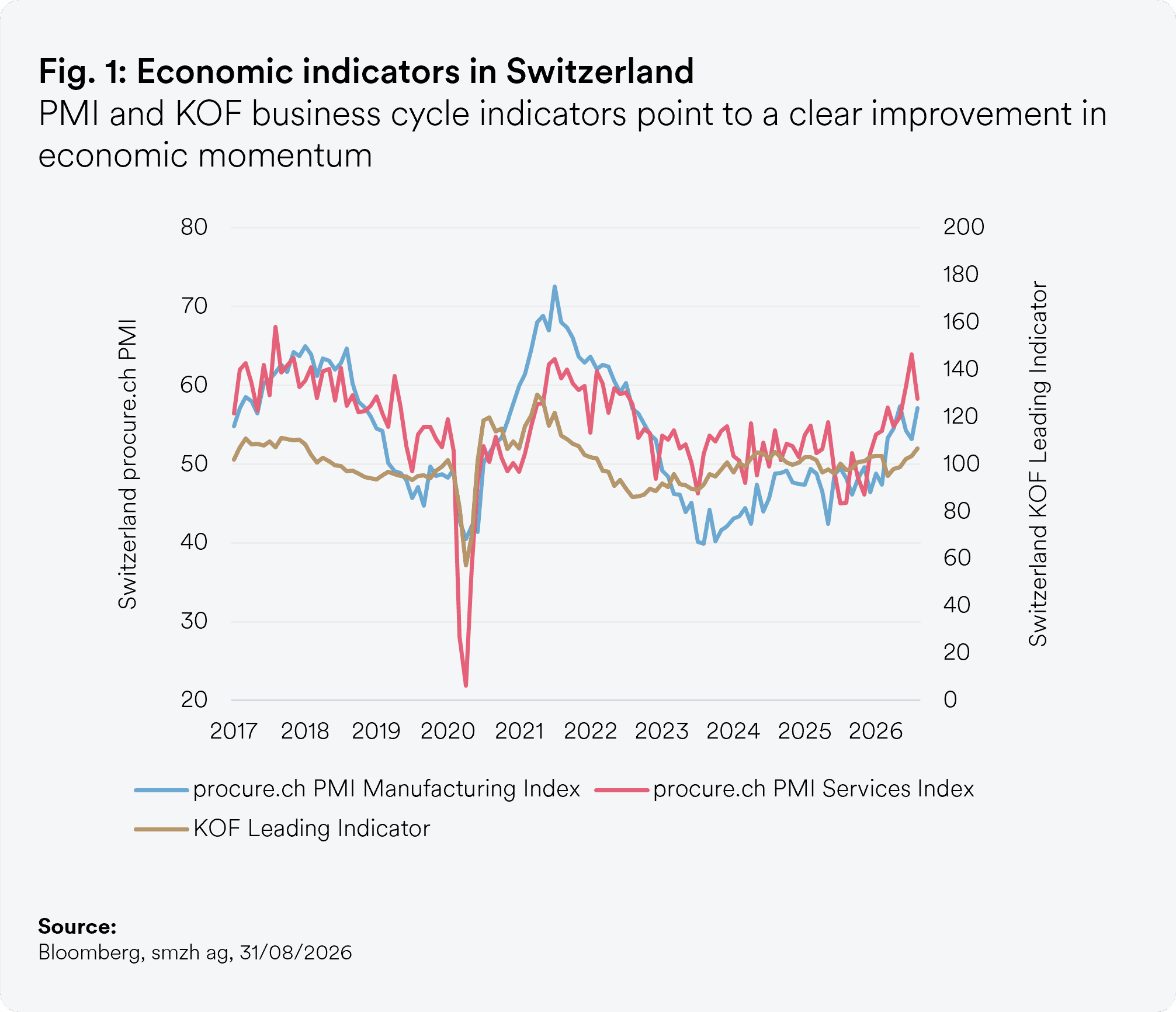
Line chart of Swiss economic indicators from 2017 to 2026: purchasing managers' index for manufacturing, purchasing managers' index for services and the KOF Economic Barometer.
Fig. 1: Swiss economic indicators – purchasing managers' indices for manufacturing and services and the KOF Economic Barometer, 2017 to 2026.
Line chart of headline and core inflation in Switzerland from 2017 to 2026, in percent.
Fig. 2: Headline and core inflation in Switzerland, 2017 to 2026, in percent.

What does this mean for your wealth?

There is little between 0% and 0.25%. For how a portfolio is positioned, the direction of the interest rate environment over several years is nonetheless relevant. We will look at your situation together with you.

Discuss your investment strategy

At first glance, both the inflation and the economic data therefore argue for less expansionary monetary policy. For an immediate rate hike, however, this is not yet enough. Inflation remains clearly within the range of price stability defined by the SNB. In its last forecast, moreover, the SNB assumed that inflation would remain within this range across the entire forecast horizon at a key interest rate of 0%.

Against this background, there is currently little to suggest a rate hike on 24 September. The more interesting view is towards 2027. Should robust growth and the gradual rise in inflation continue, a first increase to 0.25% could return to the monetary policy agenda.

Back to a positive interest rate level

Normalisation to 0.25% would not yet be an actual tightening cycle, but rather a step back to a moderately positive interest rate level. From a monetary policy perspective, such a level can be advantageous in principle. It restores conventional room for manoeuvre to respond to a future economic downturn with rate cuts, without having to resort immediately to unconventional instruments or to negative interest rates once again. A moderately positive interest rate level can also contribute to a more efficient allocation of capital, supports the functioning of credit intermediation and reduces potential distortions that can arise from the search for yield when rates are very low or negative.

In the long run, a moderately positive interest rate level is therefore not only a question of normalisation but also one of monetary policy room for manoeuvre. This could become particularly relevant for the SNB after Swiss monetary policy has repeatedly been shaped in recent years by very low or negative rates – in June 2025 the SNB cut its key rate to zero for the first time.

For the September decision, it is therefore less the level of the key interest rate that is decisive than the SNB's monetary policy assessment. Much more important will be its assessment of how sustainable the stronger economic momentum is, where inflation is heading and what role the Swiss franc plays in this. The September decision could therefore already provide important indications of the monetary policy course in 2027.

For investors, what matters is less the individual decision than the question of how their own investment strategy is positioned for a changed interest rate environment. How we structure wealth and accompany it over time is shown in our wealth advice and at smzh Invest.

Your portfolio in the new interest rate environment

Whether the key rate stays at 0% or rises again in 2027: what is decisive is how your wealth is structured. With smzh Invest we combine a digital investment platform with personal guidance – independent and on transparent terms.

Discover smzh Invest
Author:
smzh-image

Bekim Laski

Chief Investment Officer und Partner
Share on: