smzh blue logo
Insurance

2027 Health Insurance Premiums: Our Forecast for Switzerland

Artikel
15 Jan 2026
smzh-image

Health insurance premiums are likely to keep rising in 2027. An increase of 3.5 to 4.0 percent in the median premium looks like a plausible base-case scenario — noticeable, but smaller than in recent premium rounds. The federal government is expected to publish the approved premiums at the end of September 2026.

Key Takeaways

  • Our base-case scenario: a 3.5 to 4.0 percent increase in the median premium.
  • The KOF, commissioned by the federal government, expects cost growth of 4.0 percent per insured person for 2027.
  • For adults, the base-case scenario means CHF 195 to CHF 223 in added cost per year.

How Much Will Health Insurance Premiums Rise in 2027?

Based on what's currently known, an increase in the median premium of 3.5 to 4.0 percent looks plausible. That's a Swiss-wide average across every insurer, canton, and age group.

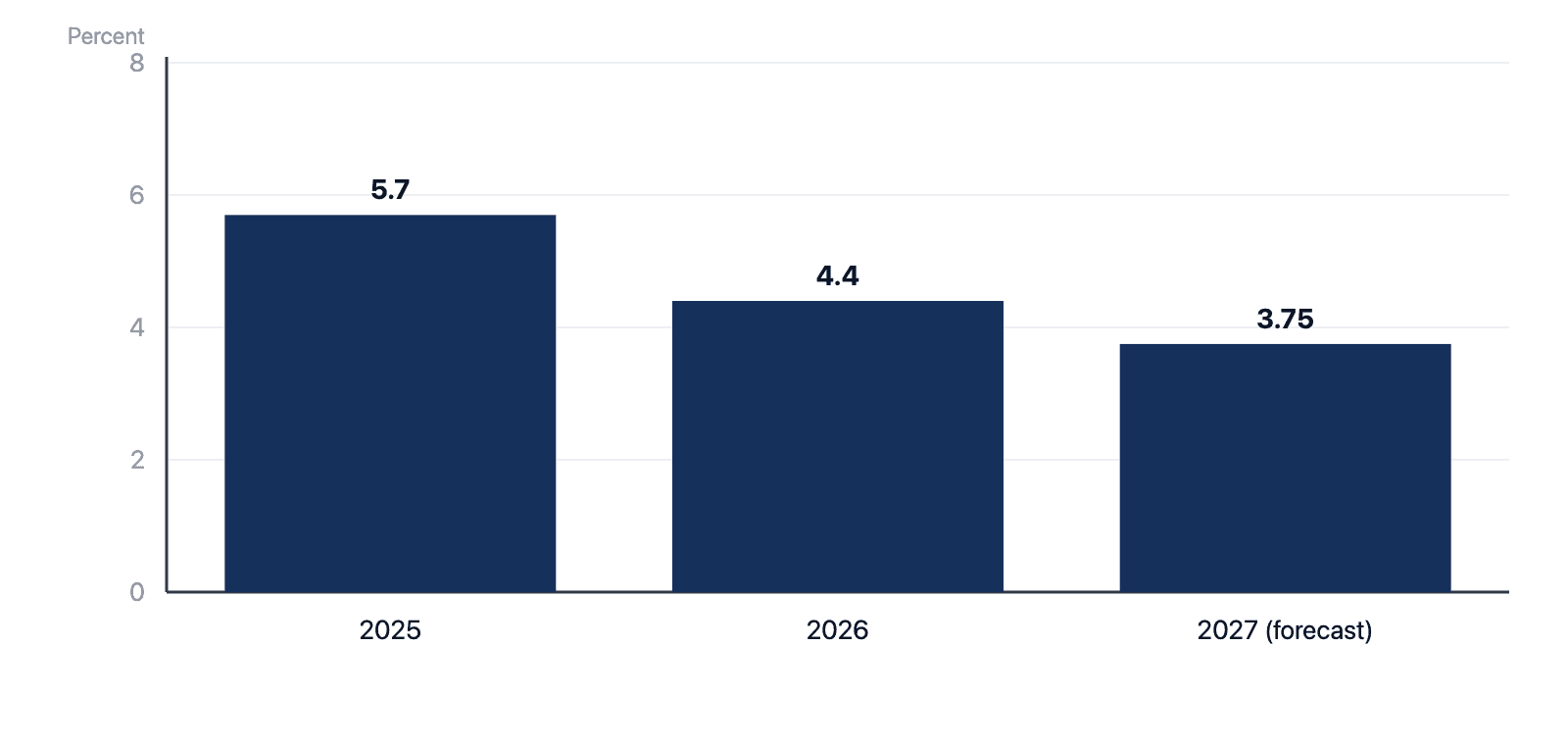
Bar chart of the year-over-year increase in the median premium: 5.7 percent in 2025, 4.4 percent in 2026, 3.75 percent in the 2027 base-case scenario.
The 2025 and 2026 figures are the values approved by the Federal Office of Public Health. The 2027 figure is the midpoint of our base-case scenario of 3.5 to 4.0 percent and is not an approved premium; the approved premiums follow in late September 2026.

Sources: FOPH for 2025 and 2026; smzh base-case scenario for 2027, as of 27 August 2026.

For comparison: in 2026, the median premium rose 4.4 percent, or CHF 16.60 a month; in 2025, it rose 5.7 percent. Our range, then, sits below both prior years. That's no reason for complacency, though: even a 3.5 percent increase would land on a base that's already well above 2022 levels. The approved 2027 premiums haven't been published yet. Every specific figure in this article comes from the official 2026 numbers, with the expected increase applied on top of that base. The median premium across all insured persons in 2026 is CHF 393.30. For adults, it's CHF 465.30 a month; for young adults, CHF 326.30; and for children, CHF 122.50.

What the KOF Cost Forecast Actually Measures

The KOF Swiss Economic Institute at ETH Zurich, commissioned by the Federal Office of Public Health, forecasts the growth in cost per insured person under mandatory health insurance. That's the figure premiums are built on — but it isn't the premium itself.

First, the forecast measures costs incurred in the forecast year itself. The premium has to cover those costs and also fund administration and reserves. Second, basic insurance covers only part of total health spending. Whatever is financed through cantons, other social insurance schemes, or households themselves doesn't show up in this figure.

That's why a 4.0 percent cost forecast isn't the same as a 4.0 percent premium increase. It's the starting point for calculating the premium, not the answer itself.

Why Premiums Are Likely to Keep Rising in 2027

The cost pressure isn't going away. The KOF projects cost growth of 4.0 percent per insured person under mandatory health insurance. Behind that are no short-term effects, but structural ones: medical advances, broader access to care, higher utilization of services, and rising costs per treatment. An aging population contributes, but it isn't the main driver. That's why the increase can't be stopped by any single measure, and why even years with more moderate increases don't reverse the underlying trend.

For households, that means: the cost trajectory is set, and the only thing you can actually influence is your own configuration of insurer, deductible, model, and accident coverage.

What a Premium Forecast Actually Depends On

A premium isn't a simple extrapolation of the past. It's an insurer's own estimate of what treating its policyholders will cost next year, plus whatever it needs for administration and reserves. Every insurer sets its own premiums, and the Federal Office of Public Health approves them.

Three things follow from this structure, and each of them limits what a forecast can actually tell you.

The forecast is about an average. The median premium is a calculated average across every insured person, every canton, every age group, every deductible, and every model. A 3.5 percent increase in that average tells you nothing about how any one individual policy will develop.

Approval is a separate step. Between an insurer's own calculation and the public release lies a review by the federal government.

Reserves cut both ways. If an insurer draws down its reserves, that softens the premium in the current year and builds up a bigger catch-up need for later. The reverse holds too. That's why a year with low cost growth can still bring a steep premium round, and vice versa.

Why Our Range Sits Below the Cost Forecast

Health care costs and premiums don't move in exact lockstep. Three reasons suggest the 2027 premium increase could come in below the cost growth figure.

First, only part of total health spending is financed through basic insurance, and cantonal contributions and other payers shift the picture further. Second, insurer reserves act as a buffer in both directions: drawing down reserves softens premium increases at first and leads to sharper adjustments later. That catch-up effect looks likely to matter less going forward. Third, projected and actual costs regularly diverge. For 2025, for example, an increase of 6 percent was forecast, while the actual figure came in at 5.7 percent.

What the Base-Case Scenario Means in Practice

The table below applies all three scenarios to the 2026 median premiums. The figures are added cost per year relative to 2026, rounded to the nearest franc.

Age Group2026 Annual PremiumAt 3.5 PercentAt 3.75 PercentAt 4.0 Percent
Adults 26+CHF 5'584CHF 195CHF 209CHF 223
Young Adults 19–25CHF 3'916CHF 137CHF 147CHF 157
Children up to 18CHF 1'470CHF 51CHF 55CHF 59

This table is based on our own calculation using the Federal Office of Public Health's 2026 median premiums. For a family of two adults and two children, the base-case scenario adds up to roughly CHF 528 a year. In the lower scenario, it's CHF 492; in the upper one, CHF 564.

Why Your Own Premium Can Differ Substantially

A nationwide forecast is a starting point, not a statement about your own bill. Even in 2026, the cantons varied widely: Ticino recorded the steepest increase, 7.1 percent, crossing the CHF 500 mark for the first time at CHF 501.50. Zug, by contrast, reported a 14.7 percent decrease to CHF 264.50.

That decrease isn't a market movement, though. The canton of Zug is relieving residents of roughly CHF 220 million in inpatient hospital costs in 2026 and 2027, covering 99 percent of hospital costs during those two years. Decisions like this affect premiums directly, but they're temporary and apply only within that specific canton.

Your own premium depends on your premium region, age, insurer, deductible, insurance model, and accident coverage.

Your own premium, not the average

A nationwide forecast says nothing about your own bill – compare the premiums for your region and your profile.

Compare health insurers now

What the Forecast Means for a Household

A percentage is hard to picture; a franc amount is easier. For adults, the base-case scenario means CHF 195 to CHF 223 in added cost per year. For a family of two adults and two children, it adds up to roughly CHF 528 a year — CHF 492 in the lower scenario and CHF 564 in the upper one.

It's worth setting these figures next to the levers actually within your control. In our analysis, the gap between the cheapest and most expensive insurer comes to CHF 1'398 a year — several times the expected increase. The premium round determines how much more expensive things get; your own configuration determines the level you're starting from.

Run the Numbers on Your Own Premium

The figures above apply to the median premium. Your own is higher or lower than that, so your actual franc amount will differ.

Take your current monthly premium, multiply it by twelve, and apply the percentage range to that figure. Say you currently pay CHF 400 a month: that's CHF 4'800 a year, and 3.5 to 4.0 percent of that comes to CHF 168 to CHF 192 in added cost.

Two things become clear from this. First, a percentage increase hits harder if you're already paying a lot, because the percentage applies to a higher base. Second, even the upper figure comes in below what switching to the cheapest insurer in the same configuration would save. Anyone worried about the premium round already holds the bigger lever in their own hands.

Why a Forecast Is Useful at All

If you'll find out the approved premiums at the end of September anyway, you might ask why an earlier estimate is worth having at all. The value isn't in the number itself — it's in the preparation it enables.

The decisions take time, and the numbers arrive late. About two months separate the publication of the premiums and the 30 November cancellation deadline. That's the window in which you need to review your deductible, model, accident coverage, and insurer. Anyone starting only then is making these decisions under time pressure.

The order of magnitude is enough to prepare with. Whether the increase turns out to be 3.5 or 4.0 percent changes nothing about whether your deductible actually fits your expected needs. That question can be answered without the final numbers.

Comparing the forecast against the outcome keeps it honest. A forecast that's written down can be checked later. For 2025, an increase of 6 percent was forecast; the actual figure was 5.7 percent. Anyone who records their expectation can see, the following year, how well the method actually held up.

What You Can Do Already

You have no influence over the cost trend, but you do have influence over your own configuration. And that can be prepared before the numbers arrive.

This isn't just a formality. Year after year in advisory conversations, the same pattern shows up: people wait for the final premiums, read the headline about the increase, and only then start comparing. But only about two months separate the publication date from 30 November, and that window has to fit reviewing your own needs, comparing multiple insurers, and canceling on time.

By the end of September, work out which services you're likely to need in 2027, whether your deductible fits that need, and whether you're already covered against non-occupational accidents through your employer. Once the premiums are published, you can compare that configuration across multiple insurers.

Where This Forecast Doesn't Apply

A forecast about the median premium says little about individual cases. Three situations depart from it systematically.

Cantonal special effects. If a canton temporarily takes on part of hospital costs, the premium there falls regardless of the underlying cost trend. Decisions like this are temporary and specific to that canton.

Moving into a new age group. Anyone turning 19 or 26 in a given year moves into a new premium age bracket on 1 January. That jump is bigger than any premium round and has nothing to do with the forecast.

Your own configuration. Anyone who changes their deductible, model, or accident coverage shifts their premium by several times what the expected increase amounts to. The forecast describes the trend — not your own bill.

Common Misconceptions About Premium Forecasts

Cost growth isn't premium growth. Only part of health spending is financed through basic insurance. Cantonal contributions, other payers, and insurer reserves shift the outcome further.

The median premium isn't the most commonly paid premium. It's a calculated average across every insured person.

A range isn't a single figure. We cite 3.5 to 4.0 percent because both endpoints are plausible.

Approved isn't the same as forecast. Until the Federal Office of Public Health releases the premiums, every number is an expectation. Only approval turns it into an actual price.

smzh's comparison is free and non-binding, and it works through your own profile.

Deadlines at a Glance

Key Dates for the 2027 Insurance Year

DateWhat to Do
End of September 2026The federal government publishes the approved 2027 premiums.
31 October 2026Your insurer must have notified you of your personal 2027 premium. Only then do you know your own starting point.
30 November 2026Your notice of cancellation must have arrived at your current insurer. What counts is the date received, not the postmark.
1 January 2027Your new basic insurance takes effect. From this date, your chosen deductible and model apply.
31 March 2027Second cancellation deadline, effective 30 June 2027, available only with the ordinary deductible and standard model.

Supplementary insurance under the Insurance Contract Act (VVG) follows its own contractual deadlines. Don't cancel it until your new coverage has been confirmed in writing.

Outstanding premiums or cost-sharing amounts that are in reminder status can block a switch until they're paid.

FAQ: The 2027 Premium Forecast

When Will the Final 2027 Health Insurance Premiums Be Available?

The Federal Office of Public Health is expected to publish the approved premiums at the end of September 2026. Your insurer must notify you of your personal premium no later than 31 October 2026. Until then, every percentage figure is a forecast and an average.

How Reliable Is a Premium Forecast?

It describes a range, not a single point. For context: an increase of 6 percent was forecast for 2025, and the actual figure came in at 5.7 percent. For any individual policy, an average tells you relatively little anyway, since canton, insurer, deductible, and model all matter more than the nationwide trend.

Why Are Premiums Rising Faster Than Wages?

Because the premium isn't based on income — it's based on the expected cost of basic insurance. If those costs grow faster than wages, the burden on households grows too, regardless of how much anyone earns. That's exactly why individual premium subsidies exist, with eligibility and amounts set by the cantons.

Could My Premium Actually Fall in 2027?

Yes, that's possible. Switching insurers, deductibles, or models can lower your premium, as can cantonal relief measures like the one in Zug in 2026. Without a change to your configuration, though, a decrease is unlikely, since the underlying costs keep rising.

Should I Wait to Compare Until the Premiums Are Out?

For the actual comparison, yes; for the preparation, no. Your deductible, model, and accident coverage can all be reviewed independently of the new figures. If you sort that out in advance, all that's left in October and November is lining up the premiums side by side. That leaves plenty of time to decide before the 30 November cancellation deadline.


Sources

KOF Swiss Economic Institute at ETH Zurich, forecast of cost trends in mandatory health insurance, commissioned by the Federal Office of Public Health

Federal Office of Public Health, press release of 23 September 2025 on the 2026 premiums: bag.admin.ch

Federal Office of Public Health, "Median Premium": priminfo.admin.ch

Federal Act on Health Insurance (KVG), SR 832.10: fedlex.admin.ch

Author:
smzh-image

Burak Er

Head Research & Advisory Solutions
Share on: