
smzh blue logo
Investments

US Midterms: Why a Divided Government Need Not Weigh on Financial Markets

Artikel
6 Aug 2026
smzh-image

The US midterm elections are coming up in November 2026. The initial situation is interesting both politically and from a financial market perspective. While equity markets are hitting new highs, President Trump’s approval ratings remain comparatively low. Current polls therefore point to a shift in the balance of power in Congress.

For investors, the question is whether a shift in power would weigh on financial markets – or, given the erratic nature of the Trump administration’s policies, might even provide relief. Historically, such an outcome would be anything but unusual. Indeed, US midterm elections have frequently resulted in divided government in the past.

At the same time, it is worth stepping back to ask how important midterm elections really are for financial markets in the first place. Over the long run, equity returns are not determined by election cycles but by economic growth, inflation, monetary policy, and, above all, corporate earnings.

The midterm effect: A historical pattern, not a law of nature

Nevertheless, investors have followed the midterms closely for decades. One reason is the so-called midterm effect, which describes a historically observable pattern over the course of the four-year presidential cycle. In midterm election years, equity markets have tended toward higher volatility and weaker performance, particularly during the late summer months, before often staging a recovery after the election. Historically, the twelve months following the midterms have often ranked among the stronger phases of the presidential cycle.
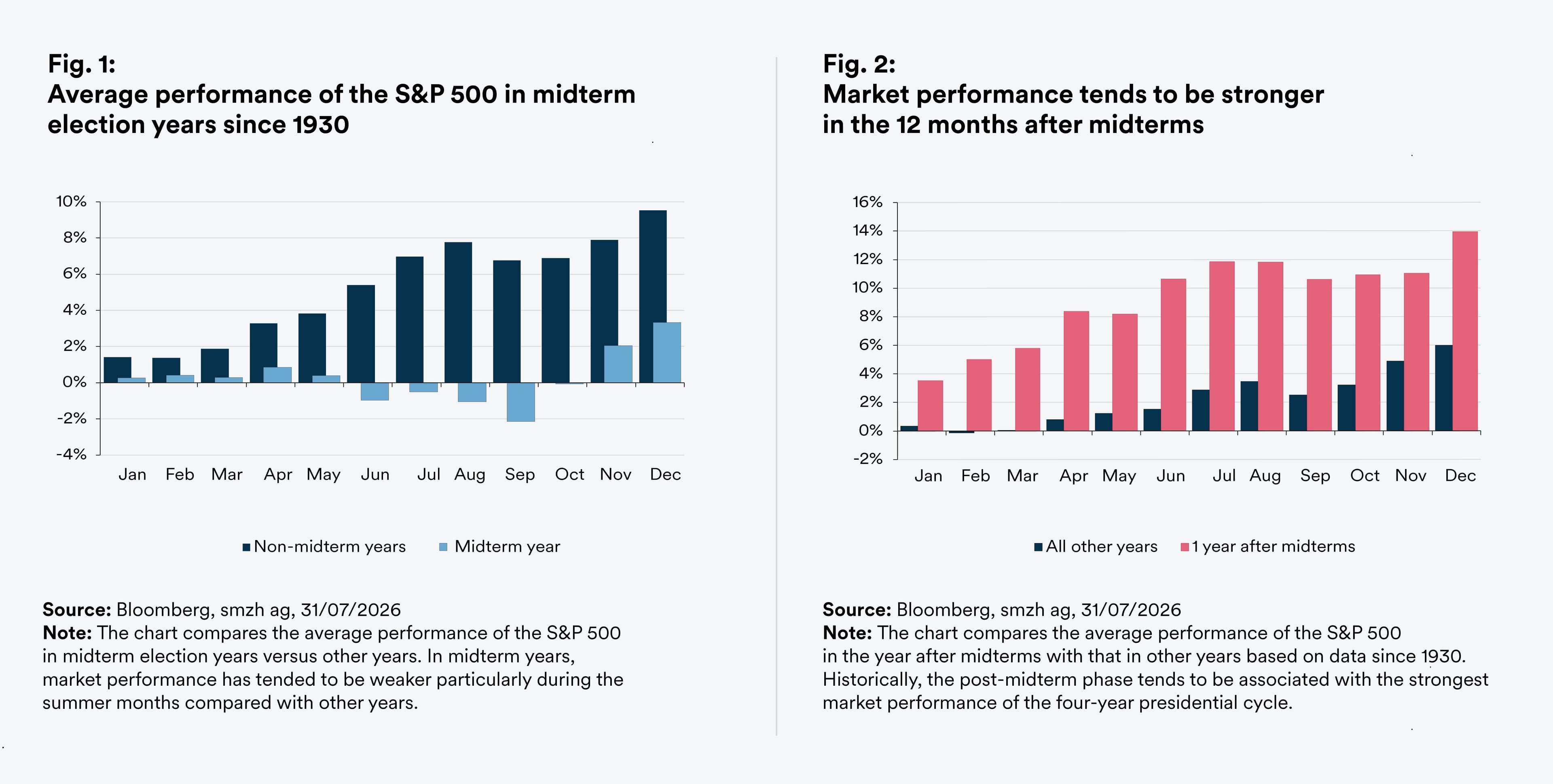
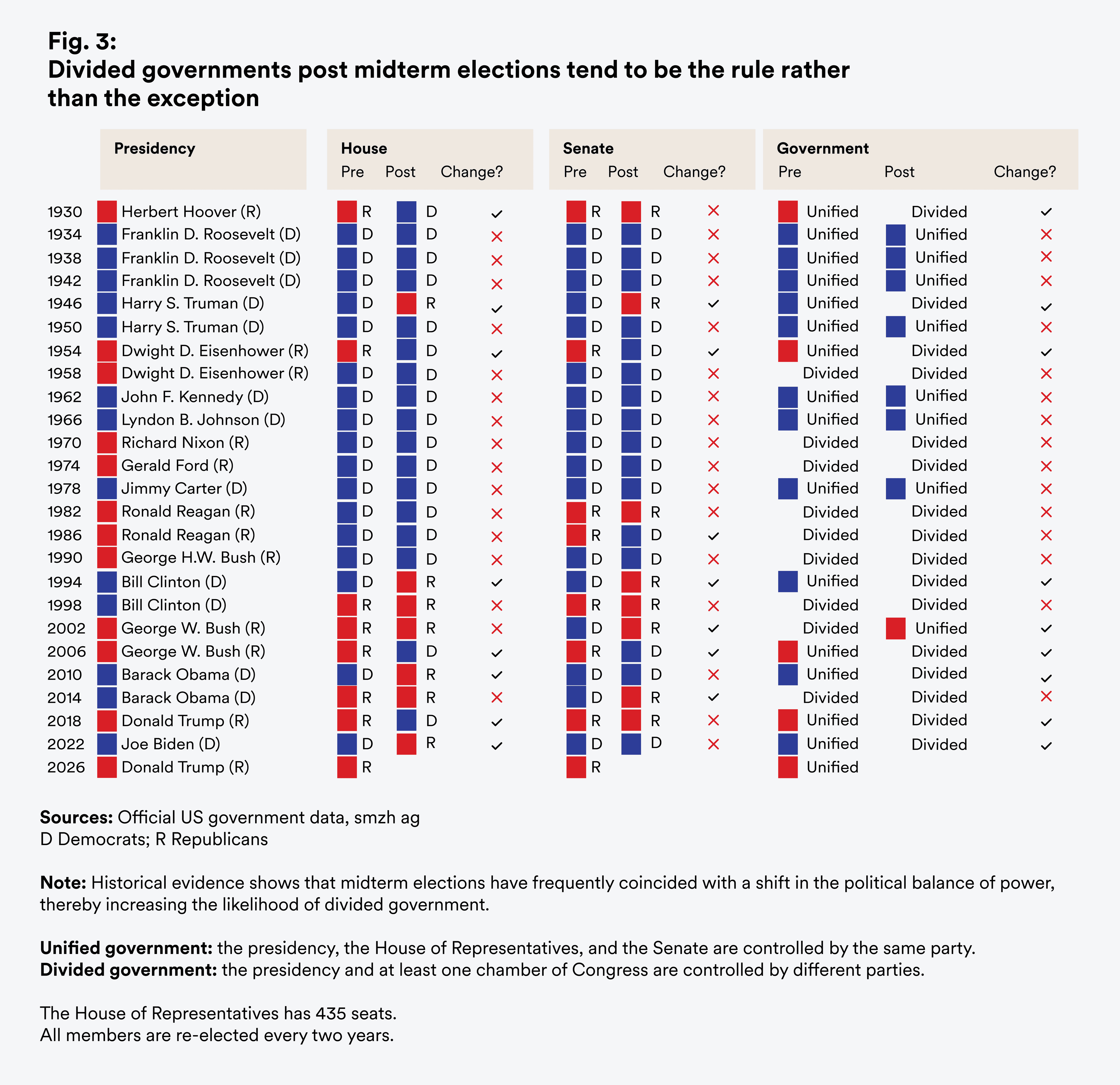
Abb. 1 & 2

One possible explanation lies in the trajectory of economic policy uncertainty, which tends to follow a comparatively stable pattern over the course of a presidential cycle. It is elevated in a president’s first year in office, rises further ahead of the midterms, and typically declines again after the election. It often bottoms out in the third year of a presidency before rising again ahead of the next presidential election.

Some observers therefore view the midterm effect less as a political phenomenon than as an expression of a political uncertainty cycle. As visibility into the economic policy environment improves, investor uncertainty tends to decline, allowing market attention to shift back toward fundamentals.

This does not mean, however, that the pattern repeats itself in every cycle or that it can serve as a reliable forecasting tool. The midterm effect should be understood as a historical pattern rather than a market law. The fact that uncertainty typically declines after the midterms is also due to the fact that the distribution of power in Congress often shifts, which is well-documented over the years.

Shifts in power are the rule rather than the exception

Since 1982, the political constellation following the midterms has been one of divided government every time except in 2002. This reflects the historical tendency for the sitting president’s party to lose some of its political support in Congress by the time the midterms are held.

The 2026 midterms could deliver this pattern as well. Republicans currently control the presidency and both chambers of Congress. This is only the fifth time since 1930 that such a constellation has existed. In all four comparable cases, the governing party subsequently lost control of at least one chamber of Congress.

Three scenarios currently appear most likely:

1. Republicans retain control of Congress.

2. Republicans retain the Senate but lose their majority in the House of Representatives.

3. Democrats take control of both chambers of Congress.

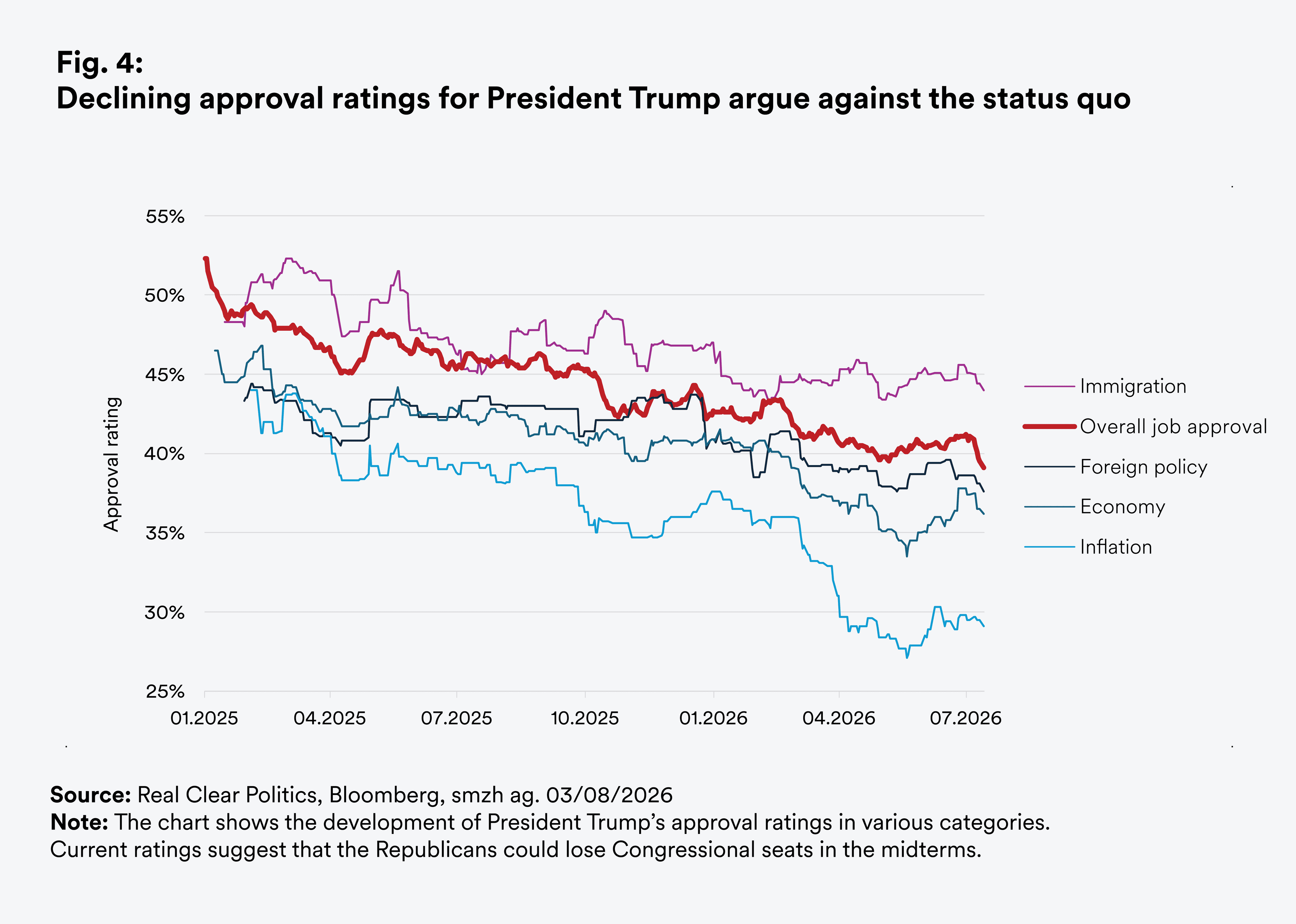
Current polls and political forecasts point primarily to the second scenario. President Trump’s approval ratings are also in a range historically associated with seat losses for the governing party.

Abb. 3
Abb. 4

Why shifts in power need not necessarily weigh on financial markets

Should this scenario play out, divided government would once again emerge after the midterms. This brings into focus the question of how much the balance of political power actually matters for financial market performance. Here, in particular, it is worth examining historical experience.

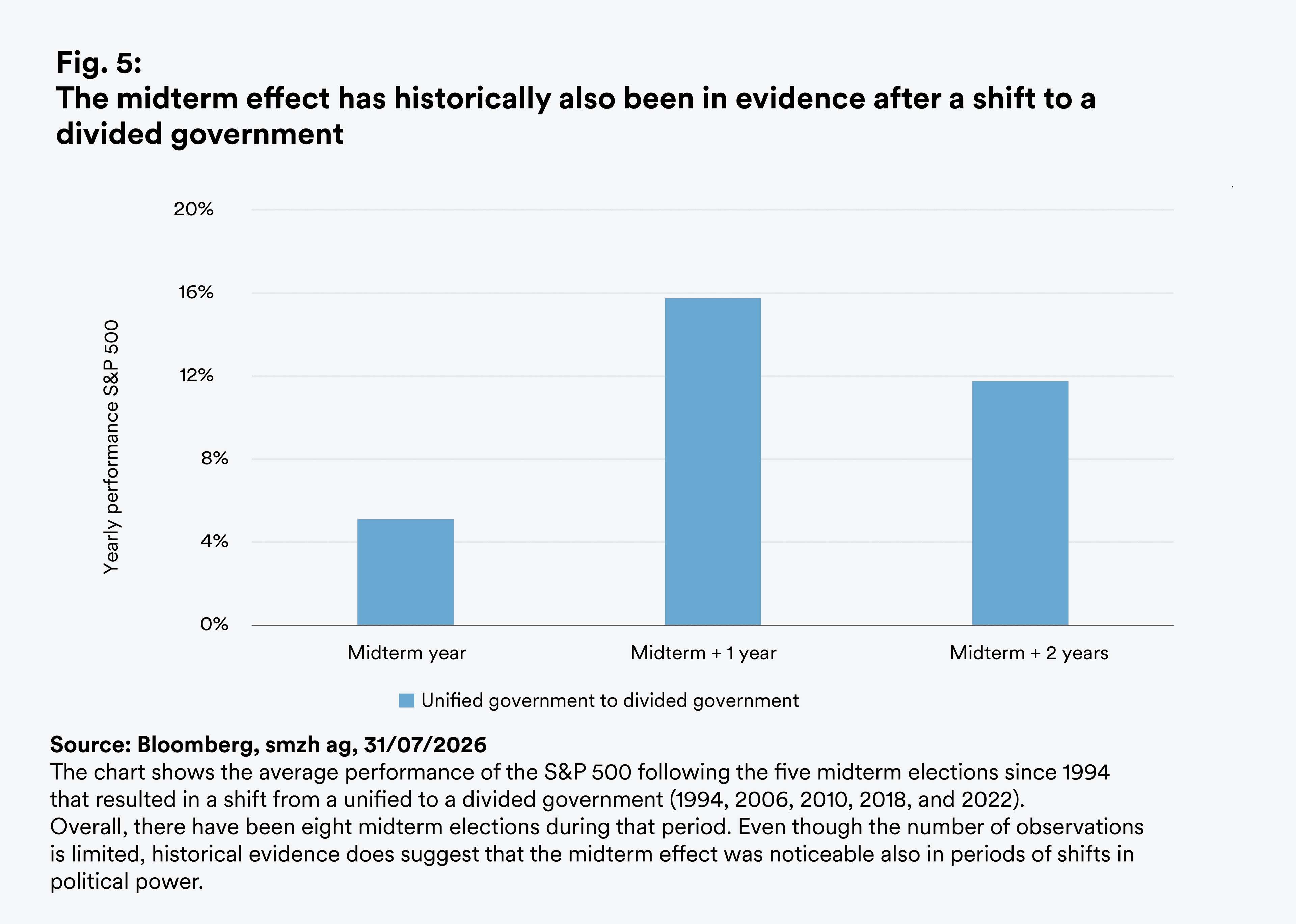
Historically, equity markets have often performed positively after midterm elections, even as the political balance of power changed on a regular basis. This illustrates that economic cycles do not necessarily move in lockstep with political election cycles.

One possible explanation is that political uncertainty declines once elections are over, which in turn improves visibility into the economic policy environment. At the same time, a split in the political majorities could limit the scope for sweeping political and regulatory change, narrowing the range of possible outcomes. This could explain why the midterm effect has historically held up even during periods when the balance of power in Washington shifted.

Yet it should be kept in mind that a government’s capacity to act does not depend solely on the balance of power in Congress. Even in the event of divided government, Donald Trump would remain president. Particularly in areas such as trade, tariff, and foreign policy, the executive branch continues to have considerable room for maneuver.

Abb. 5

What does this mean for investors?

For investors, this points to a nuanced assessment. In the short term, history suggests heightened uncertainty over the coming months. At the same time, the historical pattern indicates that such weakness tends to be temporary in nature. As political uncertainty recedes after the election, conditions for financial markets could improve again.

The macroeconomic environment remains decisive, however. Inflation, monetary policy, geopolitical developments, and, above all, corporate earnings remain the most important drivers and can override political cycles at any time. This is all the more true as consensus expectations for corporate earnings continue to trend higher and recent US inflation data point to a gradual easing of price pressure.

Since financial markets are currently pricing in one to two Federal Reserve rate hikes by the end of the first quarter of 2027, a further easing of inflationary pressure could cause these expectations to prove overdone. This would provide an additional boost to conditions for equity markets.

Regardless of the outcome of the midterms, then, one conclusion holds: political developments can influence markets in the short term, but over the long run, returns are determined primarily by fundamental economic conditions.

The midterm effect thus remains an interesting historical pattern, but not a law of nature. The history of midterm elections shows that phases of heightened uncertainty in financial markets are often accompanied by higher volatility and lower risk appetite among investors. What matters, though, is not so much which party ultimately holds the majority in Congress, but rather how quickly uncertainty recedes and investor attention shifts back to growth, inflation, interest rates, and corporate earnings.

Author:
smzh-image

Bekim Laski

Chief Investment Officer und Partner
Share on: