

smzh blue logo
Insurance

Switching Health Insurers for 2027: Deadlines, Process, and Pitfalls

Artikel
6 Mär 2026
smzh-image

Key Takeaways

  • Deadline: notice of cancellation must be received by 30 November 2026.
  • Basic insurance carries a guaranteed-acceptance requirement. Age, health status, and ongoing treatment play no role.
  • The benefits catalog is identical at every insurer. What differs is the premium, the service, and the rules of the model you choose.
  • In our comparison case, CHF 1'398 a year separates the cheapest and most expensive insurer — for identical coverage.
  • Outstanding invoices in reminder status can block a switch until they're paid.

Canceling Your Health Insurer: Deadline and Delivery

To switch effective 1 January 2027, your notice of cancellation must reach your current insurer no later than 30 November 2026. What counts is the date received, not the date sent: a postmark of 30 November isn't sufficient. Send it by registered mail or tracked mail, and build in a safety margin.

Two dates come before the cancellation deadline. The federal government is expected to publish the approved 2027 premiums at the end of September 2026. Your insurer must notify you of your personal premium by 31 October 2026 — only with that notice do you know the actual number that applies to you. Your right to cancel effective year-end is tied to that notification.

There's a second cancellation date: 30 June, with notice due by 31 March. It's only available, though, if you have the ordinary deductible and the standard model. Anyone on a cost-saving model or an optional higher deductible can only cancel effective year-end.

Must Every Insurer Accept Me?

Yes. Mandatory basic insurance carries a guaranteed-acceptance requirement: every insurer must accept every person subject to mandatory coverage within its service area. There's no health screening, no risk surcharge, and no waiting period.

This applies explicitly even during ongoing treatment, with a chronic condition, at an advanced age, and during pregnancy. An insurer may not reject an application for basic insurance, and it may not charge a higher price than it charges others for the same profile.

The guaranteed-acceptance requirement has a practical implication: An insurer may not ask health-related questions for basic insurance. If such a question appears on an application form, it relates to supplementary insurance. You don't have to answer it for basic insurance, and your acceptance can't depend on it.

Nor may the insurer charge a higher price than it charges others for the same profile. The premium is based on premium region, age group, deductible, model, and accident coverage — not your medical history.

Two limits apply here. First, the guaranteed-acceptance requirement does not apply to supplementary insurance. There, the company assesses the risk and can attach exclusions or reject the application outright. Second, if you're on a cost-saving model, check whether your ongoing treatment and your physician are compatible with that model's rules.

Is Switching Insurers Worth It?

The benefits catalog is legally identical at every insurer. So switching changes nothing about which medically necessary services you receive — it only changes what you pay for them.

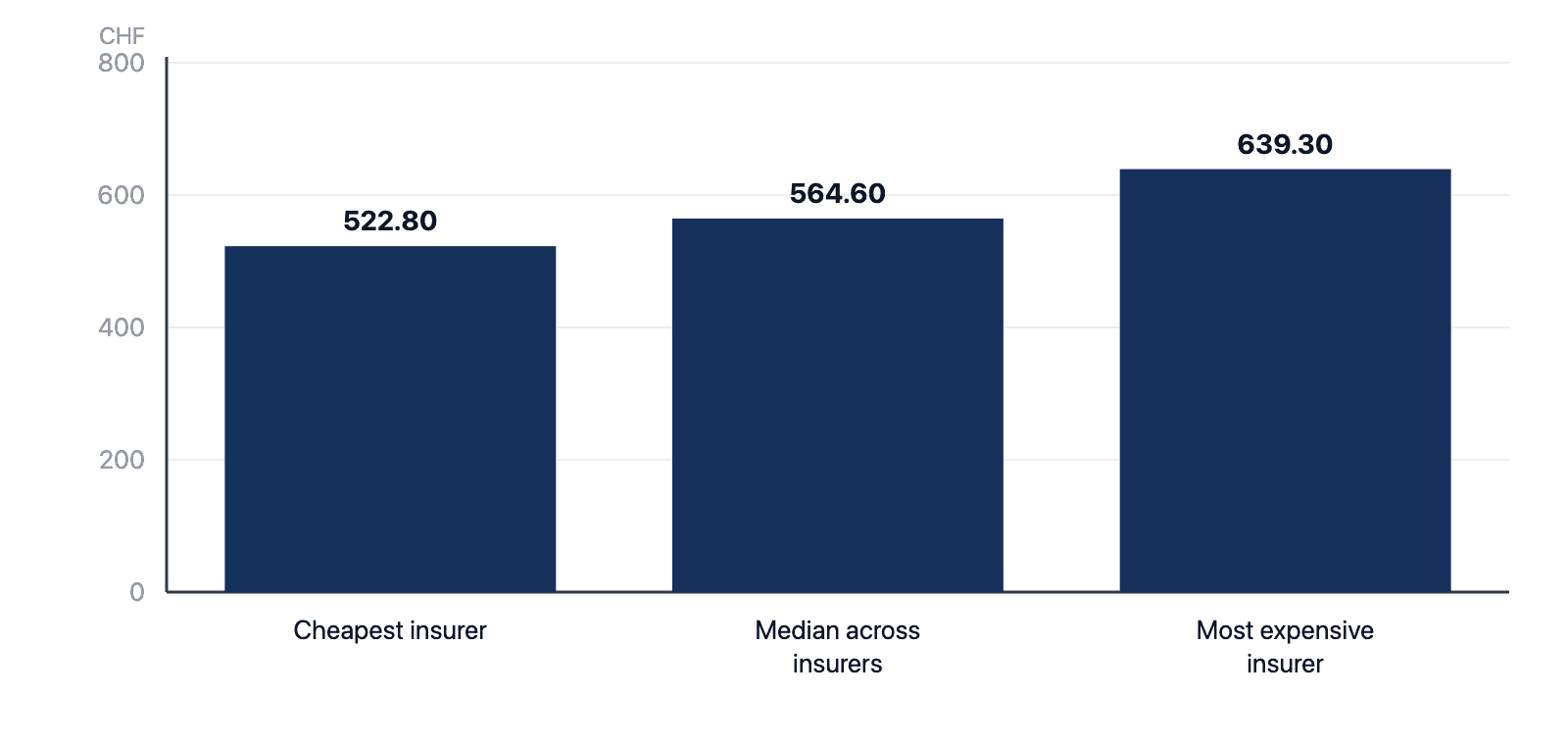
We calculated the size of that premium difference using the Federal Office of Public Health's 2026 premium dataset, comparing a configuration kept identical across every insurer: canton of Zurich, premium region 1, adults age 26 and older, family doctor model, CHF 300 deductible, with accident coverage.

Bar chart: monthly premium for the same configuration at 25 health insurers – cheapest insurer CHF 522.80, median CHF 564.60, most expensive insurer CHF 639.30.
Monthly premium for the same configuration, in Swiss francs

The cheapest of the 25 insurers analyzed charges CHF 522.80 a month, the most expensive CHF 639.30 — a difference of CHF 116.50 a month, or CHF 1'398 a year, for the same coverage. Even just moving from the median to the cheapest insurer still saves roughly CHF 502 a year.

These figures apply to one specific case, not to you personally. But they show the order of magnitude: the price for a legally identical benefit can vary substantially, and that variation is the real reason an annual comparison is worth doing.

Two tools can help, and both are free. The federal government's premium calculator shows the approved premiums of every insurer, anonymously and ad-free. And if your income falls within premium-subsidy range, that subsidy lowers your cost burden further without you having to change anything about your coverage. Eligibility and the application process are set by the cantons, and in some of them you'll need to submit an application.

If you'd rather not run the comparison yourself: smzh's comparison is free and non-binding, and it works through your own profile.

Switching Insurers: Step by Step

The process is short, but the order matters.

First, wait for your insurer's notice so you know your own premium. Then compare the same configuration across several insurers: same deductible, same model, same accident coverage — otherwise you're comparing two different products instead of two prices. After that, enroll with the new insurer, and only cancel your old policy once that enrollment has been submitted.

What belongs in the cancellation letter is easy to list: your name, your address, your policy number, and a clear statement that you're canceling basic insurance effective 31 December. State explicitly whether an existing supplementary policy should continue, otherwise the insurer may apply the cancellation to both.

Send the cancellation by registered mail or tracked mail so you can prove it was received. The switch only becomes effective once your new insurer has notified your current one that you're insured with them without any gap in coverage. Without that notification, you remain with your old insurer. When switching effective 1 January, you choose your deductible and model freely from the new insurer's offering.

What Can Prevent a Switch

Outstanding premiums or co-payment amounts in reminder status can block a switch until they're paid in full. Check well in advance whether you have anything outstanding with your current insurer. Second, it's easy to miss the deadline by tracking the date sent instead of the date received. And third, some people cancel first and look for a new insurer afterward. That approach leaves you with no certainty about continuous coverage — acceptance itself is guaranteed, but confirmation takes processing time, and that time works against the end-of-November deadline.

Supplementary insurance isn't one of these obstacles: basic and supplementary insurance can be held with different companies. Just don't cancel a supplementary policy until the new company has confirmed it in writing, free of unwanted exclusions.

What Changes When You Switch, and What Doesn't

What stays the same: your entitlement to benefits, your mandatory-coverage status, and any cost-sharing already incurred in the current year. If you switch mid-year, your new insurer credits the deductible and coinsurance you've already paid.

Your supplementary insurance also stays unchanged, unless you explicitly cancel it.

What can change: your premium, the service, the physician list, and the model's terms.

Compare before you cancel

Compare the same configuration across every insurer before you cancel – the ordinary deadline expires on 30 November.

Compare health insurers now

Special Cases That Fall Outside the Ordinary Deadlines

Not every switch needs to follow the calendar. Different rules apply in the five situations below.

Moving out of your insurer's service area. If you move out of the area your insurer serves, you gain the right to switch without waiting for the ordinary deadline. Separately, your premium is based on your new place of residence from the date you move. So a move changes your premium even if you stay with the same insurer and do nothing at all.

Moving to Switzerland from abroad. You must obtain insurance within three months of establishing residence. If you meet this deadline, coverage applies retroactively to the day you arrived.

Late enrollment. If you miss the three-month window, coverage begins only when you enroll, and you bear the cost of any care received before that yourself. If the delay is inexcusable, a premium surcharge of 30 to 50 percent applies, for twice the length of the delay.

Switching models without switching insurers. Since 1 January 2025, you can switch to a model with restricted choice with your current insurer at any point in the year. Switching back to the standard model, however, still follows the ordinary deadlines.

Common Misconceptions About Switching

Canceling isn't the same as switching. Canceling ends your old contract. But the switch only becomes effective once your new insurer has notified your old one that you're insured with them without any gap in coverage. Without that notification, you remain with your old insurer even if you canceled on time.

A postmark isn't the same as receipt. What counts is when the cancellation arrives at the insurer, not when you sent it.

Basic insurance isn't the same as supplementary insurance. The two are governed by different laws and different deadlines. Basic insurance carries a guaranteed-acceptance requirement; supplementary insurance doesn't. Anyone who cancels both at once risks losing supplementary coverage they can't get back.

Our take: the biggest mistake when switching isn't picking the wrong insurer — it's doing things in the wrong order. Follow the right sequence, and you have until the end of November, with the option to hold off on canceling at any point along the way.

Deadlines at a Glance

Key Dates for the 2027 Insurance Year

DateWhat to Do
End of September 2026The federal government publishes the approved 2027 premiums.
31 October 2026Your insurer must have notified you of your personal 2027 premium. Only then do you know your own starting point.
30 November 2026Your notice of cancellation must have arrived at your current insurer. What counts is the date received, not the postmark.
1 January 2027Your new basic insurance takes effect. From this date, your chosen deductible and model apply.
31 March 2027Second cancellation deadline, effective 30 June 2027, available only with the ordinary deductible and standard model.

Supplementary insurance under the Insurance Contract Act (VVG) follows its own contractual deadlines. Don't cancel it until your new coverage has been confirmed in writing.

Outstanding premiums or cost-sharing amounts that are in reminder status can block a switch until they're paid.

FAQ: Switching Health Insurers for 2027

By When Must the Cancellation Reach My Insurer?

No later than 30 November 2026 for a switch effective 1 January 2027. What counts is the date it's received by your current insurer, not the postmark.

Can I Switch Insurers Despite Being Ill?

Yes. Basic insurance carries a guaranteed-acceptance requirement: every insurer must accept you regardless of age, health status, or ongoing treatment. This does not apply to supplementary insurance, however.

Can I Switch Insurers During Pregnancy?

Yes. The guaranteed-acceptance requirement applies without restriction. Your insurer may not require a health screening or charge a risk surcharge. Maternity benefits are identical at every insurer, and specific maternity services are exempt from the deductible and coinsurance. This does not apply to supplementary insurance.

Do I Lose Benefits by Switching to a Cheaper Insurer?

No. The statutory mandatory-benefits catalog is identical at every insurer, and every benefit must be effective, appropriate, and cost-efficient. What differs is the premium, the service, and the rules of the insurance model you choose — not your entitlement to medically necessary treatment. A cheaper insurer therefore doesn't mean worse care, just a different price for the same benefit.

What Happens to My Deductible When I Switch?

When switching effective 1 January, you choose your deductible and model freely with the new insurer. If you switch mid-year, for example after moving, you keep your previous deductible, provided the new insurer offers it. It credits any deductible and coinsurance you've already paid.

Can I Switch Insurers Mid-Year?

Generally, no. An additional date, effective 30 June, is available only with the ordinary deductible and standard model, with notice due by 31 March. You also gain the right to switch if you move out of your insurer's service area. Anyone with an optional higher deductible or a cost-saving model can only cancel effective year-end.

Which Health Insurer Is the Cheapest in Switzerland?

There's no single cheapest insurer overall. Price depends on canton, premium region, age group, deductible, model, and accident coverage, and the ranking of insurers shifts with each of these factors. In our comparison case, CHF 1'398 a year separates the cheapest and most expensive insurer. What matters, therefore, is always the comparison run for your own specific profile.

Do I Have to Bring My Supplementary Insurance Along?

No. Basic and supplementary insurance can be held with different companies. Just don't cancel an existing supplementary policy until the new company has confirmed the coverage you want in writing, free of unwanted exclusions. Supplementary insurance carries no guaranteed-acceptance requirement.

Sources

Federal Act on Health Insurance (KVG), SR 832.10, in particular Articles 4, 7, and 64a: fedlex.admin.ch

Health Insurance Ordinance (KVV), SR 832.102, Articles 94 and 103

Federal Office of Public Health, premium calculator and approved premiums: priminfo.admin.ch

Federal Office of Public Health, Health Insurance Premiums Dataset 2026: opendata.swiss

This content is provided for general information only and does not constitute individual insurance, investment or legal advice.

Author:
smzh-image

Burak Er

Head Research & Advisory Solutions
Share on: