smzh blue logo
Investments
Finance
Mortgage

The SNB Stays at Zero Despite Robust Growth and Rising Inflation. For Now.

Artikel
24 Sep 2026
smzh-image

As widely expected, the SNB left its policy rate unchanged at 0% on September 24, 2026. While the ECB, the Fed, and the Bank of Japan have raised their policy rates in response to persistent inflation, the SNB sees no immediate need to act. Today’s decision is less a signal of a lasting commitment to expansionary monetary policy than a reflection of a comfortable starting position. The SNB has enough room to wait. That room, however, is likely to narrow in 2027.

Patience from a position of strength

Swiss consumer prices rose 0.8% year over year in August. Economic data also paint a constructive picture. GDP adjusted for major sporting events grew 1.5% quarter over quarter in the second quarter, following +0.5% in the first quarter. The industrial sector was particularly dynamic, with value added up 3.9%. The manufacturing purchasing managers’ index (PMI) rose from 53.2 to 57.1 in August, signaling a markedly stronger expansion in industry. The KOF Economic Barometer improved to 106.7, putting it above its long-term average. Consumer sentiment has also improved compared with a year ago but remains subdued at −33 points.
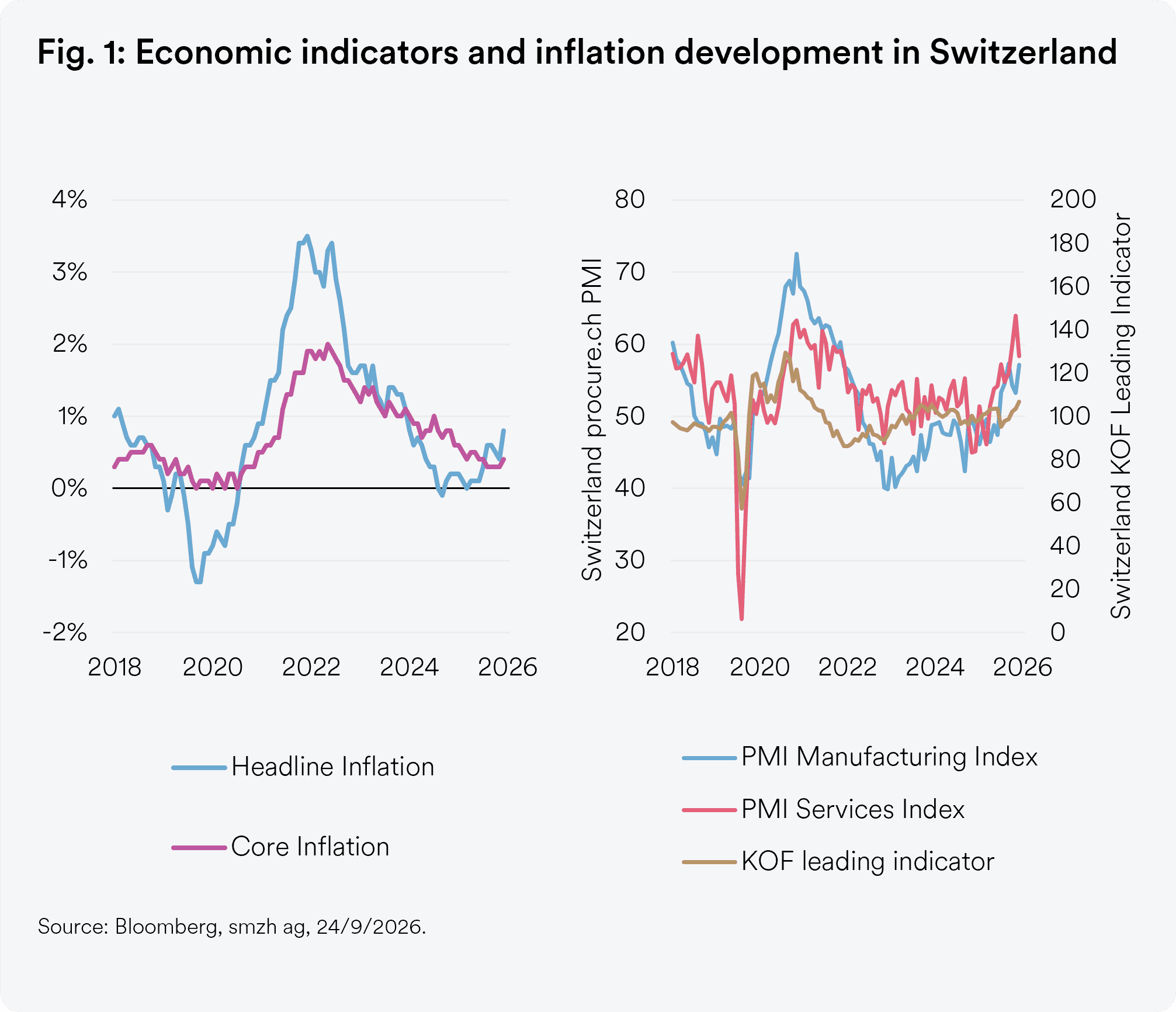
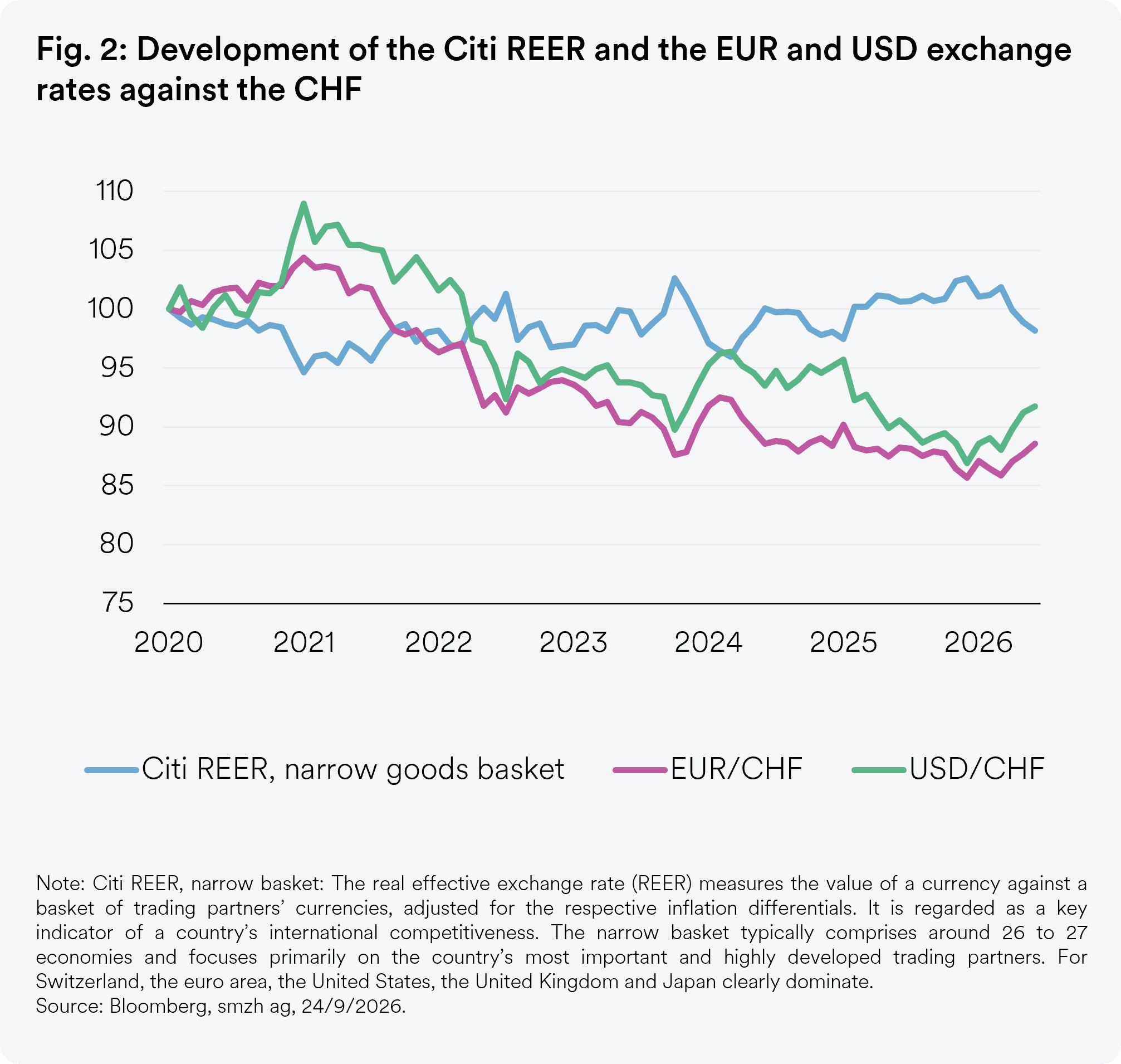
Fig. 1

Overall, the data point to a Swiss economy that is recovering but not yet overheating. Economic momentum is thus more robust than it was a few months ago. At the same time, inflation remains within the SNB’s defined price stability range of 0% to 2%. In its monetary policy assessment, the SNB continues to assume that, with a policy rate of 0%, inflation can remain within this range over the forecast horizon.

The result is a nuanced picture. Economic developments and the gradual rise in inflation point to less need for further monetary easing. However, they do not yet provide a compelling reason for an immediate rate hike.

Monetary policy is expansionary, but uneven

The zero-rate policy has kept financing conditions broadly accommodative. At the same time, its impact has not been equally strong across all areas. Banks’ funding costs have risen despite the low policy rate, driven by international market movements, domestic liquidity conditions, and structural changes in the banking system, including the disappearance of Credit Suisse. According to Bloomberg data, mortgage lending has grown by more than 3% since the end of the easing cycle in June 2025. Corporate lending grew at roughly half that pace over the same period. There are therefore no signs of credit-driven overheating.

The franc is working for the SNB

Alongside inflation and economic growth, the Swiss franc remains a key driver of the SNB’s monetary policy stance. The zero-rate policy, the SNB’s willingness to intervene in the foreign exchange market, and significantly higher interest rates abroad have helped weaken the franc against major currencies. The franc’s real effective exchange rate has fallen by around 4% so far in 2026, after rising by about 2.5% the previous year. Notably, the franc has weakened despite heightened global uncertainty, even though it is traditionally sought as a safe haven in uncertain times. This dampens imported deflationary pressure. The risk of appreciation has not gone away, however, especially as geopolitical uncertainty persists.

Fig. 2

The path to positive interest rates

The relevant question is no longer whether the SNB should have raised rates in September, but under what conditions it will normalize policy in 2027. Three factors appear decisive.

  1. Inflation: A temporary rise in energy prices alone does not justify a change of course. What matters more is whether inflation feeds through wages and services into lasting price pressure.
  2. Economic growth: What counts is not a single strong quarter, but a sustained expansion that increasingly feeds through to capacity utilization, wages, and prices.
  3. Franc: A renewed significant appreciation would reduce inflationary pressure and argue against a rate hike.

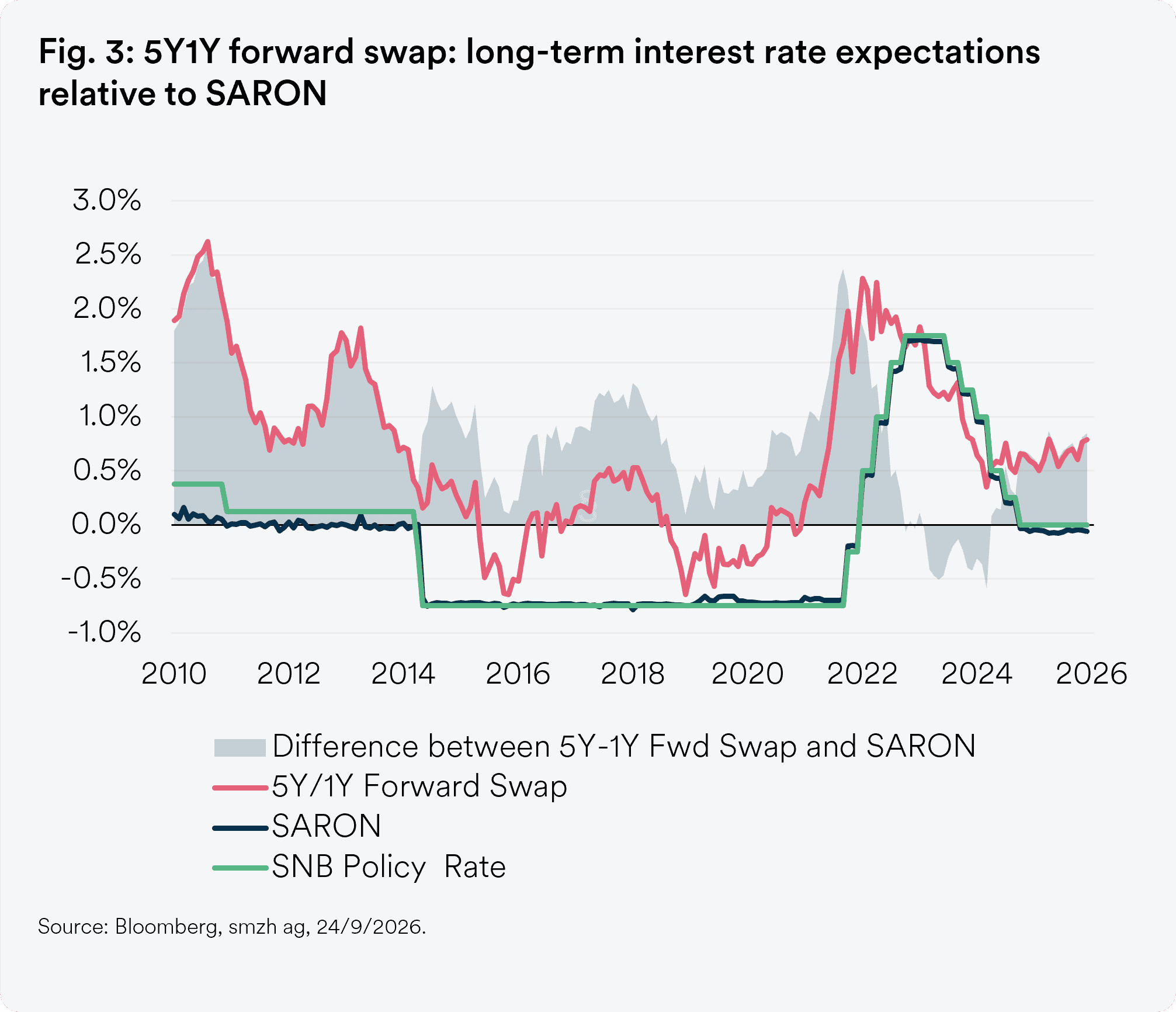
If robust growth and the gradual rise in inflation continue and the franc does not appreciate significantly again, a first rate hike to 0.25% could return to the monetary policy agenda. Forward markets, however, are pricing in considerably more. According to the OIS curve, around 1.5 rate hikes of 25 basis points each are priced in by the SNB’s monetary policy assessment in March 2027, and around 2.3 by June 2027. This corresponds to a policy rate of just under 0.6% by mid-2027. We broadly share the market’s view on direction, but not on pace. As long as inflation remains in the lower part of the price stability range and the SNB does not expect a sustained overshoot even with a policy rate of 0%, we consider such a rapid succession of rate hikes unlikely. The short end of the Swiss franc yield curve is therefore already pricing in more monetary normalization than we currently expect.

An initial hike to 0.25% would not necessarily mark the start of a pronounced tightening cycle, but would initially represent a return to moderately positive interest rates. Conversely, a prolonged hold at 0% remains plausible should the economy lose momentum or the franc appreciate significantly again.

Moderately positive interest rates can offer two long-term benefits. First, they give the central bank conventional room to respond to a future downturn with rate cuts, without immediately having to resort to negative rates or unconventional instruments. Second, positive rates tend to reduce the distortions that can arise when rates are very low or negative. These include incentives for an intensified search for yield, asset mispricing, and limited differentiation between credit risks. Financing costs and return requirements would once again be driven more by economic fundamentals and risk premiums. However, these effects do not occur automatically; they depend on the level and duration of interest rates as well as on the economic environment.

Fig. 3

What is the terminal rate?

The 5Y1Y forward swap represents the market’s expectation for the rate on a one-year CHF interest rate swap starting five years from today. It is often used as a proxy for the long-term expected, or “terminal,” Swiss interest rate. The spread between the 5Y1Y forward swap and the current SARON shows the extent to which the market is pricing in higher or lower future interest rates. For borrowers with a SARON mortgage, a positive spread means that switching to a fixed-rate mortgage already builds in a rate-increase component for the expected future rate level. However, the effective rate on a fixed-rate mortgage also depends on the term, the funding situation, and the margin of the respective lender.

No pressure, but a window of opportunity

The SNB is currently under pressure neither to ease nor to tighten. Inflation is within the price stability range, the economy is gaining momentum without overheating, and the weaker franc is providing relief for now.

It is precisely this comfortable position that makes normalization a realistic prospect for 2027. Unlike its foreign counterparts, the SNB would not have to respond to persistent inflation, but could move to moderately positive interest rates at a time of its own choosing. It is likely to proceed more gradually than markets currently expect.

After years in which Swiss monetary policy was repeatedly shaped by very low or negative interest rates, this would be less a tightening than a way of regaining room to maneuver.

Author:
smzh-image

Bekim Laski

Chief Investment Officer und Partner
Share on: