
smzh blue logo
Investments
Finance

What's In Store For Gold and Currencies

Artikel
6 Nov 2026
smzh-image

The gold price fell below USD 4,000 per ounce in October, more than 27% below its January high. At the same time, the franc recovered slightly. Our Chief Investment Officer explains what lies behind gold’s weakness and what role gold continues to play in a portfolio in the current Investment Guide November 2026.

Gold between rate pressure and central bank buying

The gold price came under renewed pressure in October and fell below USD 4,000 per ounce, more than 27% below its January high. High US nominal and real yields and a strong US dollar weigh on the non-yielding precious metal. Gold ETF flows remain volatile and react sensitively to interest rate and currency movements, while structural central bank demand remains intact, even though the pace of their purchases has been slowing.
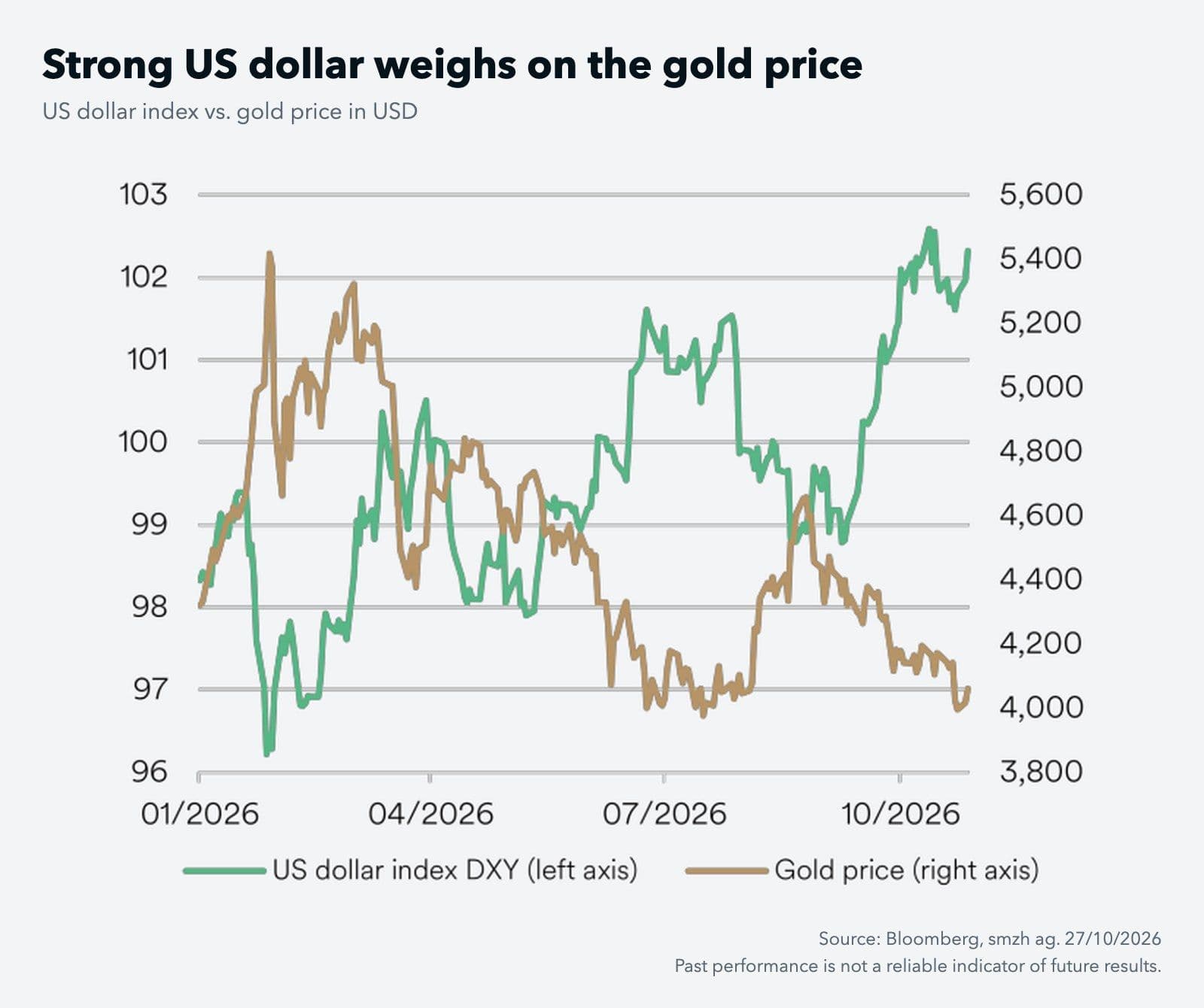
Line chart 2026: US dollar index DXY and gold price in USD – the dollar rises towards year-end, while the gold price has fallen significantly since its January high

The strategic role remains intact

The structural drivers of gold remain intact, however. Geopolitical uncertainty, high government deficits and the diversification of currency reserves support central bank demand. At the same time, investors should bear in mind that gold is not a perfect hedge against inflation. When inflation rises, central banks often respond with higher interest rates, which increases the opportunity cost of the non-yielding precious metal and can put pressure on the gold price. Historically, the direct relationship between inflation and gold has therefore been less pronounced than is often assumed. Since the outbreak of the Iran war, gold has at times moved sharply in the opposite direction to oil. Monetary policy will remain a key driver in the coming months. A persistently high level of interest rates and a strong US dollar limit the short-term upside. In the longer term, however, gold remains relevant as a reserve and diversification asset, particularly in view of fiscal risks and geopolitical uncertainty.

Search for safe havens supports the franc

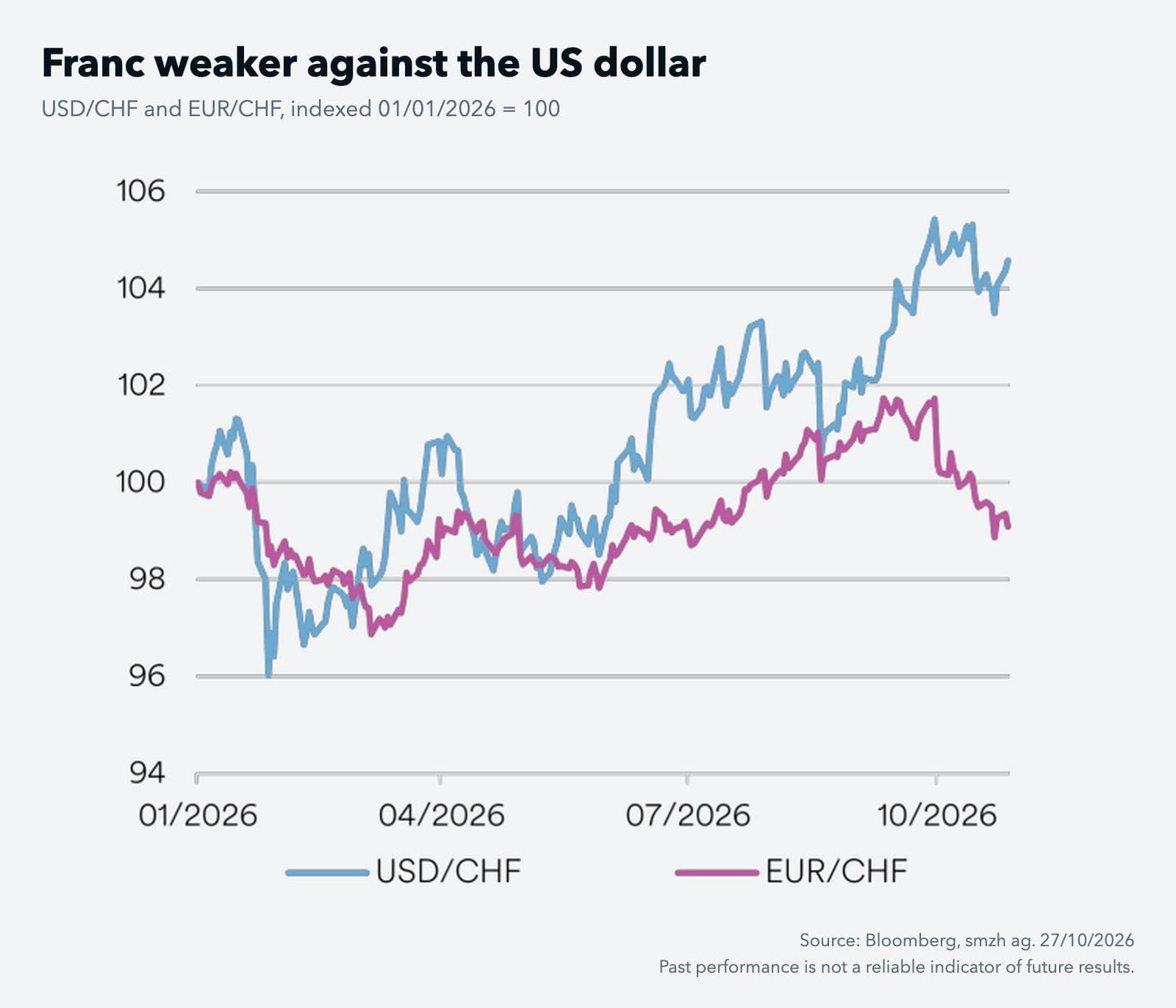
After depreciating significantly over the summer, the Swiss franc recovered slightly in October, gaining around 2% against the euro and around 1% against the USD since the end of September. Growing uncertainty in bond markets, geopolitical tensions and concerns about French public finances have increased demand for safe havens and thus supported the franc. Since the start of the year, however, the CHF is still more than 4% lower versus the USD.

Line chart 2026: USD/CHF and EUR/CHF, indexed to 100 on 1 January 2026 – the US dollar has gained against the franc, the euro is slightly below its level at the start of the year

USD/CHF: further tailwind in the short term

The USD has recently benefited from robust US economic data, higher Treasury yields and a repricing of expectations for the Fed. At the same time, market positioning is increasingly geared toward further dollar appreciation, which makes further gains harder to achieve. France’s fiscal problems are weighing on the euro, although a viable agreement on the French budget could restore confidence in the single currency.

CHF remains an important funding currency

Due to the low interest rate environment in Switzerland, the franc remains an important funding currency for carry trades, a role that has so far been played mainly by the Japanese yen. Against the US dollar, the franc is therefore likely to remain under pressure, while opposing forces are at work in EUR/CHF, so the exchange rate is likely to continue to move within a range.

This article is taken from the smzh Investment Guide November 2026 (editorial deadline: 28 October 2026). You can download the full guide as a PDF.

Author:
smzh-image

Bekim Laski

Chief Investment Officer und Partner
Share on: