

smzh blue logo
Investments
Finance

Outlook Swiss Franc, Dollar and Gold

Artikel
5 Okt 2026
smzh-image

In brief

  • US dollar strength and higher US interest rate expectations weigh on the Swiss franc short-term.
  • The franc’s structural strength remains intact, supported by robust fundamentals and its enduring safe-haven characteristics.
  • Despite elevated volatility, gold remains an attractive diversification instrument within portfolios.

Monetary policy divergence as a key driver

Foreign exchange markets were characterized by a stronger US dollar in September. Rising US yields and expectations of continued restrictive monetary policy by the Federal Reserve increased the appeal of dollar-denominated assets. The Swiss franc also weakened against the US dollar, though less mark-edly than many other major currencies. The franc also depre-ciated against the euro, continuing the weakening trend ob-served since spring.

USD/CHF: path of least resistance points up

While the SNB is keeping its policy rate at 0% and no clear path toward monetary policy tightening is evident in the near term, the Fed and ECB are pursuing more restrictive policy stances. Fair value estimates suggest that the Swiss franc is no longer significantly overvalued against the euro and the US dollar. At the same time, the franc is increasingly being used as a funding currency for carry trades, a role traditionally associated primarily with the Japanese yen.

EUR/CHF: opposing forces

The USD/CHF exchange rate is biased toward the upside. For EUR/CHF, opposing forces are at play: political risks and weak growth weigh on the euro, while the low interest rate environment weighs on the CHF. Overall, EUR/CHF is likely to trade within a range in the short term, without a clear direc-tional trend emerging.
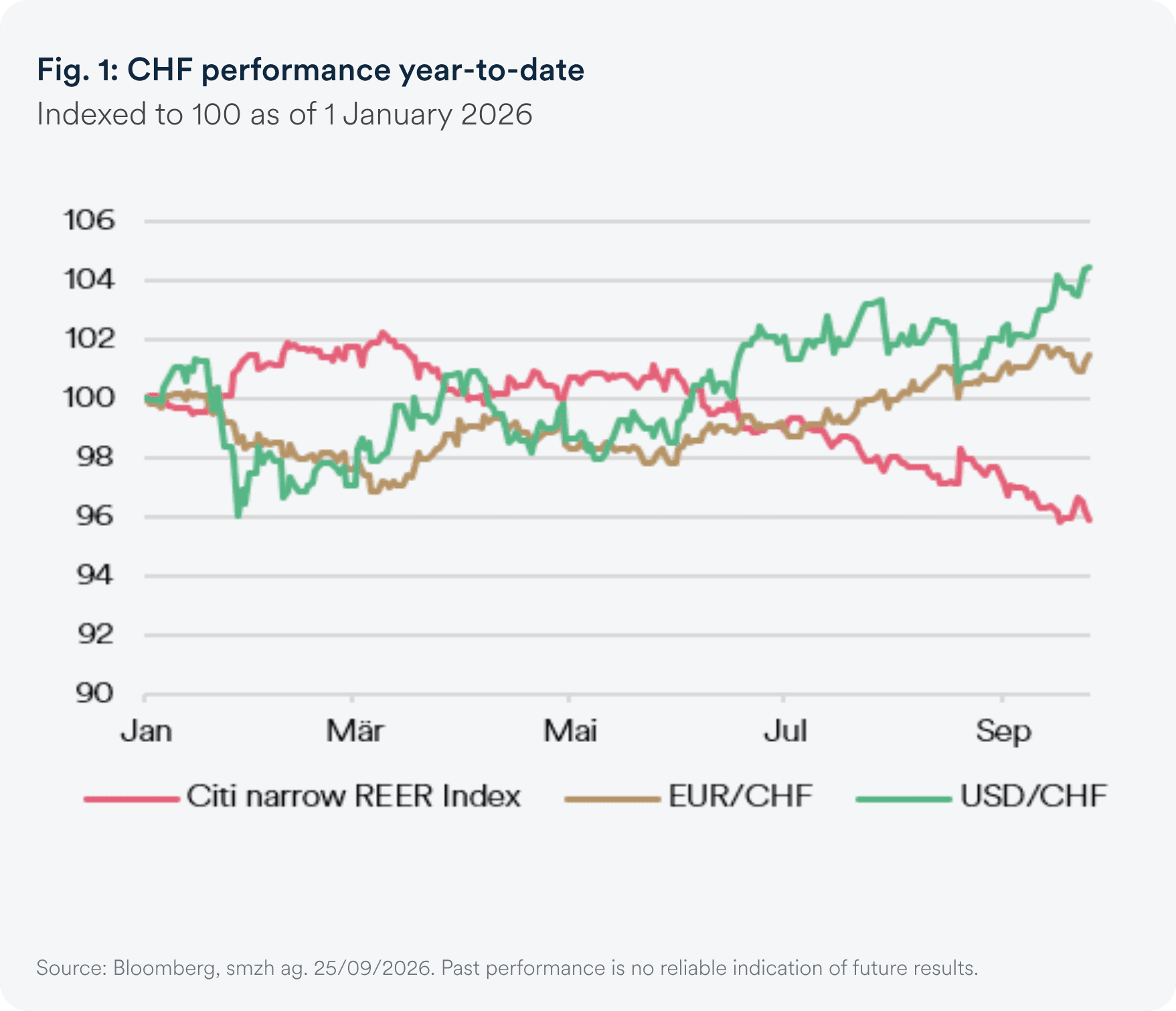
Line chart: Swiss franc since 1 January 2026, indexed to 100 – USD/CHF and EUR/CHF rise, while the franc's real effective exchange rate (Citi narrow REER index) falls to around 96
REER: real effective exchange rate, adjusted for inflation differentials; narrow basket of 27 economies. Past performance is no reliable indication of future results.

Gold has lost some of its luster, but not its relevance

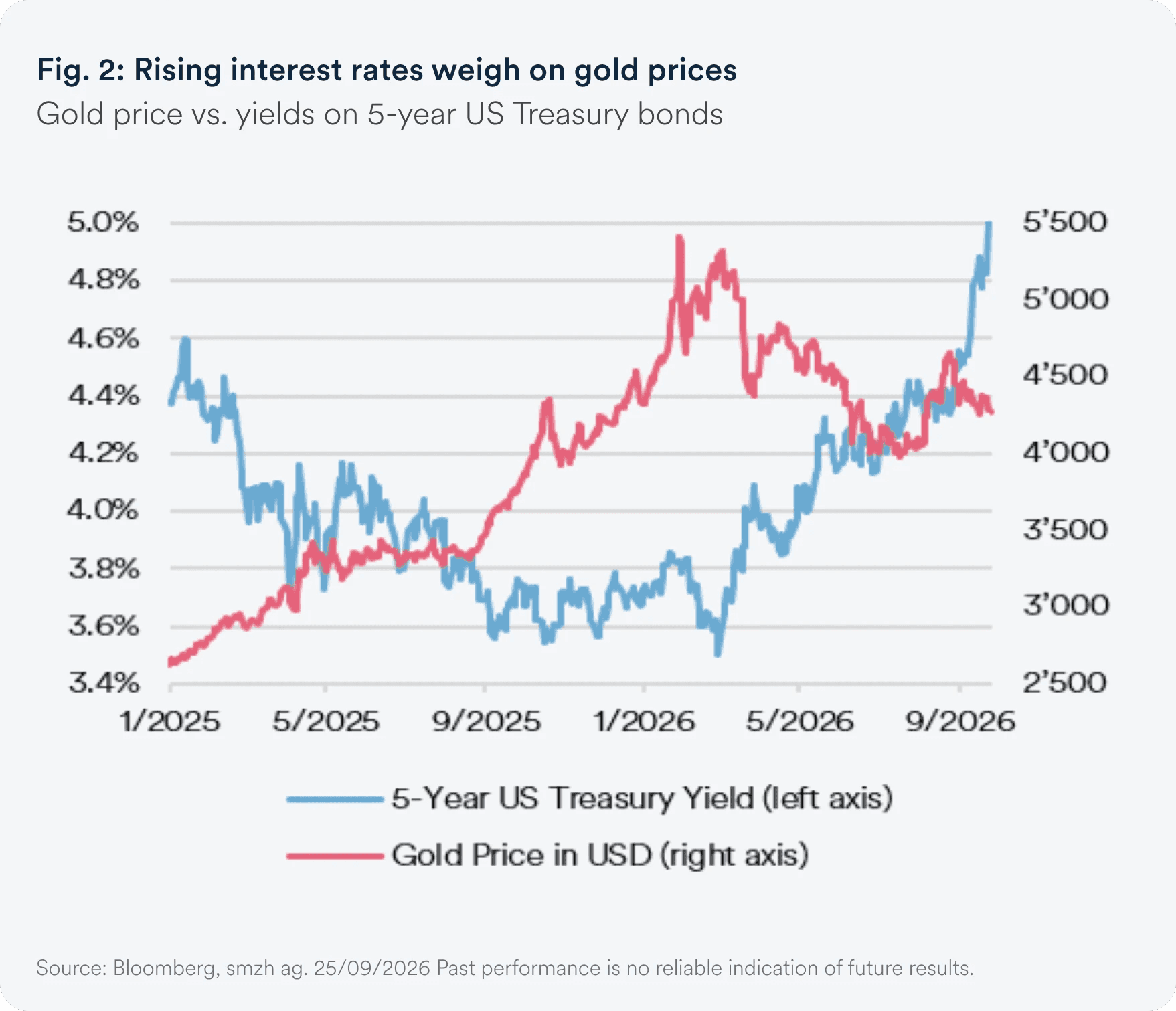
After partially recovering in August from its weak performance earlier in the year, gold came under renewed pressure in Sep-tember. Higher US real yields, a stronger US dollar and the Federal Reserve’s more restrictive stance, including its rate hike in September, weighed on gold prices.

Line chart: gold price in USD and 5-year US Treasury yield from January 2025 to September 2026 – yields rising most recently while the gold price eases

Structural drivers remain intact

The structural factors supporting gold remain broadly intact. Central banks continue to be net buyers, albeit with somewhat lower momentum in some cases. In addition, gold ETFs rec-orded renewed inflows in July and August following outflows in May and June, according to Bloomberg. Geopolitical uncer-tainty, concerns surrounding US fiscal policy and the diversifi-cation of foreign exchange reserves continue to support stra-tegic demand.

Gold in a portfolio context: reserve and diversification asset

Monetary policy will remain a key influence in the coming months. Persistently high interest rates and a strong US dollar limit gold’s short-term upside potential. Over the longer term, however, gold remains relevant as a reserve and diversification asset, particularly amid fiscal risks and geopolitical uncertain-ty. At the same time, investors should recognize that gold can also experience significant drawdowns in periods of market stress. Nevertheless, gold’s role in portfolios remains in focus – and rightly so – given the current market environment.

This article was first published as part of the Investment Guide October 2026 (editorial deadline: September 25, 2026). You can download the complete Guide covering all asset classes as a PDF.

Author:
smzh-image

Bekim Laski

Chief Investment Officer und Partner
Share on: