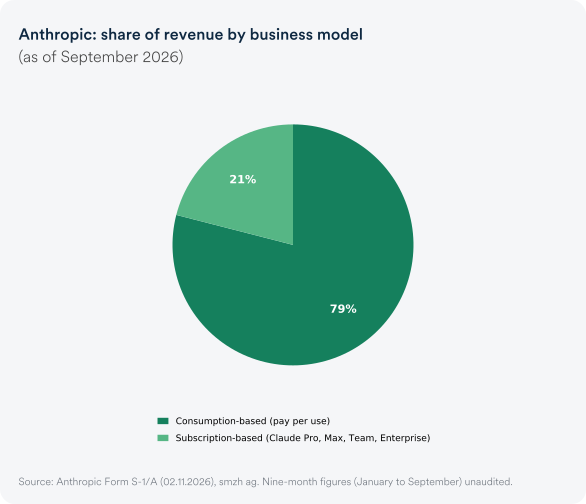
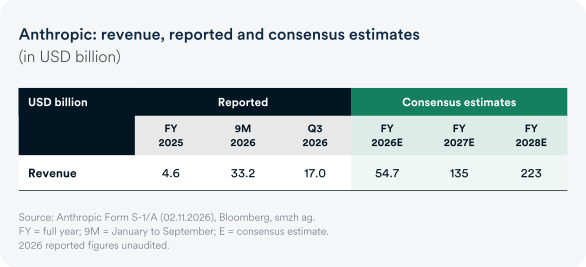
The reported net loss of USD 104 bn for the first nine months of 2026 needs to be put into context: USD 94.3 bn of it is a non-cash accounting charge, mainly linked to the revaluation of convertible notes as the company’s valuation rose. The operating loss was USD 1.3 billion. On an adjusted basis, the company was already profitable, with a 12% operating margin.
How does Anthropic compare with its competitors?
Anthropic names Google and OpenAI as its main competitors, both of which have considerable resources. Further competition comes from large technology companies and increasingly capable open-source models. Anthropic stands out for its focus on businesses and developers and its reputation for reliability and safety. Notably, Amazon and Google are investors, suppliers and sales channels for Anthropic at the same time, which can create conflicts of interest.
How can Anthropic be valued?
According to latest media news, the proposed price range for its shares could be between USD 70 and 78, valuing Anthropic at around USD 1,000 bn on an undiluted basis. Including dilution, primarily from a large pool of unvested and other employee equity awards, the fully diluted midpoint valuation would be approximately USD 1,300 bn, implying approximately 37x trailing-twelve-month revenue of USD 35.4bn (fourth quarter 2025 revenue plus nine-month revenue so far in 2026). The latest indicated valuation in various media of approximately USD 1,400-1,500 bn would imply approximately 40-42x trailing-twelve-month revenue. Analysts, however, typically use the most recent quarter annualized for hypergrowth companies because trailing-twelve-month revenue understates the current revenue run rate when a business is growing fast. In Anthropic's case, Q3 2026 revenue of USD 17 bn annualizes to USD 68 bn. Under this assumption, a market capitalization of USD 1,500 bn would imply approximately 22x annualized Q3 2026 revenue of USD 68 bn.
How should the governance structure be assessed?
Anthropic is a Public Benefit Corporation. As a result, its board must balance shareholder returns with its mission. Control lies with an independent trust that elects most of the board and with the co-founders, who will hold a majority of the voting rights following the IPO. As a result, public investors will have very little influence over the company, a structure designed to protect its long-term mission but one that significantly limits shareholder rights.
What role will Anthropic play in stock indices?
Under Nasdaq's new 'Fast Entry' rule, Anthropic could join the Nasdaq-100 as soon as 15 trading days after its listing, though inclusion is a possibility, not a certainty. Its weight in the index would initially be limited by its small free float: with a capital raise of approximately USD 100bn against a valuation of up to USD 1'500bn, only around 6-7% of the company would be freely tradeable at first, rising over time as lock-up periods expire. Such a small supply of shares for a company of this size could leave demand far exceeding what is on offer, with potentially sharp price swings in the early days of trading.
Inclusion in the S&P 500 is less likely in the near term, as it requires four consecutive quarters of positive GAAP earnings, a criterion Anthropic does not currently meet, having reported a GAAP net loss of USD 104 billion for the nine months ended in September 2026, predominantly driven by non-cash stock-based compensation charges.
What are the biggest risks facing Anthropic’s shareholders?
The biggest financial risk lies in Anthropic’s computing commitments of several hundred billion dollars, which are largely fixed, while its revenue depends mostly on customer usage and could weaken if demand slows. Other key risks include intense competition, reliance on a few chip suppliers and on partners that are also competitors, potential misuse or unexpected behavior of its AI models, and regulatory or political pressure. As the first major AI lab to list, Anthropic is also likely to become a bellwether for AI in public markets, making its share price particularly sensitive to both positive and negative news about the sector.
What is the importance of the IPO in today's market environment?
Anthropic would be the first standalone leading frontier AI lab to go public, giving investors regular insight into how AI is developing and being adopted across the economy. Just months after SpaceX’s record USD 75 billion IPO, the listing will test the market’s risk appetite and likely influence valuations across the AI sector.
How can Swiss investors participate in the IPO?
The prospectus includes a public offering in Switzerland, although shares will only be listed on Nasdaq. As IPO allocations typically favor institutional investors, Swiss investors should check access with their bank early; otherwise, regular trading in US dollars after the listing will be the main practical avenue for retail investors.
Can you invest before the IPO?
Pre-IPO investment in Anthropic is highly restricted, as the company tightly controls private share transfers. Some funds or synthetic products may offer indirect exposure, but these can involve high fees, limited liquidity and valuation uncertainty. For most private investors, buying shares after the Nasdaq listing will be the more accessible option.
What should investors pay attention to?
For investors, Anthropic's business results can be assessed against six key indicators:
1. Revenue Growth and Customer Demand
Revenue growth remains the primary indicator of commercial momentum. Quarter-on-quarter revenue grew 47% in Q3 2026, down from 144% in Q2. Investors should monitor whether growth stabilizes or continues to decelerate. Equally important is net revenue retention (NRR), reported at approximately 900%. NRR measures how much revenue a company generates from its existing customers compared with the previous year, including additional spending and contract expansions. An NRR of 900% means that existing customers collectively spend nine times more than they did a year earlier, indicating exceptionally strong customer expansion. While such levels would be too ambitious to sustain indefinitely, a continued decline in NRR or slower growth among high-value customers could signal weakening demand.
2. Revenue Quality and Profitability
Investors should distinguish between reported GAAP revenue and annualized run-rate revenue. The latter reflects the annualization of recent revenue activity and should not be confused with realized revenue. Profitability also warrants close attention: GAAP gross margin declined in Q3. The difference largely reflects revenue-sharing payments to cloud providers. The key question is whether improving computing efficiency can translate into sustainable margin expansion.
3. Capital Requirements and Funding
Anthropic's AI infrastructure requires substantial investment. Estimated compute commitments total approximately USD 900 billion, of which around USD 450 billion is expected through 2030. Investors should monitor additional funding requirements, the use of existing partner financing and the risk of further equity issuance, which could dilute existing shareholders.
4. Competitive Positioning and Model Leadership
Anthropic's valuation depends partly on maintaining its technological advantage. Although Claude currently ranks among the leading AI models, benchmark leadership can change quickly and varies across applications. Investors should assess performance across multiple benchmarks, commercial adoption and the ability to maintain pricing power as competing models, including open-weight alternatives, improve.
5. Shareholder Structure and Market Supply
The initial public float is relatively small, with IPO buyers holding approximately 6-7% of the company at listing. Upcoming lock-up expirations, particularly the larger expected supply event in Q4 2027, could increase selling pressure and share price volatility.
6. Regulatory and AI Safety Risks
Anthropic's IPO filing explicitly highlights potential risks associated with advanced AI, including unexpected capabilities and the possibility of models evading safety evaluations or resisting shutdown. Regulatory restrictions concerning model releases, data usage and AI liability could also affect product development, commercial adoption and long-term growth.
In summary, investors should focus on four fundamental questions at each reporting cycle: Is revenue growth sustainable? Are margins improving? Can the company finance its infrastructure commitments without excessive dilution? And can Anthropic maintain its competitive advantage while managing governance, regulatory and technological risks?