Politics as the Trigger, Valuations as the Amplifier
The Democrats’ electoral success and their takeover of both chambers of Congress fueled concerns that stricter regulation, local permitting processes, and policy requirements could slow the build-out of AI data centers. The high energy and water consumption of these facilities, in particular, is drawing growing criticism.
At the same time, company-specific disappointments in the semiconductor sector weighed further on sentiment. On top of this came renewed doubts about the profitability of massive AI investments. The debate over so-called circular AI investments (the mutual financing and investment dependencies within the AI ecosystem) and the growing concentration of equity indices in a handful of tech stocks are not new. In some market segments, however, so much future growth is now priced in that there is very little room for disappointment.
Political Uncertainty Does Not Mean the End of the AI Investment Cycle
The key is to distinguish between the long-term growth potential of artificial intelligence and the question of which companies can actually build sustainably profitable business models from it.
Demand for AI and computing power remains structurally strong. Nor does the Democrats’ electoral success automatically spell the end of the US AI infrastructure boom. Stricter permitting, local opposition, and policy requirements could delay individual projects or make them more expensive. But the investment cycle is unlikely to come to an abrupt halt as a result.
Rather, the market is beginning to scrutinize the economics of this growth more critically: How large are the required investments? Who is financing them? And when will they generate an adequate return? Not all companies will benefit equally. Capital-intensive infrastructure companies in particular face greater pressure to justify their spending than established platform providers with strong cash flows. That said, these platform providers are also investing substantial sums in expanding their AI infrastructure. What will matter, therefore, is how efficiently the invested capital is deployed and what returns it generates. The current correction can thus also be seen as a reset of inflated expectations.
International Market Breadth Remains Constructive
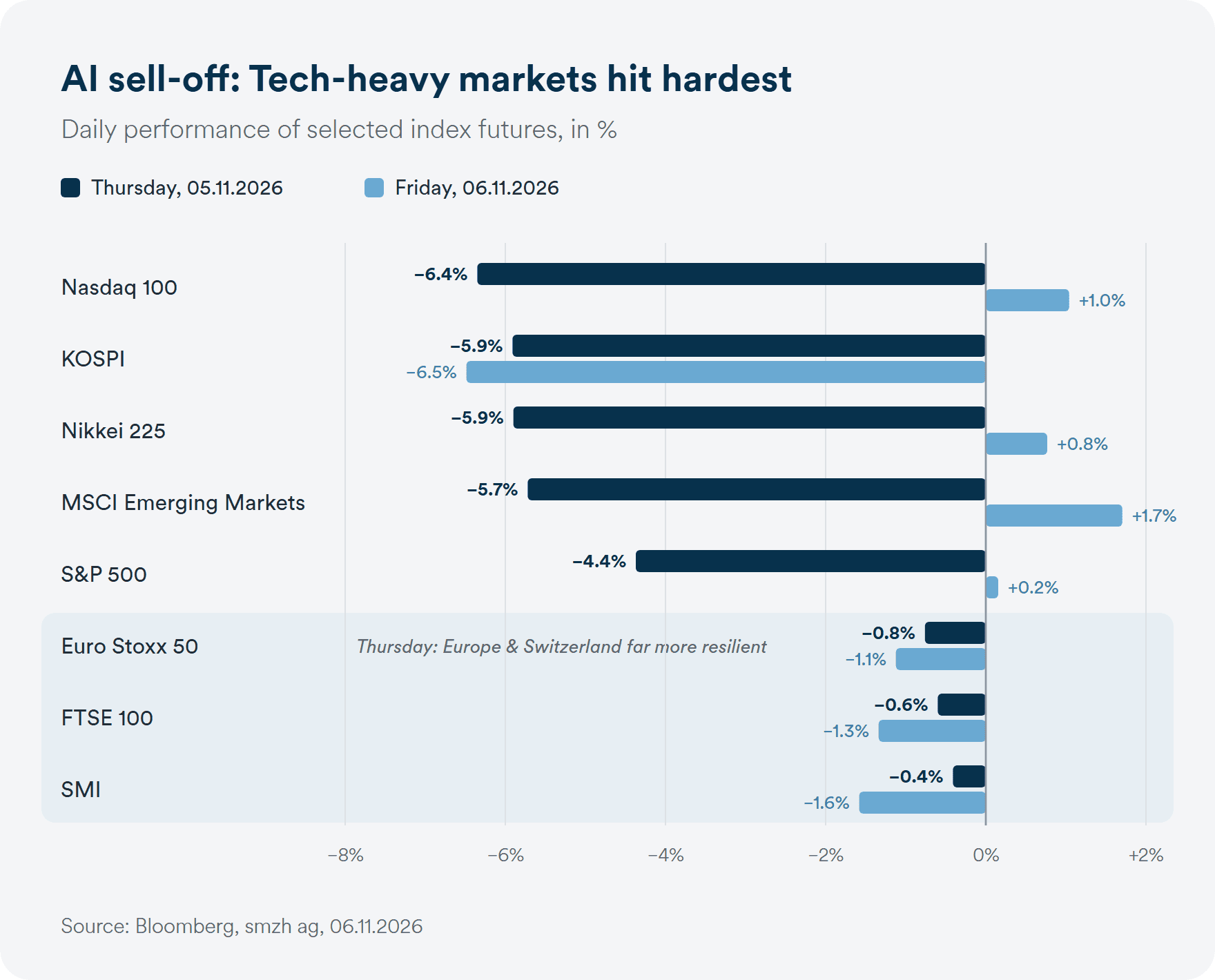
One reason for continued confidence is that the losses varied considerably across regions. The S&P 500 fell 4.4% and the even more tech-heavy Nasdaq-100 dropped 6.5%, with emerging market equities also losing nearly 6%. The MSCI Emerging Markets Index is now also heavily shaped by the AI value chain, particularly through Asian semiconductor and technology companies. This shows that AI exposure has long since extended beyond the US tech sector.
Equity markets in Europe and Switzerland, as well as more defensive sectors, proved significantly more resilient, even though they were unable to fully escape the selling pressure. The relative stability of European markets and more defensive segments is a constructive signal, even if it does not yet mean the all-clear.
At the same time, a structural risk is coming into view: a geographically broad equity allocation does not automatically mean adequate diversification. Both global equity indices and the major US indices are now heavily concentrated in a small number of technology companies. As a result, dependence on relatively few companies and investment themes remains high.
Diversification Across Risk and Return Drivers Remains Key
For investors, one thing matters most right now: no overreaction, but no complacency either. Economic fundamentals remain robust overall. The US economy and labor market continue to show resilience. In addition, the new balance of power in Washington could strengthen institutional checks and reduce certain political risks. At the same time, there is a risk of greater political gridlock, which could increase uncertainty in some policy areas.
The recent sell-off does not change the long-term significance of artificial intelligence. It is, however, a reminder that even the most compelling structural growth trends are no guarantee of attractive returns. Broad diversification across countries, sectors, and asset classes therefore remains essential. Not every setback marks a break in the trend. But every setback is a reminder of why diversification matters.
In addition to more diversified exposure to the US market, we continue to see Eurozone markets and Swiss dividend stocks as attractive. The latter offer defensive qualities and stable cash flows and, in our view, should remain the preferred choice within the Swiss equity market.
For a more detailed assessment of our current capital market and investment outlook, see our Investment Guide November 2026.