smzh blue logo
Investments
Finance

Equity Markets in November

Artikel
2 Nov 2026
smzh-image

October brought marked swings to equity markets. At the same time, the debate is growing over whether the high earnings expectations around artificial intelligence can be met. Read how our Chief Investment Officer assesses the situation in the current Investment Guide November 2026.

Equity markets remain robust despite volatility

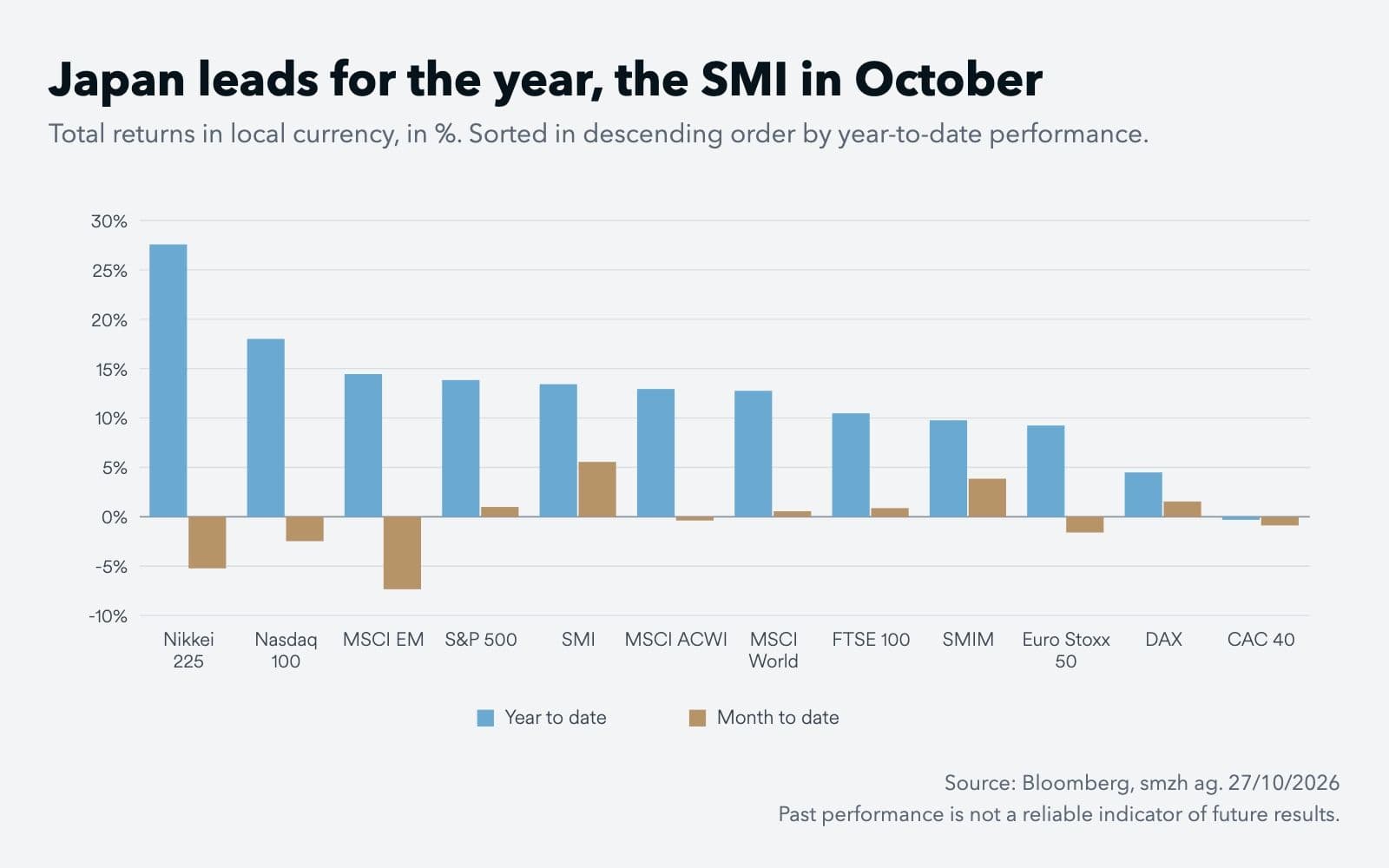
As expected, October was marked by elevated volatility. The S&P 500 reached a new all-time high in early October before rising rates and profit-taking, particularly in technology stocks, weighed on equity markets. As bond markets stabilized, however, equity markets recovered quickly, although performance varied by region. While the Nasdaq 100 and the Nikkei 225 lost around 4-6% at times during the month, the SMI gained almost 5% in October and proved to be an anchor of stability thanks to its defensive qualities.

Bar chart: total returns in local currency of twelve equity indices year to date and in October 2026 – Nikkei 225 leads year to date, the SMI posts the strongest monthly gain

Earnings season with tailwinds, but a high bar

The third-quarter reporting season has so far painted a mixed picture. Around a quarter of S&P 500 companies have reported to date, and 83% of them beat earnings expectations. At an average of just over 2%, however, positive surprises were much smaller than in the past. At the same time, expected earnings growth remains exceptionally strong at more than 29%, with a large share coming from companies that benefit from the AI investment cycle. As a result, critical voices are growing louder, as market breadth is as narrow as it was around the turn of the millennium and part of the reported earnings comes from book gains on stakes in unlisted AI companies. The key question is therefore whether the heavy investment can continue to be translated into rising revenues and margins.

Valuations depend heavily on earnings estimates

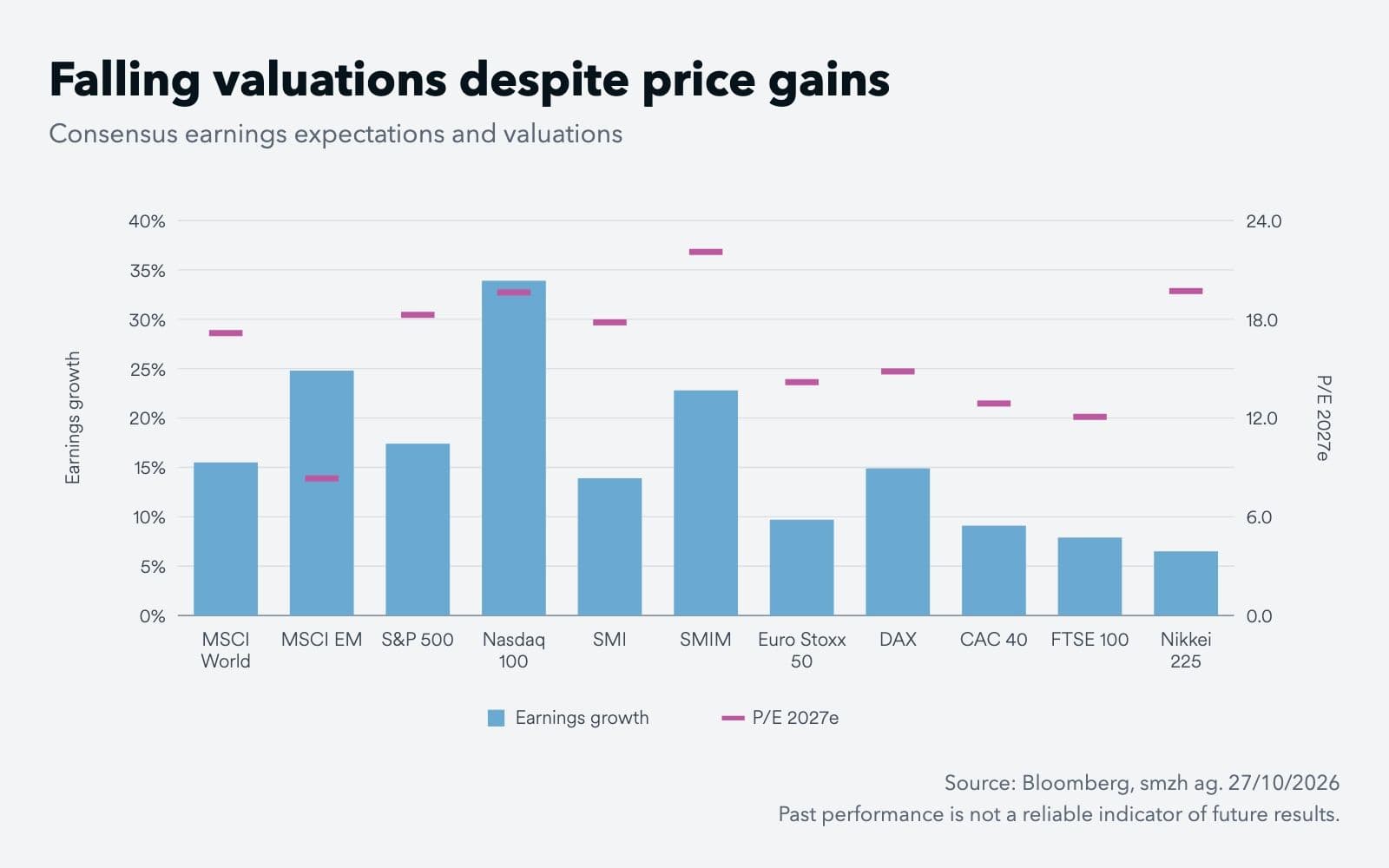
Valuations look much more moderate on the basis of expected earnings than on the basis of the past twelve months. The S&P 500 currently trades at around 26x trailing twelve-month earnings, but at around 21x and 18x on 2026 and 2027 earnings estimates, respectively. High earnings expectations have caused P/E ratios to decline for several months despite rising share prices. After the consolidation in September and October, valuations have in some cases fallen significantly again. In Europe, they are also much lower. Valuations thus depend crucially on whether earnings estimates can be achieved. For the main regions, however, the expected earnings paths appear plausible in principle. In individual segments, particularly semiconductors, the 2027 forward P/E of 15.7x compared with the current P/E of 37x implies earnings growth of around 135%. If these expected earnings fail to materialize, today’s seemingly low valuations will look considerably less attractive.

For context: the price-to-earnings ratio (P/E) compares a company’s share price with its earnings per share. The forward P/E uses expected earnings for the coming years instead of earnings over the past twelve months. If earnings expectations rise faster than share prices, the forward P/E falls even though the shares have become more expensive.


Combined chart: expected earnings growth (bars) and 2027e P/E ratio (markers) of eleven equity indices – Nasdaq 100 with the highest earnings growth, MSCI EM with the lowest P/E

AI boom or AI bubble: what matters now

Whether equity markets are forming an AI bubble cannot be read from price movements alone. What matters is whether the heavy investment in artificial intelligence continues to translate into rising revenues, margins and earnings. The critical voices point to two observations: market breadth is as narrow as it was around the turn of the millennium, and part of the reported earnings comes from book gains on stakes in unlisted AI companies. On top of this, segments such as semiconductors are valued on the assumption of earnings growth of around 135%.

In our CIO’s view, however, the expected earnings paths for the main regions appear plausible in principle. As long as the economy and earnings remain intact, the positives outweigh the negatives from today’s perspective. Expectations are high, however, and so is the potential risk of a setback.

Quality and diversification remain key

As long as the economy and earnings remain intact, however, pullbacks can be used to build positions gradually. Regionally, Europe and emerging markets remain attractive alongside the US. Swiss dividend stocks offer defensive qualities and stable cash flows and should continue to be favored within the Swiss equity market.

This article is taken from the smzh Investment Guide November 2026 (editorial deadline: 28 October 2026). You can download the full guide as a PDF.

Author:
smzh-image

Bekim Laski

Chief Investment Officer und Partner
Share on: