smzh blue logo
Insurance

Finding an Affordable Health Insurer: How to Actually Save Money

Artikel
3 Feb 2026
smzh-image

Health insurance premiums are forecast to rise again next year. Even though the increase itself is unavoidable, there are ways to influence what you actually pay.

Key Takeaways

  • The federal government is expected to publish the approved 2027 premiums at the end of September 2026.
  • Our estimate: an increase of 3.5 to 4.0 percent. At the midpoint of 3.75 percent, that works out to roughly CHF 17.45 more a month for adults, or CHF 209 a year.
  • Six factors determine whether you'll pay more than necessary next year for the same statutory coverage.
  • Notice of cancellation to your current insurer must arrive no later than 30 November 2026. The postmark date isn't sufficient.

How Much Will Health Insurance Premiums Rise in 2027?

Based on what's currently known, an increase in the median premium of 3.5 to 4.0 percent looks like a plausible base-case scenario. This forecast is a Swiss-wide average.

To put that in perspective: the median monthly premium for adults in 2026 is CHF 465.30. Applying the midpoint of our base-case scenario, 3.75 percent, works out to roughly CHF 17.45 more a month, or about CHF 209 a year. Any individual's actual premium change can differ substantially from this, in either direction.

This estimate is based on the cost forecast from the KOF Swiss Economic Institute at ETH Zurich, which — commissioned by the Federal Office of Public Health — expects cost growth of 4.0 percent per insured person for 2027. Health care costs and premiums don't move in exact lockstep, however. Only part of total health spending is financed through basic insurance. Reserves, cantonal funding, and gaps between projected and actual costs also shift the outcome.

Why Premiums Keep Rising

The cost pressure is structural, not cyclical. It stems not only from an aging population but, more significantly, from medical advances, broader access to care, higher utilization of services, and rising costs per treatment.

Just how far this reaches becomes clear when you look back at 2022 — the last year premiums didn't rise, and the first year without an increase since 2008.

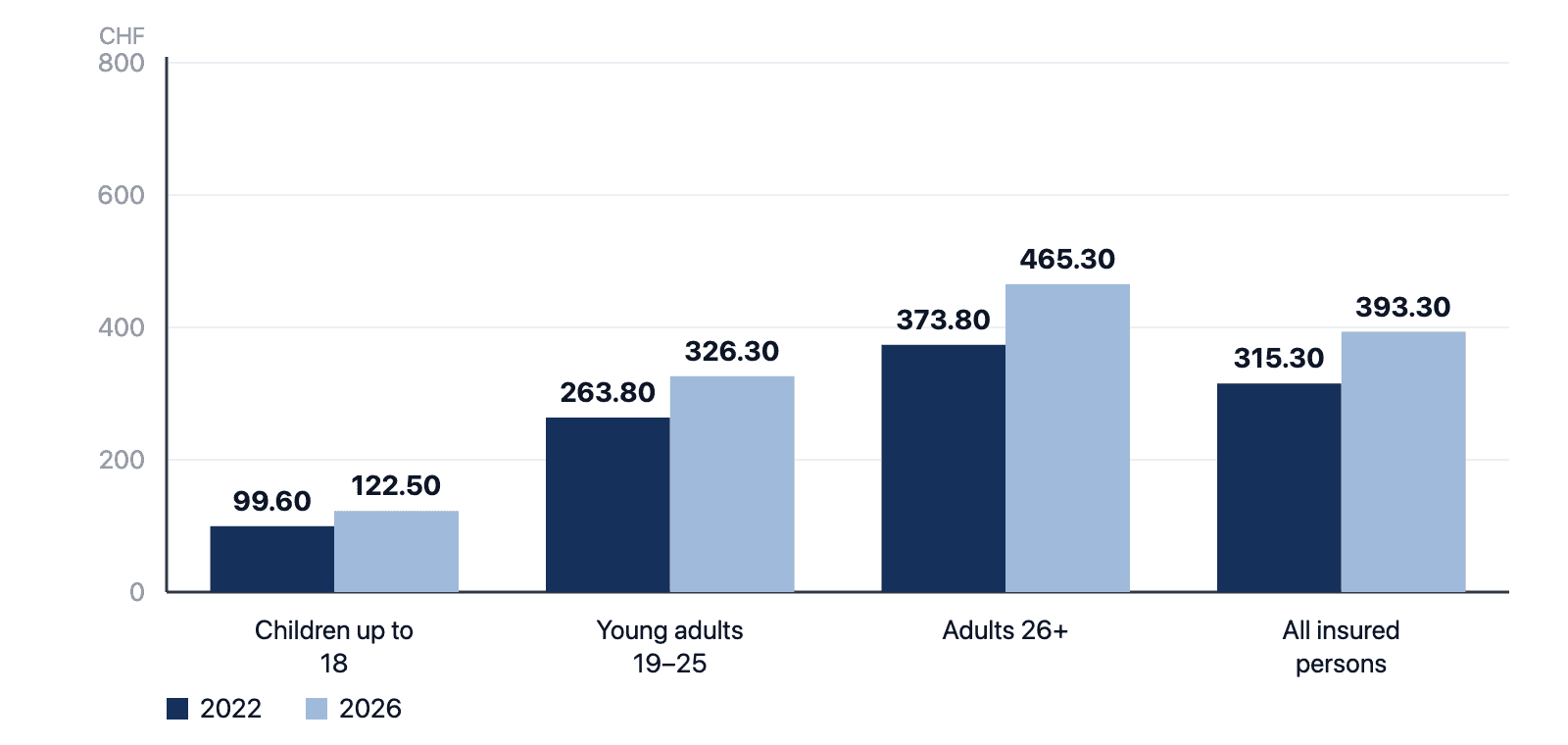
Bar chart of the median monthly premium in 2022 and 2026: children CHF 99.60 to CHF 122.50, young adults CHF 263.80 to CHF 326.30, adults CHF 373.80 to CHF 465.30, all insured persons CHF 315.30 to CHF 393.30.
Change from 2022 to 2026: children +23.0 percent, young adults +23.7 percent, adults +24.5 percent, all insured persons +24.7 percent. 2022 was the first year since 2008 without a premium increase.

Source: FOPH/FDHA press releases on the 2022 and 2026 premiums.

Over four years, the median premium across all insured persons rose from CHF 315.30 to CHF 393.30. The increase is spread fairly evenly across age groups: children pay 23.0 percent more, young adults 23.7 percent, and adults 24.5 percent. For 2026 alone, the increase was 4.4 percent, or CHF 16.60 a month; the year before, it was 5.7 percent.

Why Your Own Premium Differs From the Swiss Average

A nationwide average is a starting point, not a statement about your own bill. Even in 2026, the cantons varied widely.

Ticino recorded the steepest increase, up 7.1 percent to CHF 501.50 a month, a rise of CHF 33.20. Zug reported the sharpest decrease, down 14.7 percent to CHF 264.50, making it the least expensive canton. That decrease isn't a market movement, though: the canton of Zug is relieving residents of roughly CHF 220 million in inpatient hospital costs in 2026 and 2027, covering 99 percent of hospital costs during those two years. Decisions like this affect premiums directly, but they're temporary and specific to that canton.

Your own premium therefore depends on your premium region, age, insurer, deductible, insurance model, and accident coverage.

Saving on Health Insurance: Six Levers for 2027

Six factors determine whether you pay more than necessary for the same statutory basic coverage. The benefits catalog for basic insurance is identical at every insurer. A cheaper insurer doesn't mean medically necessary mandatory benefits are being cut.

LeverWhat to CheckWhy It Matters
InsurerCompare an identical profile across several insurers: same deductible, same model, same accident coverageOnly with an identical configuration can you see how much of the price difference is really due to your choice of insurer
DeductibleYour expected health care costs and your buffer for a bad yearWhat matters isn't the monthly premium, but the annual cost of premium, deductible, and coinsurance combined
Insurance ModelFamily doctor, HMO, telemedicine, or standardThe discount is often 8 to 20 percent, but only if the model actually fits your daily life
Accident CoverageMinimum of 8 working hours a week with the same employerIf this threshold is met, your employer's insurance already covers non-occupational accidents, and you'd otherwise be paying for that coverage twice through basic insurance
Premium SubsidyCheck your eligibility in your canton of residenceDirectly reduces your cost burden, though eligibility and the application process are set by each canton
Supplementary InsuranceCoverage, notice period, and insurabilityNo guaranteed acceptance applies here. A hasty switch can't be undone

Two of these six factors drive most of the result, and they pull in opposite directions.

Your insurer choice comes at no trade-off. The benefits catalog is legally identical for everyone. Switching insurers means giving up nothing. In our analysis, the price difference from switching runs up to CHF 1'398 a year.

The deductible works against a risk. The discount is guaranteed, and so is the extra risk you take on. Someone who moves from a CHF 300 to a CHF 2'500 deductible takes on CHF 2'200 more in exposure and gets, at most, CHF 1'540 back in return.

Start by assessing which services you're likely to need in 2027, then your deductible and model, and only after that your insurer. Reverse that order, and you end up comparing prices for a configuration that may not even fit you.

If you'd rather not run these numbers yourself: smzh's comparison is free and non-binding, and it works using your own profile.

The Lever Most People Never Check

What many people never check is whether they qualify for a premium subsidy. In 2023, 2.5 million people received a premium subsidy — 28 percent of all insured persons. The total volume came to CHF 5.9 billion.

Anyone who assumes eligibility only kicks in at a very low income underestimates how far-reaching this subsidy is. For children from lower- and middle-income households, the federal government mandates a minimum subsidy of 80 percent; for young adults still in education, it's 50 percent. Families with children qualify more often than they expect.

Eligibility is reassessed every year. In some cantons, you have to submit an application. A rejected application from last year says nothing about this year.

Compare Officially and Neutrally

Once the approved 2027 premiums are available, it's worth starting with the federal government's official premium calculator. Priminfo lists the premiums of every health insurer as approved by the Federal Office of Public Health.

The premium calculator only shows what a given configuration costs, though. Whether it is suitable for you depends on your expected treatment needs, the model's rules, the physician list, accident coverage, and any supplementary insurance you already hold.

Every lever in one comparison

Insurer, deductible, model and accident cover all work together – work them through for 2027 jointly rather than one at a time.

Compare health insurers now

By When Do You Need to Act for 2027?

Your notice of cancellation for basic insurance must reach your current insurer no later than 30 November 2026. What counts is the date received, not the postmark. Your insurer must notify you of your actual 2027 premium by 31 October 2026 — only then can you make a meaningful comparison.

If you switch, remember to settle any overdue amounts in reminder status in good time: outstanding premiums or cost-sharing amounts can block a switch until they're paid. Your new basic insurance then begins on 1 January 2027 without any gap in coverage.

Why the Cheapest Insurer Isn't Automatically Right

The cheapest policy is only the right one if you can actually live by its terms day to day. A telemedicine model won't help much if you go straight to a practice whenever you're sick. A high deductible isn't a good fit if you can't cover the coinsurance in a year with high health care costs.

Be especially careful with supplementary insurance. Basic insurance carries a guaranteed-acceptance requirement: every insurer must accept you, with no health screening and no exclusions. That doesn't apply to supplementary insurance. So don't cancel an existing supplementary policy until the new insurer has confirmed the coverage you want in writing, free of unwanted exclusions. You can re-optimize your premium every year — you can't undo a loss of insurability.

Review Your 2027 Premiums With Us

With smzh's health insurance check, you enter your details online in about two minutes.

A Word on Special Cases

Bonus insurance. Alongside the deductible and the model, there's also bonus insurance, where the discount grows with every claim-free year and drops again once you file a claim. It can't be combined with an optional higher deductible, so it's a separate path of its own.

The mid-year model switch. Since 1 January 2025, you can switch to a model with restricted choice with your current insurer at any point in the year. For this one lever, at least, you don't have to wait for year-end.

Outstanding balances. Premiums or cost-sharing amounts in reminder status can block a switch until they're paid.

Common Misconceptions About Saving

The lowest premium isn't the lowest annual cost. What matters is premium, deductible, and coinsurance combined. A high deductible lowers your premium but raises your risk in a bad year.

The discount isn't the same as the savings. The discount is guaranteed. Whether it actually translates into savings depends on your individual health care costs over the course of the year.

The average isn't your premium. The median premium is a Swiss-wide average across all cantons, age groups, and models. Your own premium depends on your premium region, age, insurer, deductible, model, and accident coverage.

The goal isn't to switch at any cost. But reviewing your current setup is worth the effort.

Deadlines at a Glance

Key Dates for the 2027 Insurance Year

DateWhat to Do
End of September 2026The federal government publishes the approved 2027 premiums.
31 October 2026Your insurer must have notified you of your personal 2027 premium. Only then do you know your own starting point.
30 November 2026Your notice of cancellation must have arrived at your current insurer. What counts is the date received, not the postmark.
1 January 2027Your new basic insurance takes effect. From this date, your chosen deductible and model apply.
31 March 2027Second cancellation deadline, effective 30 June 2027, available only with the ordinary deductible and standard model.

Supplementary insurance under the Insurance Contract Act (VVG) follows its own contractual deadlines. Don't cancel it until your new coverage has been confirmed in writing.

Outstanding premiums or cost-sharing amounts that are in reminder status can block a switch until they're paid.

FAQ: 2027 Health Insurance Premiums

When Will the 2027 Health Insurance Premiums Be Announced?

The approved premiums are expected to be published at the end of September 2026. Your insurer must notify you of your personal premium no later than 31 October 2026. Only then will you know the exact amount to compare.

Where Can I Officially Compare the 2027 Premiums?

On Priminfo, the federal government's premium calculator. It lists the premiums of every health insurer as approved by the Federal Office of Public Health, and it's anonymous and ad-free. Until the 2027 premiums are approved, the 2026 figures remain posted there. Make sure you set the same configuration for every insurer so that you're comparing identical products.

By When Must I Cancel My Basic Insurance?

Your notice of cancellation must arrive at your current insurer no later than 30 November 2026. The postmark isn't sufficient. Sending it by mid-November builds in a safety margin. The switch also only becomes effective once your new insurer has notified your current one that you'll be insured with them without any gap in coverage.

Are Basic Insurance Benefits the Same at Every Insurer?

Yes. The statutory mandatory-benefits catalog is identical at every insurer, and benefits must be effective, appropriate, and cost-efficient. The differences lie in the premium, the service, and the rules of the insurance model you choose. A cheaper insurer isn't cutting mandatory benefits — it's simply pricing differently and carrying a different pool of insured members.

Can I Switch Only My Basic Insurance?

Yes. Basic and supplementary insurance can be held with different companies, and many households do exactly that. Don't cancel a supplementary policy until the new company has confirmed the coverage you want in writing, free of unwanted exclusions. Supplementary insurance carries no guaranteed-acceptance requirement.

Can I Switch Despite an Illness or Ongoing Treatment?

Yes. Every insurer must accept every person subject to mandatory coverage into basic insurance within its service area, regardless of age, health status, or ongoing treatment. There's no health screening, no risk surcharge, and no waiting period. With cost-saving models, though, you should check whether your ongoing treatment is compatible with the model's rules.

What's the Benefit of Checking Accident Coverage?

Anyone who works at least 8 hours a week for the same employer is already covered against non-occupational accidents through that employer's accident insurance. Accident coverage under basic insurance can then be suspended, which lowers your premium. If that condition no longer applies, coverage automatically resumes by law.


Sources

Federal Office of Public Health, press release of 23 September 2025 on the 2026 premiums: bag.admin.ch

Federal Office of Public Health, premium calculator and approved premiums: priminfo.admin.ch

KOF Swiss Economic Institute at ETH Zurich, forecast of cost trends in mandatory health insurance, commissioned by the Federal Office of Public Health

Federal Act on Health Insurance (KVG), SR 832.10, in particular Articles 7 and 8: fedlex.admin.ch

Health Insurance Ordinance (KVV), SR 832.102, Articles 93 through 95 and 103

Federal Act on Accident Insurance (UVG), SR 832.20, and Article 13 of its ordinance (UVV)

Author:
smzh-image

Burak Er

Head Research & Advisory Solutions
Share on: