
smzh blue logo
Real Estate
Mortgage

Who Can Still Afford a Home?

Artikel
24 Jul 2026
smzh-image

Swiss real estate prices have moved in only one direction for years: up. And everything suggests that isn't about to change.

With voters rejecting the immigration cap initiative on June 14, 2026, one of the housing market's most important demand drivers remains intact: demographic growth. Interest rates also remain comparatively low despite geopolitical tension, while banks continue to compete aggressively for mortgage business. At the same time, rents keep climbing, making ownership even more attractive by comparison. Combined with tight supply and limited construction activity, everything points to home prices staying high this year – and going higher still.

More and more people, especially younger ones, are asking themselves a simple question: can they still afford to dream of owning a home at all?

A low ownership rate with clear causes

Only about 36% of Swiss households own their home – far fewer than in Germany (nearly 50%) or the European average (almost 70%). The reasons are structural: Switzerland has a well-functioning rental market, a high degree of urbanization, and a limited supply of property that's further constrained by zoning rules and scarce building land.

Add to that strict financing requirements: buying a home requires at least 20% equity, at least half of which must be "hard" equity that hasn't been withdrawn early from a pension fund – a rule in place since 2012. Banks also stress-test affordability using calculated interest rates well above current market rates. The result: many households don't qualify on paper, even with a solid income.

Why equity has become the real lever

Income is hard to increase quickly. Equity, by contrast, can be actively planned – through savings rate, pension contributions, third-pillar retirement savings, and the timing of when capital-building begins. That's exactly why equity has moved to the center of the buying decision: in many regions, the legal minimum of 20% is no longer enough, because income caps the maximum affordable mortgage.

Saving alone is no longer enough

A household isn't saving toward a fixed price – it's saving toward a moving target. Since 2000, Swiss home prices have risen roughly 3.5% a year, and are now about 160% higher than at the turn of the millennium. Wages, over the same period, grew only about 30%.
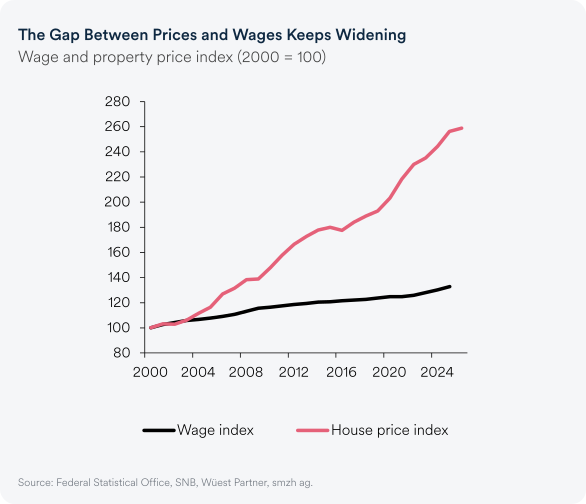
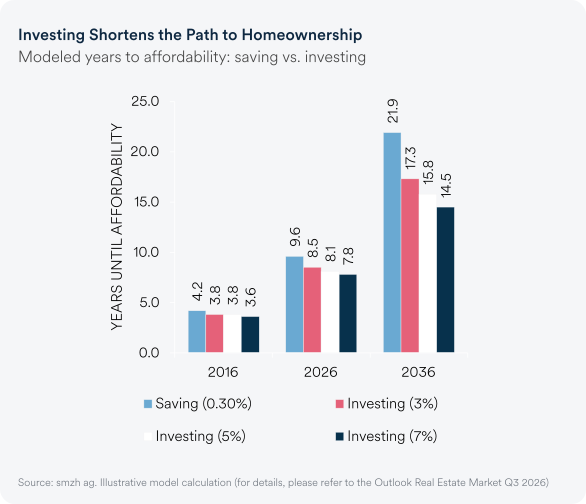
Fig. 1

That gap shows up clearly in the time it takes a model household earning CHF 120,000 a year to build the required equity, saving 15% of gross income. In 2016, a comparable property took just over four years to afford. By 2026, it takes nearly ten. Projected forward to 2036 at the same trend, the wait stretches past 20 years – for a reference property expected to cost around CHF 1.35 million by then. Little wonder the average age of first-time buyers in Switzerland is 48, compared with just 31 across Europe.

Returns can meaningfully shorten the timeline

If equity is invested rather than simply saved, the path to homeownership shortens noticeably – from nearly ten years to about eight for today's reference property. The effect grows the longer the time horizon: even a few percentage points of return can bring the point of affordability forward by several years. Returns aren't the goal in themselves – they're a means of aligning capital growth with the intended purchase timeline.

Fig. 2

The right vehicles – and the right bank – matter too

It's not just how much equity you have, but where it's held. Personal assets, third-pillar savings, and pension fund capital differ in tax treatment, withdrawal rules, and deadlines. Households that don't coordinate these carefully risk giving up tax advantages and financing flexibility. Bank choice matters as well: income components, personal funds, pension fund withdrawals, and pledging are all assessed differently from bank to bank – meaning the same household can end up with very different results depending on how the financing is structured.

The path to homeownership, then, doesn't start with the property search. It starts much earlier – with a retirement and investment strategy built well ahead of the purchase.

The path to homeownership isn't decided by the savings rate alone. What matters is that capital is built early, invested wisely, and structured in the right vehicles. Financing itself is another factor: the same household can be assessed differently depending on the bank. Those who don't think about returns, retirement planning, and financing together often lose exactly the time the market keeps moving forward.

Find our detailed assessment in the latest Outlook Real Estate Market

Download

Contact us for holistic advice from our real estate advisory team

Make an appointment
Author:
smzh-image

Burak Er

Head Research & Advisory Solutions
Share on: