
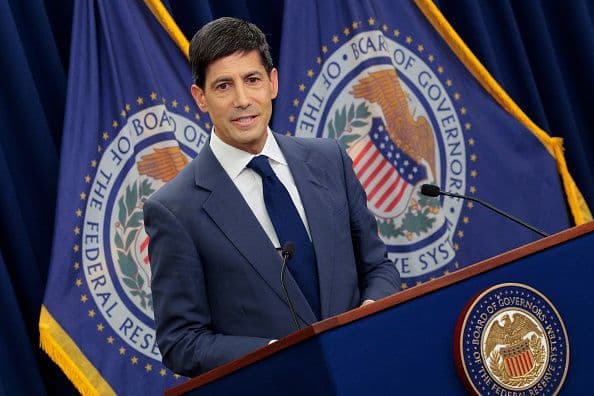
The first meeting under Kevin Warsh and what it means for investors
The Federal Reserve held its policy rate steady at its June 17 meeting, as widely expected. More significant than the rate decision itself, however, was Kevin Warsh's debut as the new Chairman. Under his leadership, the Fed is set to prioritize the fight against inflation while deliberately scaling back its forward guidance. We assess what this shift means for investors.
What was decided
The Fed voted unanimously to leave its policy rate unchanged in the 3.50%–3.75% target range, where it has stood since December 2025, thus no surprise there. The real substance lay in the updated projections, which were notably more restrictive than before. In the so-called dot plot – the chart in which each member anonymously records where they expect the policy rate to be in coming years – the median for end-2026 rose to 3.8%, up from 3.4% in March. Nine of the eighteen members now expect at least one rate hike before year-end. At the same time, the Committee raised its inflation forecast significantly: the 2026 PCE inflation projection – the Fed's preferred inflation gauge – jumped to 3.6%, from a prior estimate of 2.7%. Financial markets responded swiftly, pricing in a rate hike by October at the latest. The rate cuts that were broadly anticipated at the start of the year are, for now, off the table.
The key surprises
While the rate decision itself was expected, the style of the presentation was not. First, Kevin Warsh eliminated forward guidance – the practice of signaling to financial markets in advance which direction interest rates are likely to move. The significantly shortened post-meeting statement contained no references whatsoever to the future path of rates. Second, Warsh was the only Committee member to refrain from submitting his own rate projection, citing his view that the tool is not useful. In doing so, he effectively undermines the informational value of the other members' projections, as the most influential voice stays silent.
What sounds like a technical adjustment is, in fact, monetary policy history. Fed members' economic and rate projections have long been central pillars of forward guidance. Since December 2008, in the wake of the global financial crisis, forward guidance itself became a key instrument of central bank policy. For more than fifteen years, the Fed steered markets through its communication as much as its actions. Warsh is now bringing that era to a close. His reasoning is conceptually revealing: market prices are a central bank's most important source of information, but if markets do nothing more than reflect back what the Fed has already signaled, the Fed blinds itself to that very signal. Warsh intends to remove those blinders.
Third, Warsh spoke with unmistakable conviction about his commitment to fighting inflation, pledging to deliver price stability. With US inflation reaching a three-year high in May, this tone sends a clear message – to financial markets and to the political establishment alike, both of which have been pushing for lower rates.
Is the dual mandate still in effect?
Given this emphasis on price stability, the obvious question is whether the Fed's dual mandate – price stability and maximum employment – still holds. By emphasizing inflation, the Fed under Warsh is effectively reordering those two priorities. As long as employment and growth remain solid, however, Warsh has sufficient room to remain focused on inflation.
Wide-ranging changes set in motion
Even before taking office, Warsh had signaled his preference for a less communicative Fed. In keeping with that vision, he announced five independent task forces, staffed with experts from both inside and outside the institution. These groups will examine communication, the inflation framework, the Fed's balance sheet, alternative economic data, and productivity and employment — with findings due by December. The choice of topics points to potentially far-reaching changes in how the Fed operates and is structured.
What this means for investors
Taken together, Warsh's debut made clear that under his leadership the Fed will speak less, focus more on inflation, and offer financial markets less support than it has in the past. For investors, this means an environment with less central bank guidance, more independent price discovery in markets, and a structural tendency toward greater volatility.
This is the most immediately consequential change. The reference point around which markets have oriented themselves for more than a decade is being removed. Academic research has shown that forward guidance reduced uncertainty about the future path of interest rates, thereby dampening volatility at the short end of the yield curve. In equity markets, it operated primarily through risk premiums and the cost of hedging against sharp drawdowns. With that anchor gone, investors should expect structurally higher volatility in short-term rates, a repricing of hedging costs in equity markets, and a central bank safety net that is considerably less reliable than before.
Whether the Fed actually follows through on the announced course will become clearer when the task force reports are published by year-end – and when it becomes apparent whether the rest of the Committee is on board. Against this backdrop, the next meeting at the end of July takes on added significance.
For investors, it is worth remembering that long-term investment success is not built on reacting to any single central bank meeting, but on maintaining a consistent strategy aligned with one's own financial plan and risk profile. The value of that discipline is never more apparent than in moments like this – when the world's most important central bank is offering markets less guidance than they have come to expect.