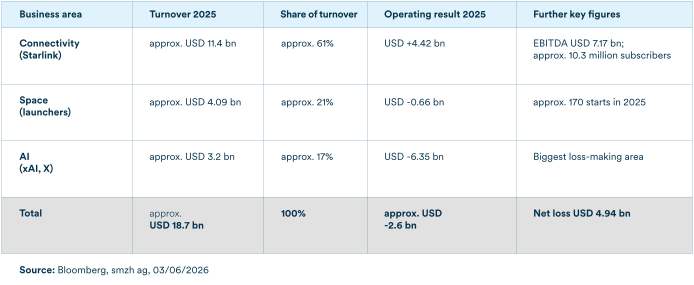
In 2025 total revenues increased by about a third higher compared to the previous year. The company also faces high investment needs, recently around USD 25 billion per year, leaving free cash flow at a negative amount of approx. USD -19.5 billion. No dividends are planned; profits and IPO proceeds are expected to be reinvested.
What underpins the high growth expectations?
The valuation is based less on current earnings and more on future expectations, which are naturally uncertain. The potential for Starlink is about expanding reach and leveraging scale. The next generation of satellites is expected to multiply capacity per satellite, and direct connections with regular mobile phones would significantly expand the customer base beyond those using dedicated Starlink terminals today.
Expectations for the Space division center on Starship. If regular, cost-effective operations of this reusable system succeed, orbital transportation costs could fall substantially, opening entirely new business opportunities, up to and including space-based data centers.
For the AI segment, the goal is to shift energy-intensive workloads to satellites and connect them via Starlink. However, large-scale external commercialization has yet to be demonstrated.
Are there any comparable companies, and how can SpaceX be valued?
Only to a limited extent. There is no publicly listed company with a comparable business mix of space services, satellite connectivity, and AI infrastructure, so comps can only be applied to individual segments rather than holistically. Therefore, outcomes depend greatly on which benchmarks are chosen. For instance, using the valuation metric of a high-growth but pre-commercial provider for Starlink could yield a segment valuation of nearly USD 5 trillion, according to Bloomberg estimates. Using mature satellite operator multiples, the same segment shrinks to several hundred billion dollars. Accordingly, independent estimates differ widely. Sum-of-the-parts calculations range from around USD 390 billion to just over USD 900 billion, with research firm Morningstar listing around USD 780 billion. All of these are significantly below the targeted IPO valuation of USD 1.75 trillion, which is about 78 times expected 2026 revenue and around 265 times expected operating income (EV/EBITDA).
The market is therefore not pricing today’s revenues and profits, but future scale effects, technological optionality, and the ability to convert major investments into a sustainable business. Third-party analyses highlight three main requirements for the targeted valuation to be plausible: successful commercialization of Starship, robust Starlink margins, and external monetization of AI infrastructure.
How can private investors participate?
There are three phases: indirect access before the IPO, possible participation in the IPO, and post-listing purchases. Before the IPO, investment is primarily possible via select funds and ETFs, whereas direct participation in the IPO is generally constrained for most investors. After listing, regular trading will be the main practical avenue for retail investors.
What vehicles exist for pre-IPO participation?
Several publicly traded funds hold SpaceX shares, some directly, some via special purpose vehicles (SPVs). Examples include closed-end funds, active ETFs, and non-traded interval funds. Crucially, such vehicles do not equate to direct equity participation in SpaceX. Structure and valuation mechanics play a significant role, especially premiums or discounts to net asset value (NAV). The fund’s share price can thus be significantly above or below the actual value of its holdings.
Can retail investors participate in the IPO itself?
In principle, yes, but in practice, access is likely to be limited. Reuters recently reported that SpaceX may reserve up to 30% of shares in the offering for retail investors, which is unusually high for a US IPO of this size. However, it remains to be seen how many retail investors will actually receive allocations, as demand will likely be very high and access will depend on brokers or banks. In Switzerland, participation will likely only be possible once the stock begins trading.
What does the small free float imply?
With a capital raise of around USD 75 billion and a valuation of around USD 1.75 trillion, the free float would be about 4%. While this would make SpaceX one of the largest companies by market cap, the portion actually available for trading would be comparatively small. This is important for market mechanics, as a large cap with a small free float is both prominent and only partially liquid.
What role will SpaceX play in stock indices?
The small free float will likely limit its initial weighting in broad indices such as the S&P 500 or Nasdaq 100. However, once added, all index-tracking funds must buy the stock, regardless of price. Bloomberg Intelligence estimates this forced demand at about USD 18–22 billion in the first few months. So anyone holding such an index fund will then participate in SpaceX indirectly, without holding the actual stock.
How is the governance structure to be assessed?
Post-IPO, SpaceX will retain a dual-class share structure. The publicly offered Class A shares carry one vote each, while the Class B shares, held by Elon Musk and selected investors, will have 10 votes per share. According to Bloomberg and Reuters, the founder’s voting control will remain very high, limiting public shareholders’ influence. No dividend is planned, and IPO proceeds are expected to be reinvested in AI infrastructure, launch infrastructure, and further satellite constellation expansion.
What is the importance of the IPO in today’s market environment?
It’s highly relevant. Market participants see SpaceX in a context where artificial intelligence, infrastructure, private tech companies, and potential future mega-IPOs (like Anthropic or OpenAI) are at the center of attention. The IPO is therefore seen as a signal of how much capital markets are currently willing to allocate to very large, future-oriented innovations, making it a key sentiment indicator for today’s financial markets.
What should investors pay attention to?
The SpaceX IPO is exceptional in size, but also a valuable case study of the divergence between headlines and fundamentals. Four objective questions are helpful for monitoring developments: What price does the market assign after the initial trading days? Can Starlink maintain high margins as per-user prices fall? Will Starship make the leap from development to commercial viability? And how do the AI segment’s losses develop? None of these questions can be answered today. That is the challenge. SpaceX’s value hinges less on what the company is today than on what it could become in the future.