smzh blue logo
Investments

Understanding Gold's Underperformance During the Iran Crisis

Artikel
16 Apr 2026
gold_mockup_artikel_a18c39a002_4379d9ccaa.webp

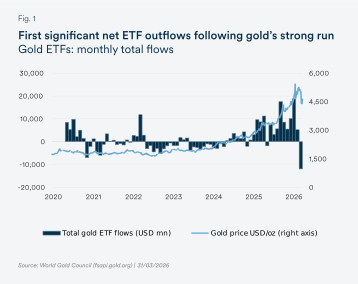
Gold is widely regarded as a safe-haven asset, typically performing well in periods of economic stress and geopolitical uncertainty. However, the Iran conflict presents a more nuanced picture. Despite heightened tensions, gold has failed to benefit from the expected flight-to-safety flows. This divergence highlights the importance of its underlying drivers.

Abb. 1

Favorable conditions for gold performance

Alongside geopolitical developments, gold’s performance is highly influenced by macroeconomic conditions. Historically, it tends to perform best in environments characterized by low or declining real interest rates, as holding gold becomes more attractive when other investments offer lower returns.

A weaker US dollar also supports gold prices. As gold is priced in dollars, a depreciation of the currency increases demand from international investors and provides upward price pressure. In addition, gold benefits from rising inflation expectations, particularly when they are not fully offset by higher interest rates. In these scenarios, gold serves as an effective hedge against a decline in purchasing power and monetary instability.

Finally, structural factors such as central bank demand also support gold prices. When central banks buy gold to diversify their reserves, demand increases. Since the supply of gold is limited, this additional buying helps sustain prices over time and reinforces gold’s role as a long-term store of value.

No crisis advantage for gold

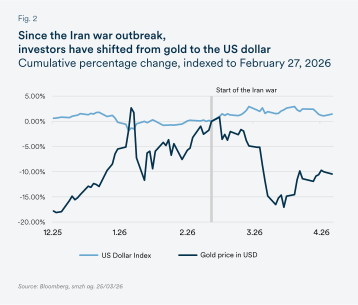
Given that gold has not benefited from the Iran conflict, it shows that it does not always react positively to periods of stress. The increase in uncertainty led to a typical risk-off environment, with investors favoring liquidity and yield. In this context, the US dollar emerged as the preferred defensive asset, supported by higher oil prices, its central role in global markets, and stronger relative economic fundamentals.

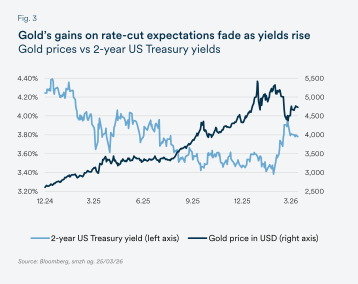
At the same time, rising real interest rates, meaning interest rates adjusted for inflation, reduced the appeal of non-yielding assets such as gold. A stronger US dollar further weighed on prices, both by increasing the cost of gold for international investors and by competing directly as a safe-haven asset.

Abb. 2
Abb. 3

Market dynamics reinforced this pressure. Profit-taking following previous gains and the forced unwinding of leveraged positions driven by liquidity needs led to additional selling. More structural factors also played a role: elevated government deficits and tighter liquidity conditions have exerted upward pressure on yields, while some central banks, such as Turkey, acted as net sellers of gold to stabilize their currencies and rebuild foreign exchange reserves.

Gold remains a strategic portfolio allocation

Against this backdrop, the recent underperformance of gold reinforces a key principle: it should not be viewed as a short-term hedge against geopolitical events, but as a strategic asset driven by macroeconomic conditions.

For investors, this implies taking a long-term perspective. While gold may experience periods of weakness, its fundamental characteristics remain intact. It continues to serve as a diversifier, a hedge against monetary risks, and a store of value in a system marked by rising government deficits and long-term currency debasement risks.

Episodes such as the current one demonstrate that short-term price movements can diverge from traditional expectations. However, such phases do not invalidate gold’s strategic role but rather underline the importance of maintaining a disciplined, long-term allocation, rather than reacting to temporary market dynamics.

Author:
Bekim Laski_Avatar.png

Bekim Laski

Chief Investment Officer und Partner
Share on: