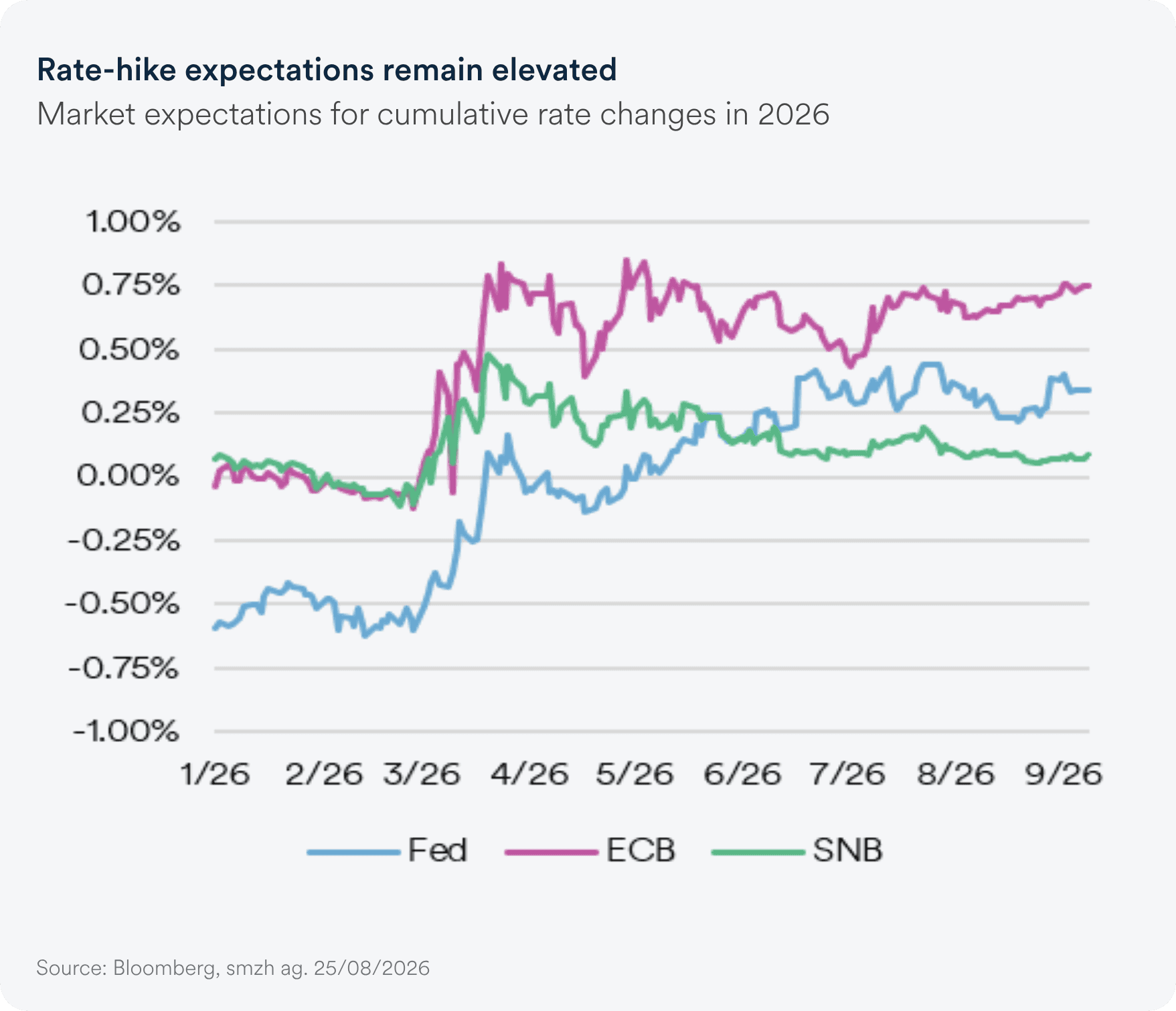
This month, monetary policy decisions from three major central banks are attracting particular attention. The ECB's decision on September 10 is the most clearly telegraphed of the three, while the Fed's decision on September 16 looks increasingly uncertain. The SNB follows on September 24 and occupies a category of its own.
What matters, then, is not only what these central banks decide in September, but what signals they send about the path of rates ahead — and, by extension, for financial markets.
ECB poised for another rate hike
Of the three upcoming decisions, Thursday's ECB meeting is the most fully anticipated. Financial markets are pricing in a 25-basis-point rate hike with near certainty, which would take the main refinancing rate to 2.65%. Headline inflation in the eurozone has picked up sharply again this year, climbing from 1.7% in January to 3.3% in August. The main drivers have been sharply higher energy prices tied to the conflict in the Middle East and disruptions around the Strait of Hormuz. At the same time, economic growth has also surprised to the upside: second-quarter GDP growth came in at 1.2% year-over-year, above consensus estimates, supported in particular by higher defense spending and AI-related investment. This combination takes away at least part of the ECB's case for standing pat, since economic momentum remains resilient despite inflationary pressure.
While the rate hike itself is widely seen as a foregone conclusion, the ECB's communication on the path ahead — together with its updated projections, due out at the same meeting — is likely to matter more. A Bloomberg survey of economists suggests the September hike could be the last, with the deposit rate remaining unchanged through 2027. Financial markets, by contrast, are currently pricing in roughly three rate hikes by mid-2027 — a materially steeper path than economists expect.
The Fed: uncertainty ahead of the September decision
In the US, the FOMC meeting has become one of the most uncertain monetary policy decisions in years. US headline inflation remains sticky at 3.4% year-over-year in July, still well above the Fed's 2% target, even though it has eased notably from a peak of 4.25% in May. At the same time, economic growth remains robust: second-quarter GDP growth came in at 1.5% year-over-year, while the labor market continues to outperform consensus expectations. Nonfarm payrolls rose by 162,000 in August, well above expectations, while the unemployment rate held steady at 4.1%. Although growth cooled somewhat from the first quarter, consumer spending and business investment remained resilient despite higher energy and fuel prices.
The combination of sticky inflation and a robust labor market has considerably strengthened the case for tighter monetary policy, even as second-quarter growth moderated somewhat. Fed Chair Warsh also struck a clearly hawkish tone in his Jackson Hole speech, reinforcing market expectations for an imminent rate hike.
The key remaining data point, however, is the August inflation report, due out ahead of the Fed's September 16 decision. Inflation coming in hotter than expected would largely seal the case for a hike, while a significantly softer-than-expected reading could tilt the balance back toward holding rates steady. Financial markets currently price in roughly a 60% probability of a rate hike.