smzh blue logo
Finance
Pension

AHV 2030: Why Retirement Could Become Even More of an Active Planning Issue

Artikel
27 Mai 2026
smzh-image

The Swiss Federal Council has published the consultation draft for the AHV 2030 reform. The aim is to stabilize the financial situation of the AHV (Old Age and Survivors’ Insurance) from 2030 to 2040 and to adapt the insurance system to social and economic developments. The focus is not only on the financing of the AHV, but also on the question of how the transition into retirement should be structured in the future.

The draft does not include a direct increase of the reference retirement age. However, it does indicate how the rules regarding early retirement, continued employment, and pension planning could change. Those who regularly contribute to pillar 3a have already addressed an important aspect. Nevertheless, this alone is unlikely to be sufficient under the future retirement logic.

Key message: AHV 2030 is currently not an adopted reform package, but a proposal to reorganize the transition to retirement. Early retirement is set to be more tightly regulated, while continued employment beyond the reference age is intended to become more flexible. As a result, retirement may require an even more individualized financial strategy.

What is the AHV debate all about?

The debate around the AHV is often reduced to a simple question: Is there enough money, or does the retirement age need to be raised? This oversimplification falls short. AHV 2030 follows a different approach. The draft does not directly propose raising the reference retirement age. Instead, it suggests adjusting the rules for early retirement, continued employment, and access to pension benefits.

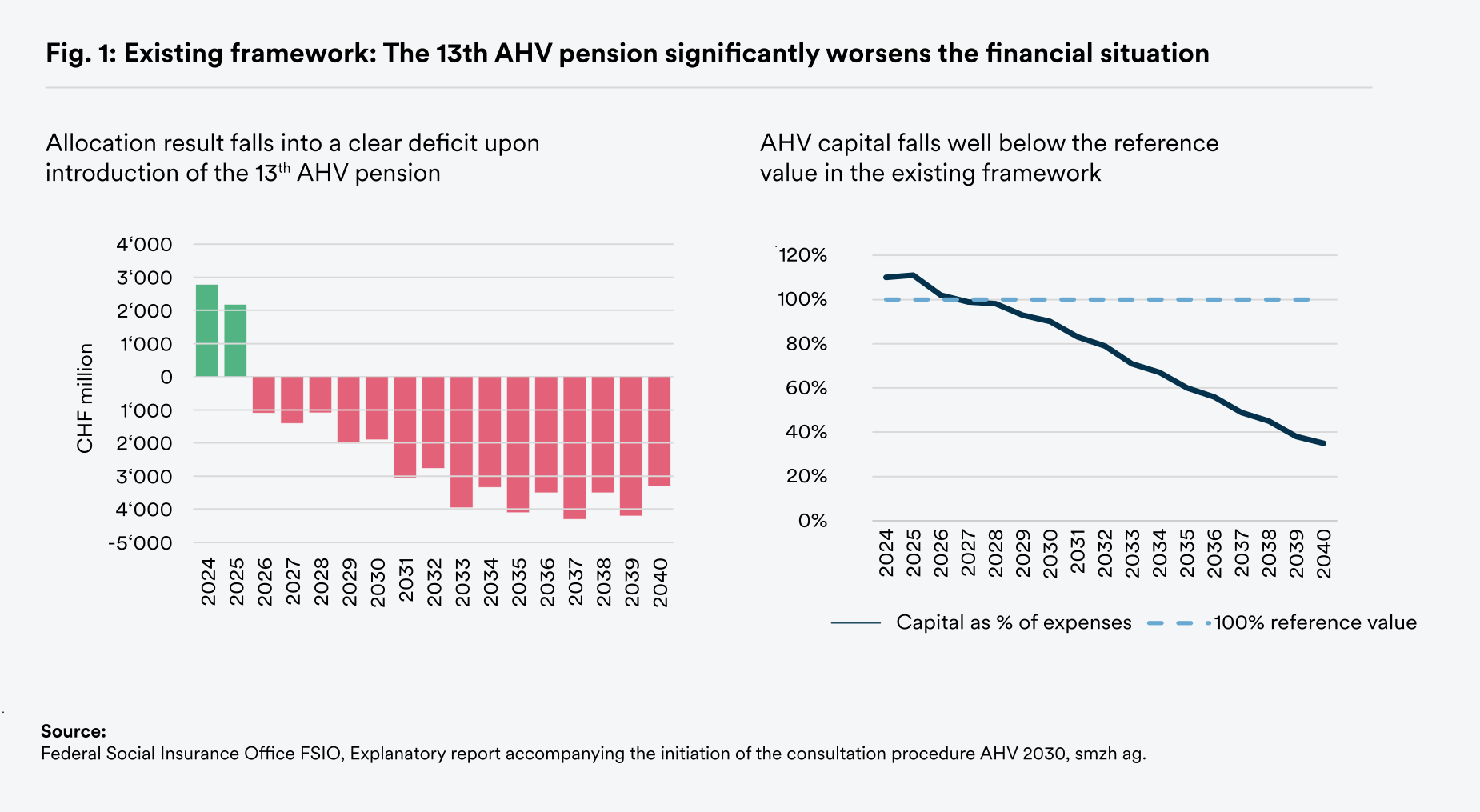
The starting point is important: The AHV was significantly stabilized through STAF (tax reform and AHV financing) and AHV 21 (reform to stabilize the AHV). These reforms generated additional revenues and curbed the growth of expenditures. Without the introduction of a 13th AHV pension payment, the system would have largely remained balanced until 2040, according to current financial forecasts. However, the new additional benefit changes this baseline: From 2026 onward, annual expenditures will increase permanently by several billion Swiss francs, while long-term financing of this benefit remains unresolved.

Therefore, AHV 2030 is more than just a technical follow-up discussion. On the one hand, policymakers need to clarify how the 13th AHV pension will be financed in the long run. On the other hand, the draft already shows the direction in which the transition to retirement could be managed in the future: very early exits from working life are likely to become less common, while longer participation in the workforce will be more institutionally supported.

Thus, for insured individuals, what matters is not only how the AHV will be financed in the future but also how the rules governing the transition to their own retirement may change. AHV 2030 is not only about the first pillar. The draft also calls for adjustments to occupational pension plans, vested benefits, and pillar 3a solutions. For many households, these are exactly the areas where the financial viability of retiring at a preferred date will be determined.

Fig. 1

Financing Is Key, but Only One Aspect of the Reform

The AHV operates as a pay-as-you-go system. Current pensions are financed by ongoing contributions, federal funding, and VAT revenues. If this balance comes under pressure, policymakers have only a few major levers at their disposal: higher AHV contributions, an increase in VAT, higher federal contributions, or a higher reference retirement age.

Each lever allocates the burden differently. Higher AHV contributions affect employees and employers. Increasing VAT places the burden on consumption. Higher federal contributions contend with other governmental priorities. A higher retirement age shifts the adjustment directly to future retirees. Therefore, AHV financing is never just a technical accounting matter – it is always an issue of distributional policy.

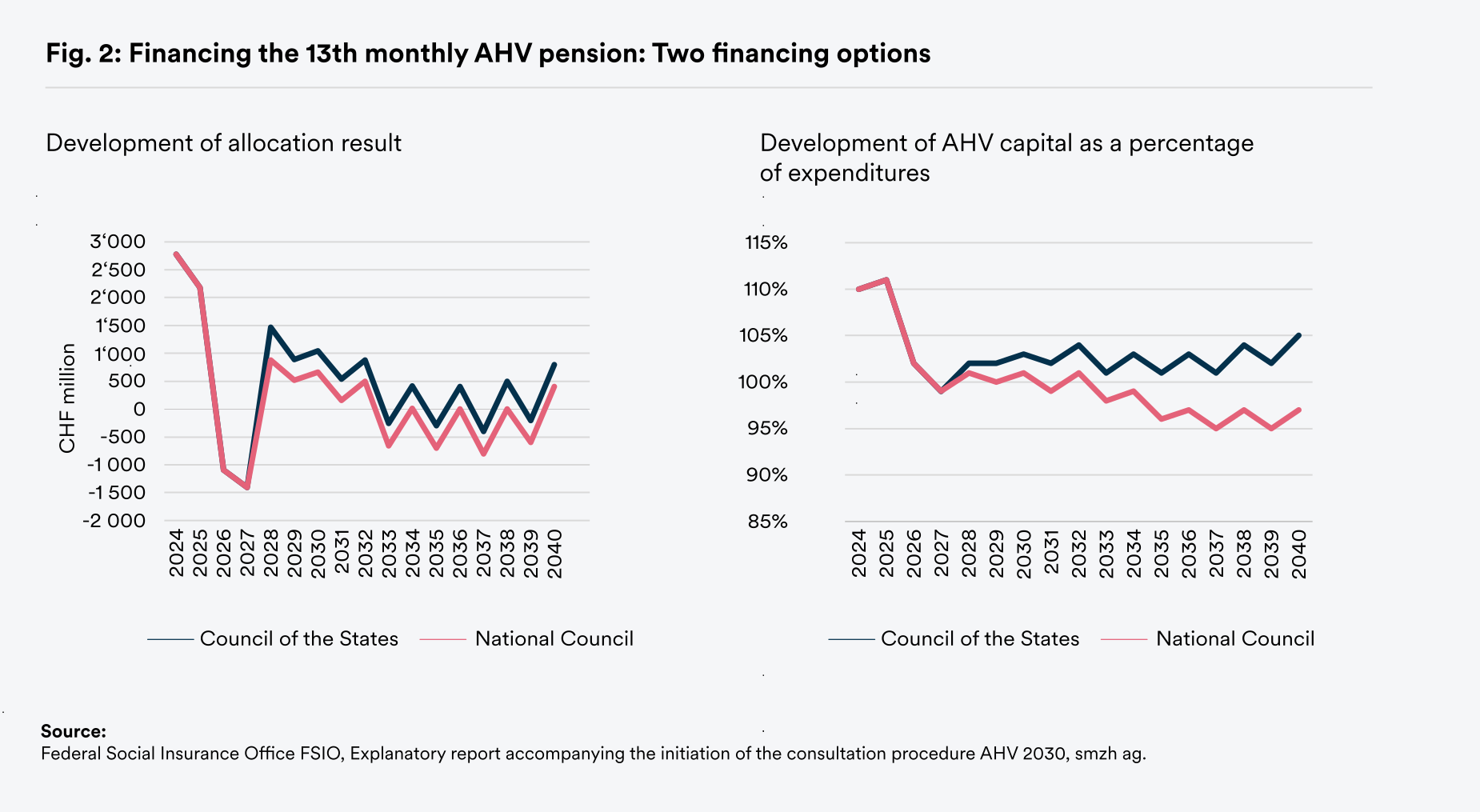
The introduction of the 13th AHV pension adds another layer of urgency. The supplementary pension will be paid for the first time at the end of 2026, while the long-term financing has not yet been definitively settled politically. The National Council seeks to increase VAT by 0.7 percentage points, but only temporarily until the end of 2030. This would secure the payments initially, but financing from 2031 onward would again be unresolved.

The Council of States is pursuing a more permanent solution and aims to finance the 13th AHV pension through a combination of a 0.4 percentage point increase in VAT and a 0.3 percentage point increase in AHV contributions. These increases are scheduled to take effect in 2028. As a result, the burden would be distributed more broadly: consumers contribute via VAT, while employees and employers provide additional funding through higher contributions.

In addition, the Council of States’ proposal includes an intervention mechanism: if the AHV compensation fund subsequently falls below 80 percent of annual expenditures, the Federal Council would be required to automatically raise wage contributions by up to another 0.3 percentage points.

Fig. 2

An Additional Safeguard Mechanism

In addition to the proposed financing measures, AHV 2030 includes a financial intervention mechanism. The AHV compensation fund should generally continue to cover one year’s worth of expenditures. However, if it becomes apparent that the fund balance will, within the next three years, fall below 90 percent of one year’s expenditure, the Federal Council would be required to present stabilizing measures to Parliament within one year. This is intended to ensure that financial imbalances are addressed before the situation becomes critical.

What This Means

The financing of the 13th AHV pension and AHV 2030 are related but not identical. The financing plan defines how the additional 13th AHV pension will be funded. AHV 2030, on the other hand, outlines how the transition to retirement could be reorganized in the future. If funding remains temporary or insufficient only until the end of 2030, AHV 2030 will have to address ongoing financing needs from 2031 onward. In that case, the focus will not only be on early retirement, continued employment, and pension withdrawals, but also on raising additional revenues through VAT and/or AHV contributions.

The Core Strategy: Guide Behavior Rather Than Directly Increasing the Reference Age

A direct increase of the reference age is currently almost impossible to achieve politically. The clear rejection of the pension initiative in 2024 demonstrated the ongoing sensitivity of this issue. Therefore, the AHV 2030 consultation draft takes an indirect approach: the focus is not on the statutory retirement age itself, but on the framework conditions surrounding retirement.

The intended logic is clear: Prior to the reference age, very early exits from the workforce should become less common. Early retirement through occupational pensions, vested benefits, or pillar 3a should be more strictly regulated. After reaching the reference age, more flexible options should become available. Those who continue working should be able to continue building their pension entitlements, make contributions, and, in certain cases, improve their future benefits.

This approach would place greater emphasis on working years compared to retirement years, without directly raising the retirement age. Politically, this would be less visible than a formal increase of the retirement age but could be equally significant for individual retirement planning.

What Is Set to Change in the First Pillar

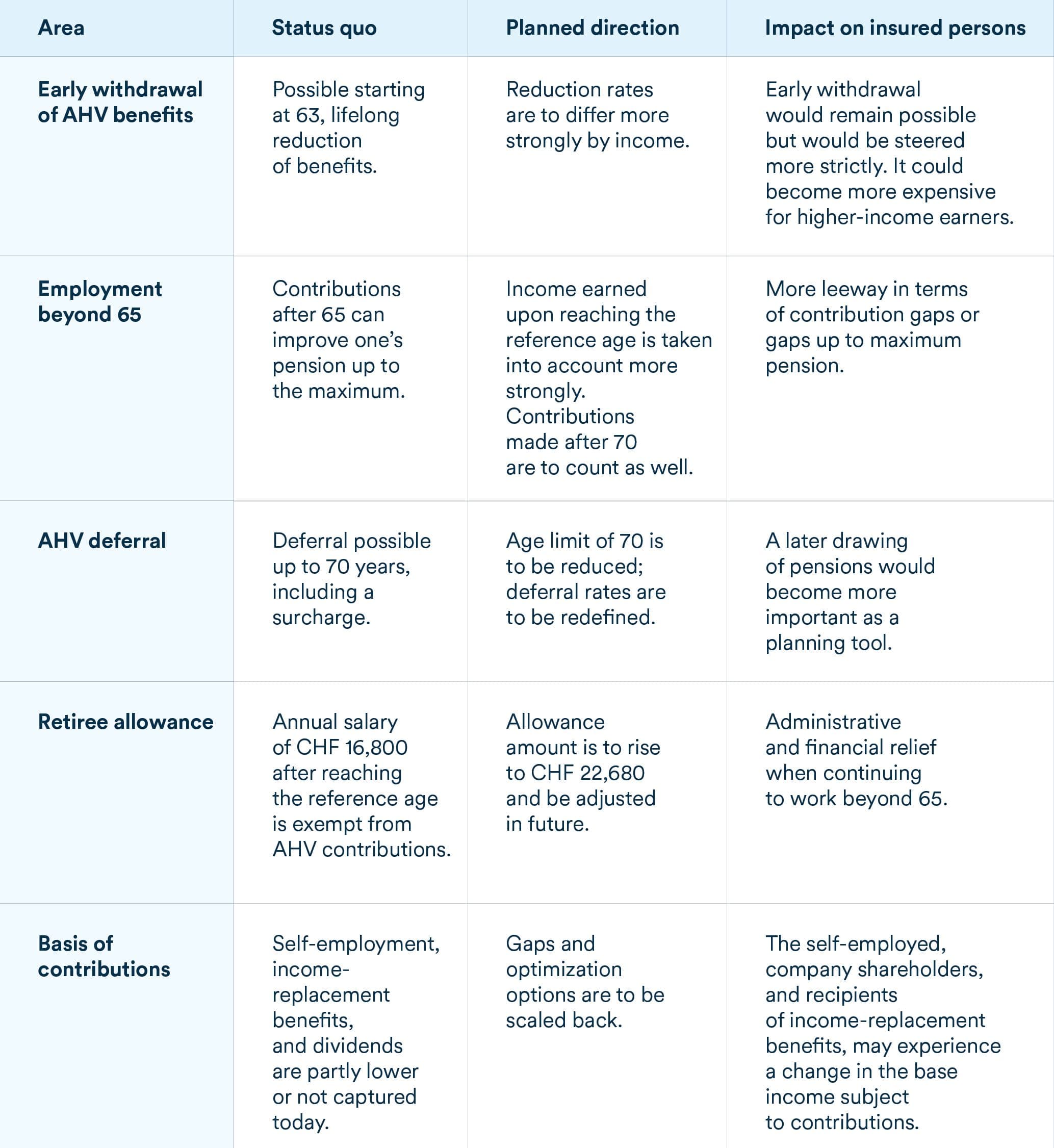
Within AHV itself, the proposed changes mainly concern three areas: early withdrawal, deferred withdrawal, and continued employment after age 65.

Early withdrawal of AHV benefits is to be differentiated more closely based on income. Lower-income individuals would face smaller reductions, while higher-income individuals would face greater reductions. Deferred withdrawal is to become more flexible and attractive. At the same time, earned income after the reference age is to have a greater effect on increasing pension payments, provided the maximum pension has not yet been reached. Those already receiving the maximum pension would benefit more from a higher pensioner allowance rather than from additional pension entitlements.

In addition to changes regarding the transition to retirement, the draft also proposes adjustments to the contribution base. Contribution rates for self-employed individuals are to be aligned more closely with those for employees, with the maximum AHV contribution rate increasing from 8.1 to 8.7 percent. The declining contribution scale – which currently applies to incomes of up to CHF 60,500 – would be tightened, with the income threshold lowered to CHF 40,500.

For buy-ins to the second pillar, the AHV treatment of self-employed individuals will also be restricted. Currently, self-employed persons can deduct, in addition to regular voluntary occupational benefits contributions, 50 percent of additional buy-in amounts when calculating AHV-liable income. In the future, the AHV deduction will be limited to ongoing contributions to the second pillar only. Additional buy-ins will still reduce taxable income, but no longer the base for AHV contributions.

Furthermore, sickness and accident daily allowances will become subject to AHV contributions if they replace salary during an active employment relationship. Excessive dividends paid to owner-managers will also be more strictly captured if they are economically similar to salary. While this is less significant for most employees, it could be directly relevant for self-employed individuals, entrepreneurs, and those with long-term salary replacement benefits.

Table 1

In summary

In the first pillar, the reference age is expected to remain unchanged. However, the timing of pension withdrawals would be more strongly regulated: early withdrawals would be treated differently depending on income, while continued employment and deferral after age 65 would be specifically incentivized.

What Is Set to Change in the Second and Third Pillars

Many retirement plans begin before reaching the AHV reference age. The years between ages 58, 60, 63, and 65 are often bridged today using occupational pensions, vested benefit accounts, pillar 3a assets, or personal savings. It is precisely this transition phase that AHV 2030 aims to reorganize.

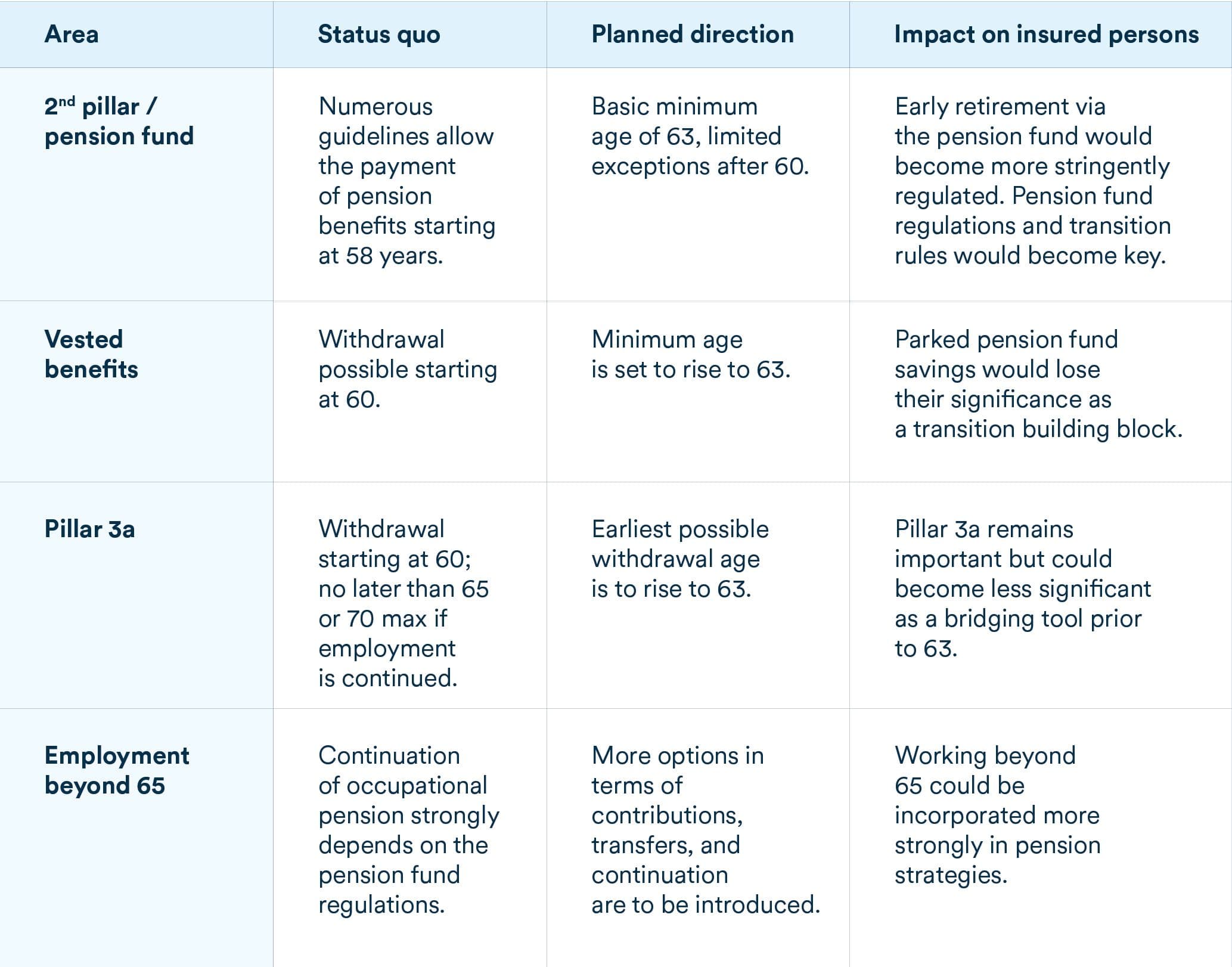
The proposal intends to focus benefit withdrawals more clearly around age 63. In the occupational pension system, many pension funds currently allow retirement benefits from as early as age 58. In the future, withdrawals should generally only be permitted from age 63 onward. Earlier withdrawals would be allowed only in exceptional cases, such as company restructurings, collective labor agreement solutions, or specific public-sector regulations. Likewise, vested benefit and pillar 3a funds should generally become available for retirement withdrawals only after reaching age 63.

After the reference age, pension funds would be granted greater flexibility to continue providing retirement benefits and to transfer vested benefits to a new employer in the event of a job change.

This transition is not intended to occur abruptly. For the second pillar, a ten-year transition period is foreseen. This should give pension funds time to adjust their regulations and protect individuals close to a planned early retirement from any sudden changes. Already-accrued entitlements will be preserved. Nonetheless, for insured individuals, the key question remains how their pension fund will implement the new rules in practice and whether their planned retirement date will align with the future withdrawal options.

Table 2

In summary

In the second and third pillars, early withdrawals are to be focused more clearly on age 63. Therefore, anyone wishing to retire earlier would need to rely more heavily on freely available personal assets for their financial planning.

What Does This Mean Depending on Your Planning Situation?

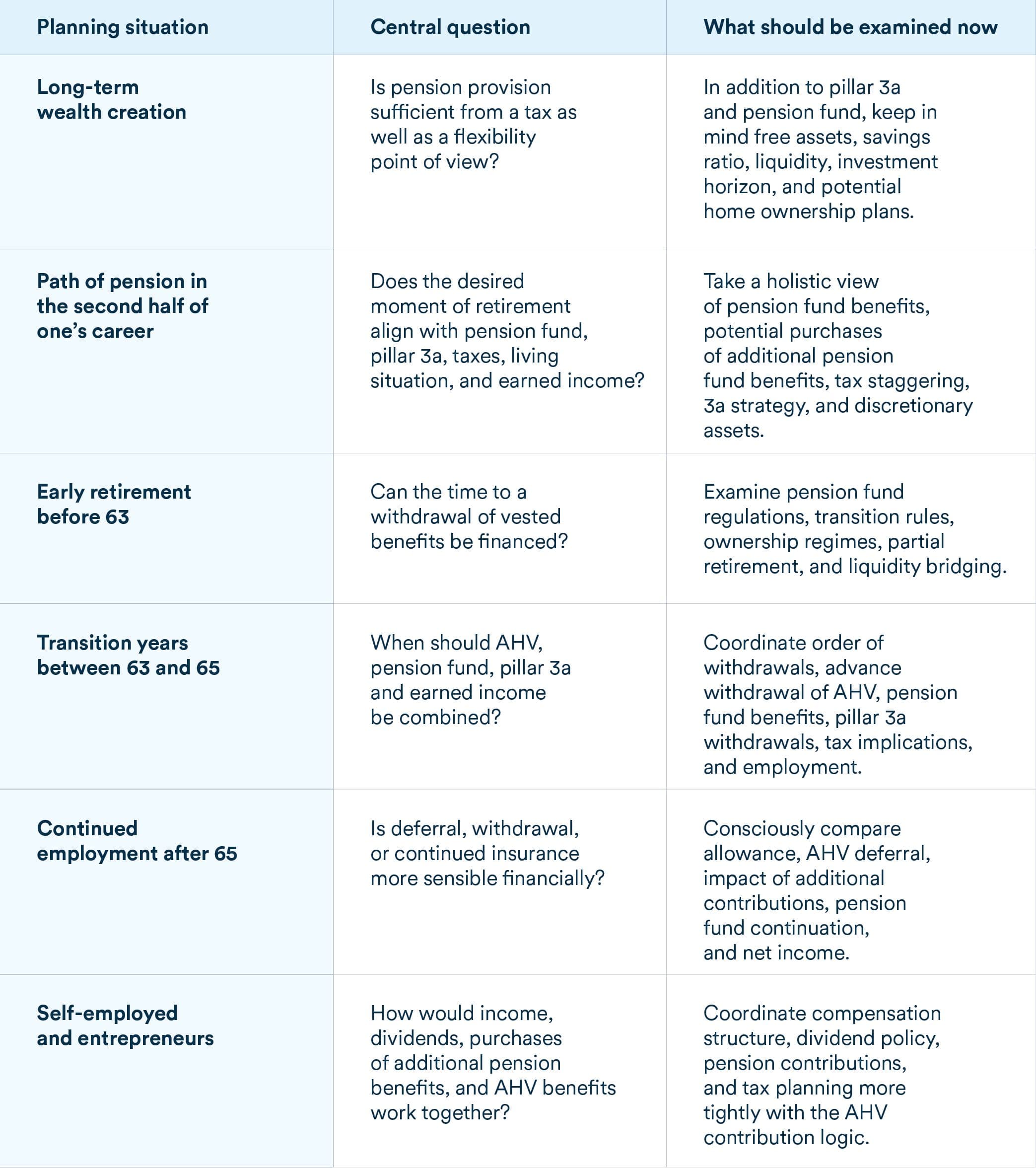
AHV 2030 would not only change certain withdrawal options, but would also place greater emphasis on coordinating AHV, occupational pensions, vested benefits, pillar 3a, and personal assets. The decisive factor would no longer be whether a specific retirement vehicle is available, but whether the right resources are accessible at the right time. Individuals wishing to retire before 63 would face different planning challenges than those who combine various benefits between 63 and 65 or continue working beyond 65. Therefore, the significance of AHV 2030 depends less on age alone and more on the chosen retirement path.

Table 3

The New Planning Logic

AHV 2030 would not force insured individuals to work longer. While the proposal has not yet been adopted, its intended direction is clear enough to warrant an early review of one’s retirement planning: those wishing to retire early would need to allocate more of their own funds, while those who continue working would have expanded opportunities to further develop their retirement benefits. Relying solely on the traditional standard solution could mean that the desired transition to retirement no longer matches one’s financial reality.

As a result, retirement will become less about choosing individual financial products and more about designing an integrated financial architecture. The key question is no longer just whether someone contributes to pillar 3a, makes pension fund buy-ins, or defers AHV benefits. What matters instead is whether these elements fit together: When does which capital become available? What are the tax implications? How much personal wealth is needed before age 63? What roles do occupational pension plans, home ownership, employment income, and liquidity play in the same plan?

This illustrates the broader logic at play. Wealth does not consist of isolated components; it is the result of a coordinated approach. AHV, occupational pension plans, pillar 3a, personal assets, taxes, mortgages, and life planning must all be considered together. Optimizing only individual components may still result in gaps within the overall financial picture.

What Matters Now

The key question is no longer simply whether someone makes regular contributions to pillar 3a. What truly matters is which resources need to be available at which point in time, which source they will come from, what the tax implications are, and how much flexibility the individual retirement plan actually provides.

Conclusion: Anyone Wanting Flexibility in Retirement Will Have to Rely on Freely Available Assets

AHV 2030 would not directly raise the reference retirement age. However, the proposal would impact how flexibly the transition into retirement can be financed. In particular, those wishing to reduce their workload or retire completely before age 63 would become more dependent on assets that are not tied up in occupational pensions, vested benefits, or pillar 3a.

This shifts the focus of retirement planning. It is no longer sufficient to simply manage individual products effectively and make regular contributions to pillar 3a. What is crucial now is whether tied retirement plans, freely available assets, taxes, and earned income come together to form a sustainable transition plan.

Viewing AHV 2030 solely as an AHV issue misses the broader perspective. The proposal affects the entire retirement architecture. Precisely because the reform has not yet been adopted, it is worthwhile to review your own planning early – not to take hasty action, but to understand whether your planned retirement transition remains viable under new rules.

Are you concerned about retirement? We support you in your planning

Would you like to receive advice on pension or retirement planning? We help you develop a strategy that is right for you – considering all relevant factors.

Make an appointment
Author:
smzh-image

Burak Er

Head Research & Advisory Solutions
Share on: