
smzh blue logo
Finance
Investments

Ten Questions and Answers for Investors on the Escalating Greenland Conflict

Artikel
21 Jan 2026
smzh-image

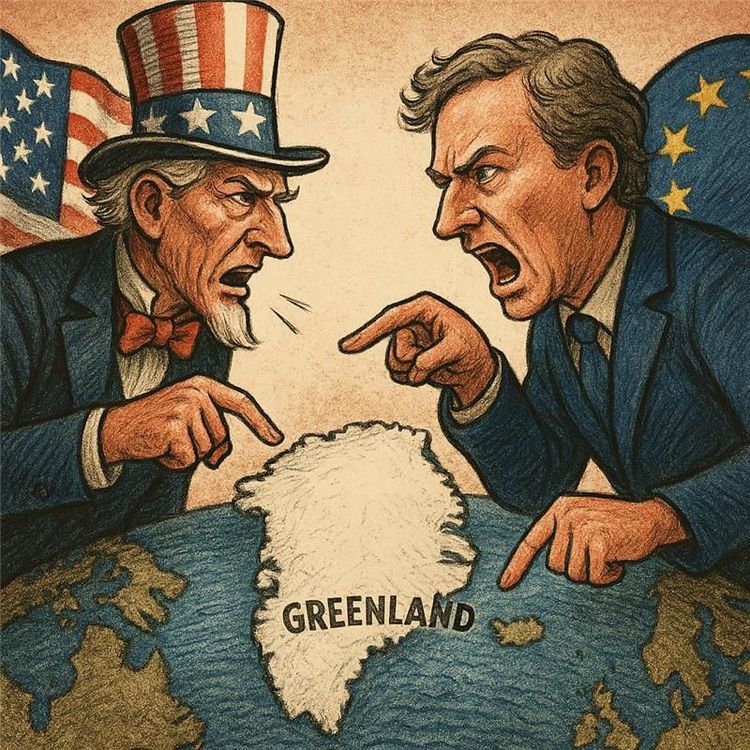
US demands for control over Greenland and the threatened tariffs against European allies have led to a significant escalation of geopolitical tensions. For investors, this is creating a new, complex mix of trade conflicts and growing fragmentation of the world order. Investors should address these developments calmly and consider them carefully within the context of a long-term investment strategy, rather than succumbing to panic-driven reactions. Despite the sharp rhetorics, solid economic fundamentals are continuing to support a constructive market scenario as long as risks are addressed with consistent diversification.

Here we comment on the recent events and respond to the most important questions that have arisen in the context of the standoff.

1. What has happened?

In the first weeks of 2026, tensions between the United States and several European countries have grown significantly. US President Donald Trump has once again explicitly named Greenland as a strategic target for the US, effectively demanding a change in the island’s status, which, under international law, belongs to Denmark. To enforce this claim, Trump has threatened European countries that oppose it with punitive tariffs of initially 10%, which could later increase to 25%. Europe is responding with criticism, protests, and consideration of countermeasures. The planned ratification of a transatlantic trade agreement has been put on ice, and the situation is developing into an open transatlantic conflict.

2. Is the US claim new or is there a history?

US interest in Greenland dates back more than a century, including an official purchase offer from President Truman in 1946 and repeated security agreements. President Trump already spoke publicly about a “purchase” of Greenland in 2019, but was clearly rebuffed by both Denmark and Greenland at the time. What is different this time around is that the claim is now being linked to substantial trade policy threats against allies.

3. Why does the US want to control Greenland?

From a US perspective, Greenland holds considerable strategic importance:

Geopolitics: Control over key routes in the Arctic and improved military surveillance capabilities.

Security: Proximity to potential Russian and Chinese activities in the far north.

Commodities: Deposits of rare earths and mineral resources.

Transport routes: Melting polar ice is opening new strategic maritime routes.

These factors explain why the United States has designated Greenland a “strategic asset.”

4. What is different this time, and why is the conflict so sensitive?

Traditionally, the transatlantic relationship has been regarded as the foundation of global security and world trade. An open conflict over tariffs and geopolitical claims between economic partners and NATO allies represents a major rupture. Unlike previous disputes, such as those with China, this conflict targets countries that have long maintained close ties with the United States. It is particularly sensitive as it risks eroding trust, causing economic disruption, and potentially triggering a restructuring of global alliances. For the first time, a US trade dispute of this scale is directed squarely at key NATO allies – undermining the credibility of the Western alliance and weakening the very unity required to face Russia and China.

5. What further-reaching geopolitical risks are emerging?

The behavior displayed by the US could encourage other major powers to act similarly. China may feel validated in its approach toward Taiwan or the South China Sea, while Russia could be emboldened to assert its revisionist claims in the post-Soviet region. This would mark a departure from previously consensual bilateral relations and the adherence to global trade frameworks set by the WTO, with potentially far-reaching economic and political consequences.

6. How are financial markets responding?

Financial markets typically react to such conflicts with increased volatility, prompting investors to seek safe haven assets such as the Swiss franc and gold. This uncertainty is currently combining with market conditions characterized by elevated equity valuations, which significantly increases susceptibility to corrections in the case of negative surprises.

7. How should investors position their portfolio?

Historically, political shocks tend to cause short-term volatility without sustainably changing long-term trends. The tensions surrounding Greenland are a serious concern, yet do not warrant a panic response. A portfolio that is broadly diversified across asset classes and regions remains the most effective protection against idiosyncratic risks.

A prolonged escalation between the US and Europe, with reciprocal retaliatory measures, would have much more severe effects on the economies and financial markets, especially in Europe. Absent further escalation – and in light of robust corporate earnings supported by solid economic growth and AI-driven productivity gains – no lasting market impact is currently anticipated. Still, heightened uncertainty is leading to greater market volatility.

Given these circumstances, it remains crucial for investors to maintain a measured and strategic approach. Reacting hastily in an opaque environment could jeopardize long-term investment goals. It is advisable to stick to a well-structured investment strategy that emphasizes diversification and aligns with individual financial objectives. A disciplined approach enables investors to navigate periods of uncertainty more effectively.

8. Should I put my investment plan on hold?

No, as mentioned, it remains advisable to adhere to a well-structured investment strategy that emphasizes diversification and aligns with personal financial goals. If these areas are properly addressed, the current market correction may also present attractive buying opportunities, especially by optimizing the entry prices of long-term positions.

Volatility is inseparable from financial markets and a key factor in determining one’s individual risk profile. It shapes the relationship between risk and return and is a central element of any investment strategy. It is important to view volatility not as a disruptive factor, but as a natural market feature to be consciously incorporated into portfolio decisions and strategy execution.

9. What does this mean for my smzh Invest solution?

smzh Invest portfolios are broadly diversified across regions, sectors, and asset classes, and are supplemented by alternative investments such as Swiss real estate and gold, which provide stability in periods of market volatility. This structure helps to buffer idiosyncratic risks, such as the current Greenland standoff, without compromising long-term return potential.

The positive global growth outlook for 2026 provides a fundamentally supportive environment for equities. Real GDP growth is the most important macroeconomic driver for equity markets, and the world’s four largest economies (the US, China, Japan, and Germany) are all currently undergoing fiscal expansion, providing economic stimulus. This solid growth is expected to translate into robust corporate earnings: Consensus estimates project double-digit earnings growth across most equity regions for 2026, driven by AI-powered productivity and efficiency gains.

These strong growth expectations underpin the elevated equity valuations and support a constructive stance on equities. Nevertheless, for 2026, further price gains will likely depend primarily on the actual realization of earnings growth rather than further valuation expansion. This means the near-term upside potential is naturally more limited than in phases of rising valuation multiples, while geopolitical risks such as the Greenland conflict may increase volatility. smzh Invest portfolios are deliberately positioned for this environment: sufficiently offensive to benefit from positive fundamentals, but with enough defensive components to cushion volatility and generate stable long-term returns in line with the underlying strategy.

10. What is next?

Financial markets will closely monitor the possible implementation of the proposed tariffs, rhetoric from both sides, and potential feedback loops through corporate earnings and economic indicators. Another factor may be a possible decision by the US Supreme Court regarding the constitutionality of US tariffs, which would add further uncertainty.

Download the Investment Outlook 2026

Download English version
Author:
smzh-image

Bekim Laski

Chief Investment Officer und Partner
Share on: